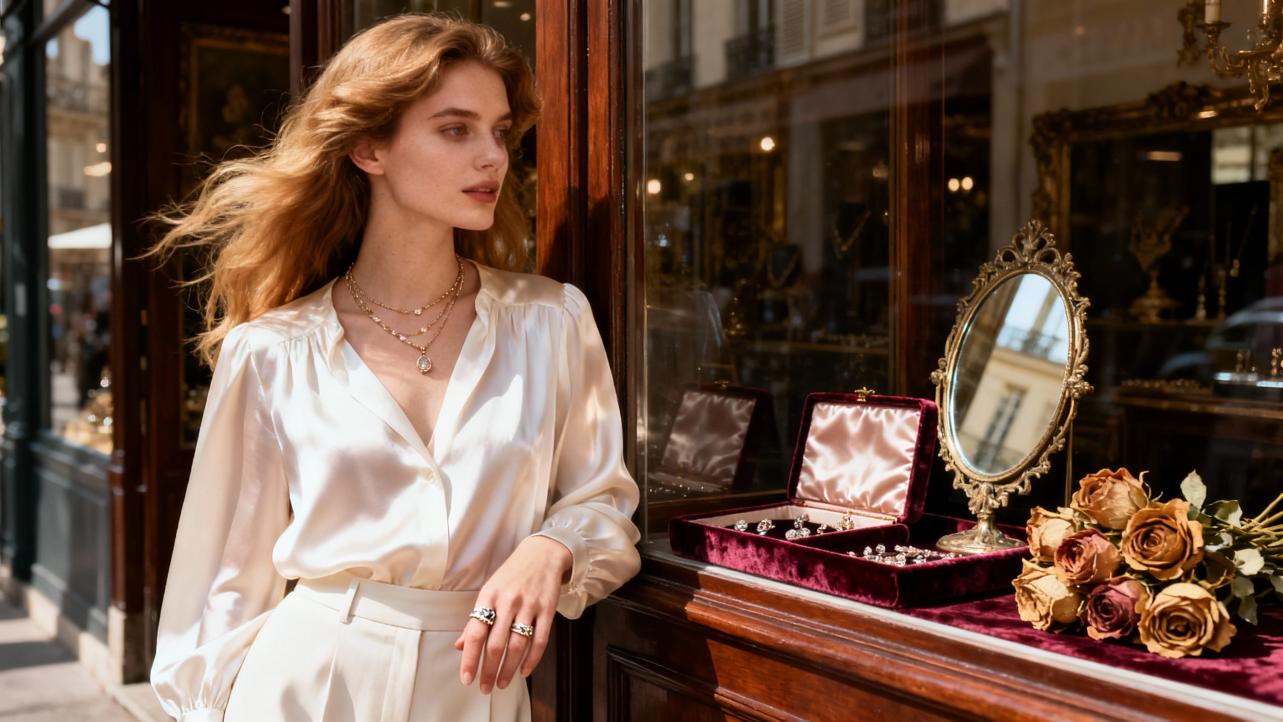
What Jewelry Creates the Right Aura for Business Negotiations?
The air in a negotiation room is different. It is denser, charged with unspoken calculations and silent judgments that begin long before anyone speaks. Your handshake, your posture, the way your jewelry catches the light when you gesture across the table—all of it contributes to an aura that can either support your message or subtly work against it.
Jewelry, when chosen with intention, becomes more than ornament. It becomes a quiet but highly effective instrument of persuasion. The right pieces suggest discipline, reliability, strategic boldness, or calm authority before the first slide appears on the screen.
In this guide, I will walk you through how to curate jewelry that creates the right aura for business negotiations—rooted in the best practices shared by professional jewelers and corporate-style experts from houses such as Atolea Jewelry, LaCkore Couture, Liz James, Roma Designer Jewelry, and others.
Why Jewelry Matters When the Stakes Are High
Negotiations are built on perception as much as on numbers. The other side is continuously asking, often unconsciously: Can I trust you? Are you competent? Are you in control?
Jewelry plays directly into that first layer of perception. Roma Designer Jewelry notes that nearly 80% of American workplaces now operate with casual dress codes, yet a polished, professional appearance still strongly influences how seriously your contributions are taken. In a world where suits are softer and dress codes more relaxed, accessories carry even more weight.
Across sources from Baunat to Atolea Jewelry, a consistent principle emerges: professional jewelry should be simple, understated, high quality, and non-distracting. When your earrings quietly frame your face, your watch signals punctuality, and your ring hints at discernment, you reinforce the storyline you want in that room: that you are meticulous, measured, and prepared.
Poorly chosen jewelry does the opposite. Liz James emphasizes that loud bangles, oversized hoops, or overly flashy pieces can pull attention away from your words, especially in formal meetings or interviews. LaCkore Couture warns about pieces that jingle, glare on camera, or feel oversized for your frame—they become small but persistent distractions that chip away at your aura of control.
In negotiations, distraction is expensive. Every detail should help your counterpart listen more closely to what you are saying, not less.
The Negotiator’s Aura: What Are You Trying to Signal?
Before you decide what to wear, decide what you want your jewelry to say. Most negotiation scenarios call for a blend of four key qualities.
Authority and Competence
This is the foundation: you want to look like someone whose numbers are accurate, whose timeline is realistic, and whose signature carries weight. Classic materials such as gold, silver, and platinum, along with timeless gemstones like diamonds, sapphires, and pearls, consistently read as serious and competent. A slim metal watch, diamond or pearl studs, and a simple band ring immediately create a sense of control.
Jewelry specialists at Finesse to Success highlight pieces such as tennis bracelets, signet rings, and classic watches as the backbone of a timeless professional wardrobe. In a negotiation setting, those same pieces underscore that you are not improvising your life—or your deal.
Trust and Reliability
Trust is often built on subtle signals of consistency and restraint. Roma Designer Jewelry frames “professional jewelry” as simple, understated pieces you can wear repeatedly without drawing attention away from your role. When your accessories look thoughtfully chosen rather than impulsively trendy, you send the message that you value stability and long-term thinking.
Consistent use of a signature combination—a pair of studs, a minimalist watch, and one delicate necklace—creates a sense of reliability: you are the same person from pitch to follow-up to close.
Warmth and Approachability
Not every negotiation is adversarial. Many are collaborative, where warmth is an asset. Pearls, softly faceted gemstones, and delicate chains can soften the sharpness of a structured blazer, signaling that you are firm but fair and open to win–win solutions.
Jewelry guidance from Liz James and Beauty in Stone stresses that personality is welcome in the office when it is expressed through color and subtle design rather than aggressive statement pieces. A blush-toned gemstone, a pearl lariat, or a softly textured bangle can make you seem more human without sacrificing professionalism.
Creativity and Strategic Thinking
In creative or less conservative industries, a touch of unusual design can subtly signal innovation. LaCkore Couture and Finesse to Success both acknowledge the role of statement pieces and handcrafted jewelry in expressing individuality and original thinking.
The key for negotiations is scale and context. One distinctive ring, a modern sculptural cuff, or an artful pendant in a neutral tone can quietly say, “I do not think like everyone else,” while still respecting the formality of the room.

Core Principles for Negotiation-Ready Jewelry
When you distill the advice from Atolea Jewelry, LaCkore Couture, Roma Designer Jewelry, and corporate-focused stylists, four principles emerge that matter especially in negotiation scenarios.
Professional jewelry, across these sources, is defined as simple, understated, high-quality pieces—stud earrings, delicate pendants, slim bracelets, classic watches—that enhance, not dominate, a business look.
Simplicity anchors the aura you project. Multiple sources, including Liz James and Aureus Boutique, return to the same mantra: less is more. Wearing three or four carefully chosen pieces—a watch, earrings, a ring, and perhaps a necklace—is generally enough. Add more, and the eye stops knowing where to rest.
Quality matters more than quantity. Roma Designer Jewelry and Finesse to Success both recommend investing in real gold, silver, or platinum when possible, and in well-crafted pieces that can withstand daily wear. Tarnished or scratched jewelry, as LaCkore Couture warns, gives an impression of carelessness that you do not want in a high-stakes meeting.
Comfort and silence are non‑negotiable. Noisy bracelets that clink on the conference table or earrings that you constantly adjust are more memorable than your strongest argument. Experts at Corporette and LaCkore Couture repeatedly caution against clattering bangles, oversized hoops, or anything that glows so brightly it glares on camera.
Alignment with dress code and culture is critical. Atolea Jewelry and Robinsons Jewelers both stress that conservative environments call for classic, understated styles, while creative studios may tolerate slightly bolder designs. Your goal is to dial your jewelry one notch quieter than the boldest acceptable level, so you appear polished but never risky.

Earrings: Framing Your Message
Earrings are often the most influential work accessory because they sit closest to your eyes. The right pair can frame your face and draw attention to your expressions; the wrong pair can compete with your words.
Studs: The Safest Power Move
Across articles from Classy Women Collection, Roma Designer Jewelry, and multiple business-style guides, classic studs are repeatedly crowned as the ideal professional earring.
Diamond, pearl, or simple metal studs deliver several advantages in a negotiation room. They are always visible yet never overwhelming. They look appropriate with everything from a sharply tailored suit to a more relaxed blazer. They do not swing when you turn your head or jingle as you move.
Diamond or diamond-like studs (including moissanite or cubic zirconia) offer crisp, controlled sparkle. They suggest precision, especially when set in a clean bezel or classic prong. Pearl studs add a softer, more traditional elegance that pairs beautifully with formal business attire and client dinners.
The main consideration with studs is scale. Keeping them modest in size ensures they read as polished rather than showy, especially under bright boardroom lighting.
Small Hoops and Huggies: Controlled Confidence
Small hoops and huggies sit in the sweet spot between minimalist and expressive. Atolea Jewelry, Liz James, and LaCkore Couture all endorse them for everyday business wear when kept close to the ear and under about an inch in diameter.
Huggies are defined, in guides such as Corporette, as snug-fitting small hoops that hug the earlobe. Their advantage in negotiations is practical as much as aesthetic: they stay out of the way when you pick up a pen or phone, they rarely catch on hair or headset wires, and they add a subtle modernity that feels current without being trendy.
Choose high-quality metals in a finish that matches your other jewelry, and keep embellishments minimal. A slim gold huggie or a tiny hoop with a discreet row of stones feels intentional and sophisticated, especially in industries where a touch of fashion awareness is expected.
Drops and Dangles: Elegance with Boundaries
Drop earrings can be beautiful in business settings, but they demand discipline. Classy Women Collection notes a simple yet vital rule: keep drops short enough that they do not dangle below the jawline if you want to maintain a professional impression.
Short, streamlined drops can visually elongate the neck and create a graceful vertical line, which many professionals love for important presentations and dinners. However, long, swinging, or overly ornate drops quickly become the focal point of your appearance, especially when you turn your head to address different people at the table.
If you choose drops for a negotiation, favor slim designs in neutral metals, small pearls, or subtle crystals, and keep your necklace minimal to avoid visual competition.
Necklaces: Where the Eye Rests
Necklaces sit near your voice, making them particularly potent during negotiations. They can guide where the eye settles while you speak and influence whether your neckline reads sharp, soft, or cluttered.
Pendants and Solitaires: Quiet Focus
Delicate pendants on fine chains are among the most frequently recommended pieces for professional wardrobes, highlighted by Atolea Jewelry, LaCkore Couture, and Roma Designer Jewelry. A single pendant—whether a small diamond, a simple bar, or a refined symbol—provides a focal point that never overwhelms.
In negotiation contexts, these pendants do three things elegantly. They draw the gaze toward your face but not away from it. They suggest attention to detail and personal refinement. And they tuck easily under a blazer lapel or align with a shirt collar without fighting the lines of your outfit.
Chain length matters. Many corporate stylists favor chains in the 16–20 inch range for business, as LaCkore Couture notes, since they sit high enough to stay visible above most necklines yet low enough to feel relaxed and modern.
Pearls and Statement Necklaces: When to Dial Up
Pearls appear in nearly every professional jewelry guide as a timeless workhorse: single strands, lariats, or modern asymmetric designs. Finesse to Success and Liz James both frame pearls as ideal for interviews, conferences, and networking events because they signal tradition, care, and understated status.
For high-stakes negotiations, a single strand of medium-scale pearls or a refined pearl pendant can be powerful at a formal dinner or closing celebration. The key is restraint: extremely large pearls, multiple strands, or overly baroque designs can cross into old-fashioned formality or visual dominance.
Statement necklaces, by contrast, are defined by Finesse to Success and LaCkore Couture as bold focal pieces that anchor an outfit. These can occasionally be used strategically in more relaxed or creative negotiations, especially at networking events where memorability matters. When you choose such a piece, nearly every expert—from Aureus Boutique to Liz James—advises making it your one statement item and keeping earrings and bracelets minimal.
Rings and Bracelets: Authority at Handshake Level
Hands are always on stage in a negotiation. They sign contracts, gesture over charts, and slide proposals across the table. Jewelry on your hands and wrists must therefore be chosen with exceptional care.
Watches and Cuffs: Time, Control, and Discipline
A watch is arguably the single most powerful professional accessory. Corporette and Finesse to Success present watches as quiet signals of responsibility and time awareness, even when you also carry a cell phone. LaCkore Couture suggests case sizes around 36–40 millimeters for a sleek but substantial look in corporate settings.
For negotiations, a classic analog or refined smartwatch with a metal or leather strap does more than tell time. It signals that you respect schedules and that your day is structured. A metal bracelet watch in gold, silver, or two-tone (a mix of metals, which Finesse to Success recommends for versatility) reads especially polished across industries.
Bracelets should be understated and silent. Multiple sources warn against stacks of bangles or charm bracelets that jingle whenever you rest your hands on the table. A single slim cuff, a simple tennis bracelet, or a delicate chain is ideal. Finesse to Success defines a tennis bracelet as a slim line bracelet with a continuous row of matched stones—when kept narrow, it can add controlled sparkle without becoming ostentatious.
Rings: Storytelling Without Distraction
Rings carry emotional weight, which is why so many professionals rely on a small, consistent set. Liz James and Roma Designer Jewelry agree that engagement and wedding bands are always appropriate. If you add another ring, they recommend keeping it on the opposite hand, choosing something slim and non-flashy.
From Finesse to Success, we have useful definitions that help in choosing rings that support the aura you want. A signet ring bears a personal emblem, such as an initial or symbolic motif, and can subtly communicate heritage or identity. An eternity ring, encircled fully by stones, symbolizes lasting commitment—an interesting metaphor for long-term partnerships or client fidelity.
In negotiations, limit yourself to one or two rings per hand, and avoid overly large stones or settings that snag on papers or clothing. Statement rings absolutely have their place: Robinsons Jewelers and LaCkore Couture both acknowledge that one bold ring can be a memorable focal point, especially on the hand you extend for handshakes or to exchange business cards. The secret is scale and context. A strong, artful ring paired with minimal other jewelry can project assured individuality; the same ring with heavy earrings and multiple bracelets starts to feel theatrical.

Metals, Gemstones, and Color: Subtle Psychology at Work
The metal and stones you choose fine-tune the story your jewelry tells.
LaCkore Couture and Roma Designer Jewelry both encourage coordinating metals with both skin tone and wardrobe. Silver tends to flatter cooler undertones and cooler clothing shades such as navy, gray, and black. Yellow and rose gold enrich warmer skin and earth-toned outfits. Two-tone pieces—combining yellow and white gold—are praised by Finesse to Success as “bridge pieces” that let you mix hardware and jewelry intentionally.
Gemstones must be chosen with particular restraint in negotiations. Atolea Jewelry, Aureus Boutique, and Baunat all reinforce the value of subtle, neutral stones for business: diamonds and diamond substitutes, sapphires, pearls, and occasionally emeralds or soft-toned gems such as aquamarine or blush-colored stones. Bright, oversized, or highly saturated gemstones create a more dramatic, social aura that can dominate a negotiation room.
Seasonal color guidance from Atolea Jewelry offers a refined way to introduce interest. In spring, soft pastels like blush and lavender can quietly soften a sharp suit. In summer, controlled touches of coral or turquoise (used sparingly in small studs or accents) can add energy. In fall, deeper tones such as burgundy or forest green can echo rich fabrics and wood-paneled boardrooms. The through-line is subtlety; color should harmonize with your clothing rather than shout over it.
To bring these choices together, consider this comparison.
Jewelry choice |
Aura it projects |
Best negotiation contexts |
Key watch-outs |
Diamond or pearl studs |
Competence, reliability, calm |
Formal board meetings, salary talks, high-stakes deals |
Avoid overly large stones that feel showy |
Slim metal or two-tone watch |
Discipline, structure, authority |
Any in-person or video negotiation |
Keep dials clean, avoid overly sporty styles |
Single-strand pearls or pearl pendant |
Tradition, trust, polished warmth |
Client dinners, partnership renewals, formal pitches |
Multiple strands can look heavy or overly formal |
Small hoops or huggies |
Modern confidence, controlled ease |
Creative-industry negotiations, business casual meetings |
Keep under about 1 inch and avoid heavy designs |
One sculptural statement ring |
Strategic boldness, individuality |
Networking-heavy talks, creative or leadership roles |
Pair with very minimal other jewelry |
Layered delicate necklaces |
Thoughtful complexity, subtle creativity |
Informal or internal negotiations, business casual days |
Limit to two or three strands and keep pendants small |

Matching Jewelry to Different Negotiation Scenarios
Not all deals are alike, and neither should your jewelry be. Drawing on recommendations from LaCkore Couture, Roma Designer Jewelry, Liz James, and others, you can fine-tune your choices to the situation.
In formal board meetings or high-level client presentations, the safest formula is classic and quiet. Think diamond or pearl studs, a slim metal watch, one delicate necklace or a single strand of pearls, and a wedding band with perhaps one subtle additional ring. LaCkore Couture specifically recommends small studs, thin necklaces, and classic watches for formal meetings, with at most one refined cuff bracelet.
For business casual negotiations—internal alignment conversations, ongoing vendor discussions, or creative-client meetings—you can relax the formality slightly. Small hoops under about an inch, layered pendants in the 16–20 inch range, and a quiet bangle or two-tone watch keep you polished but approachable. LaCkore Couture points to subtle mixed metals and imperfect pearls as modern touches that are office-appropriate when kept understated.
Video negotiations introduce a different set of considerations. LaCkore Couture and Aureus Boutique both note that glare, movement, and reflection become more pronounced on camera. Simple earrings, non-reflective or modestly polished metals, and a single pendant that sits cleanly within the camera frame work best. Anything that swings or sparkles aggressively can be exaggerated by studio lighting or laptop webcams.
Networking-heavy negotiation environments—conferences, industry dinners, or informal deal discussions after events—allow for a touch more personality. This is where the “one statement piece” rule, emphasized by LaCkore Couture and Liz James, becomes invaluable. A distinctive ring, a memorable but tasteful necklace, or an artful cuff can serve as a conversation starter and help people remember you, provided the rest of your jewelry remains discreet.
Even internal negotiations, such as asking for a promotion or discussing a salary adjustment, benefit from carefully chosen jewelry. Pieces that you wear as personal milestones—a signet ring acquired at a previous promotion, a bracelet commemorating a career milestone, as Finesse to Success suggests—can quietly remind you of your own trajectory and ground you during difficult conversations.

Building a Small, Negotiation-Ready Jewelry Capsule
Creating an aura of authority and ease in negotiations does not require an overflowing jewelry box. In fact, the most convincing professionals tend to rotate a small, coherent set of pieces.
Finesse to Success outlines a core group of timeless work items: a sleek watch, stud earrings, a pendant necklace, an elegant bracelet, a simple ring, a subtle brooch, a statement necklace, cufflinks where applicable, and classy hoops. Roma Designer Jewelry and Corporette echo this with their own essentials: studs or small hoops, a minimal watch, delicate chains or solitaire pendants, and slim cuff bracelets.
For negotiations, a focused capsule might include a pair of diamond or pearl studs, a pair of small metal hoops or huggies, a slim metal or leather-strap watch suitable for both in-person and video meetings, one delicate pendant necklace, a single-strand pearl necklace or pearl pendant for formal events, one understated ring plus one statement ring you reserve for select occasions, and a slim bracelet or tennis bracelet that never clinks.
Experts such as Finesse to Success suggest acquiring these gradually to mark milestones: promotions, major deals, significant moves. When your jewelry carries your own history, it does more than complete your outfit—it reinforces your story to yourself at the very moment you need to project calm conviction.
Consistent care is part of the capsule philosophy. Atolea Jewelry and Mason Madison both stress regular cleaning with mild soap and a soft cloth, avoiding harsh chemicals, and storing pieces separately in soft-lined pouches or boxes. Tarnish, loose stones, and worn clasps do not only endanger your jewelry; they undermine the aura of detail-oriented professionalism you have worked carefully to build.

FAQ: Fine-Tuning Your Negotiation Jewelry
Can I ever wear bold statement jewelry to a serious negotiation?
Yes, but with strategy and restraint. Finesse to Success, LaCkore Couture, and Liz James all allow for one statement piece in professional settings, especially for networking events or roles where creativity is part of your value. For a formal, high-stakes negotiation, consider limiting this to a single, well-crafted ring or a modern necklace in neutral tones and keep everything else extremely minimal. If colleagues spend more time commenting on your jewelry than your ideas, the piece is too strong for that context.
Is colored gemstone jewelry appropriate when I am trying to project authority?
It can be, if you follow the “soft and subtle” rule. Atolea Jewelry, Aureus Boutique, and Baunat recommend neutral or classic stones—diamonds, pearls, sapphires, and emeralds—in understated designs. Soft hues such as light blue, gentle green, or blush pink can add depth to a solid navy or charcoal suit. Very bright, large, or heavily saturated stones, especially in multiple pieces at once, tend to shift the aura toward social or fashion-forward rather than business-focused.
Do these principles apply to men’s jewelry in negotiations as well?
The specifics may differ, but the core principles absolutely carry over. Simplicity, restraint, quality materials, and comfort are just as critical for cufflinks, tie bars, watches, and rings as they are for earrings and necklaces. A classic watch, a pair of understated cufflinks, a wedding band or simple signet ring, and perhaps a subtle chain under the shirt can create a composed, authoritative aura without crossing into ostentation.
Jewelry in business negotiations is not about decoration; it is about deliberate emphasis. The right earrings frame your gaze, the right watch anchors your presence in time, and the right ring or bracelet adds a final, quiet underline to your gestures. When each piece is chosen with care—aligned to the room, the culture, and the story you want to tell—you step into the negotiation not only well prepared on paper, but beautifully calibrated in presence. That is when jewelry stops being an accessory and becomes a silent ally at the table.

References
- https://www.baunat.com/en/how-important-is-wearing-jewellery-in-a-business-meeting
- https://corporette.com/how-to-build-a-jewelry-collection-for-work/
- https://finessetosuccess.com/timeless-jewelry-pieces-for-your-work-wardrobe/
- https://www.linkedin.com/pulse/what-jewelry-wear-business-meeting-palmonas
- https://atoleajewelry.com/blogs/waterproof-jewelry-blog/business-professional-jewelry?srsltid=AfmBOoqJWdfk8KapTTzlWObBFLV1MTfL9Ldoysq-va2cqVt1z-Fj78wj
- https://www.aureusboutique.com/blogs/articles/how-to-style-jewelry-for-a-corporate-setting-without-looking-too-flashy?srsltid=AfmBOoq4bivxAH15BrSqDAHJzi8zqiqJpiaWumpiuAWIjefLibl2jBCI
- https://beautyinstonejewelry.com/collections/what-to-wear-for-business-casual/layer?srsltid=AfmBOopC3PzT9Z1eSVrPRV8_Row0Dqpchq8eQrDYUHJz1GNoq1Gt6eST
- https://www.charlesandcolvard.com/blog/10-essential-jewelry-pieces-for-working-professionals/?srsltid=AfmBOoqCzlKvW-gPkpI8BXcBPPWt68bjIVQEtBVZn3jze3TbClW-z-p6
- https://classywomencollection.com/blogs/fashion-guide/professional-earrings-for-work?srsltid=AfmBOoqtFbQxTx3QmW9383CRa0v92N9OII14OH1R1JmzwixZLEmO-Ht3
- https://www.gabrielny.com/blog/12-fine-jewelry-designs-perfect-for-an-everyday-work-wear/?srsltid=AfmBOoo8e6IkeMCVS5VXTUAv_vpT-0FUy6Py2-OngrYw8sycbSRL-ugt