What Jewelry Best Enhances the Oriental Charm of a Qipao?
The qipao, or cheongsam, is not just a dress. It is a distilled silhouette of Shanghai nights in the 1920s, the quiet authority of a mandarin collar, and the subtle drama of a side slit that reveals only what it must. When you add jewelry to this icon, you are not merely decorating; you are editing a story that has been told for over a century.
As someone who has spent years studying and styling qipao looks for weddings, New Year dinners, and quiet portraits, I can tell you this with absolute certainty: the right jewelry does not compete with a qipao’s oriental charm, it amplifies it. The wrong jewelry turns it into a costume.
Let us explore, in a grounded and practical way, what truly enhances that sought‑after oriental elegance.
Understanding the Qipao’s Oriental Aesthetic
Before choosing jewelry, you need to understand what you are framing.
Modern guides from qipao specialists such as LUXE ORIENTA and NewHanfu describe the qipao as a form‑fitting dress with a high collar, clean lines, and often intricate embroidery or brocade. Pearl Falco reminds us that this long dress, sometimes even called “eye‑catching jewelry” itself, blends Chinese and Western influences and has been worn by royalty, socialites, and women in official roles from the late nineteenth century through Shanghai’s golden age and into today.
An article on fashion history hosted on Academia.edu notes that jewelry and dress together have always communicated status, identity, and sentiment. When you pair a qipao with jewelry, you are participating in that same language: body adornment as narrative.
The qipao’s oriental charm comes from several elements working together. The mandarin collar frames the face with quiet discipline. The sleek cut carves a vertical line that elongates the body. Embroidery, whether peonies, phoenixes, or abstract waves, adds a layer of symbolism. Jewelry must sit inside this composition and respect its hierarchies.
Think of the qipao as the main melody. Jewelry is the harmony line underneath: present, felt, essential—but never louder than the tune.

Principles for Choosing Jewelry That Honors the Qipao
Most specialized qipao styling guides—from East Meets Dress and LUXE ORIENTA to Taobao’s editorials on formal qipao dressing—agree on a central principle: less, but deeply intentional, is more.
Several consistent rules emerge across these sources.
First, let the collar and embroidery lead. A high, fully closed mandarin collar is already a strong visual line. LUXE ORIENTA recommends either no necklace or a very fine, unobtrusive chain in this case, and advises focusing your attention on earrings and bracelets instead. Love & Co., in its guide to styling gold jewelry with traditional Chinese outfits, echoes this by prioritizing bracelets and earrings over necklaces when the collar is high.
Second, coordinate metal with embroidery. LUXE ORIENTA’s metal‑matching rule is both simple and transformative: warm‑toned embroidery such as red, gold, or orange pairs best with gold jewelry; cool tones like blue, jade green, or lilac sing with silver or platinum. This is not superstition; it is color theory applied to silk.
Third, respect symbolism without turning it into costume. East Meets Dress highlights jade necklaces symbolizing beauty and wisdom, dragon‑and‑phoenix motifs representing the couple, and bracelets worn in pairs to symbolize future wealth. Love & Co. emphasizes gold as a symbol of prosperity and good fortune for occasions like Chinese New Year. These symbolic codes are powerful. They work best when rendered in refined, well‑crafted pieces—never in oversized pendants or plastic imitations, which a Taobao styling article explicitly warns against.
Finally, favor quality over quantity. DHgate’s editorial guides on cheongsam accessorizing and Taobao’s qipao styling pieces both stress that a single elegant pair of jade or gold earrings, a slim bracelet, and a compact clutch will always outshine stacks of cheap bangles and heavy, noisy necklaces. Jewelry historians writing about the evolution of jewelry note that while costume jewelry democratized adornment, quality of design and proportion remains what separates chic from cluttered.
Imagine a red silk qipao with subtle gold peony embroidery for a tea ceremony. If you follow these principles, you might choose fine gold dragon‑and‑phoenix studs, a slender gold bangle, and skip the necklace entirely. The collar remains pristine. The embroidery stays legible. And yet, the oriental charm feels heightened, not diluted.

Pearl, Jade, or Gold? Choosing the Right “Language” of Jewelry
Different materials speak different dialects of elegance. For qipao styling, three families dominate: pearls, jade, and gold. Each brings distinct advantages and a few cautions.
Pearl Jewelry: Soft Light on Silk
Pearl Falco describes pearl jewelry as almost inseparable from the cheongsam. In their words, pearl jewelry has long been an essential accessory to traditional Chinese long dresses, associated with qualities such as purity, longevity, sincerity, perfection, and achievement. The qipao’s sleek lines and a strand of pearls are, quite literally, a historic pairing.
Modern fashion guides back this up. Elucid Magazine, in its guide to styling modern qipaos, calls refined gold and pearl jewelry iconic with the dress, noting that pearls can either evoke a vintage, minimalist charm or a contemporary twist, depending on design. DHgate’s styling articles suggest classic pearl studs or a single‑strand necklace as a default choice for print‑heavy cheongsams because pearls soften, rather than fight, busy patterns.
The strengths of pearls with qipao are clear. Their luster is gentle rather than blinding; they wrap light around the face and collarbone instead of throwing hard reflections. They suit almost every age and photograph beautifully. Pearl Falco also underscores their cultural acceptance across both everyday and formal contexts.
There are, however, considerations. Very elaborate multi‑strand or oversized pearl pieces can quickly tip a qipao into retro costume territory, especially with heavily embroidered silk. Smart styling editors at NewHanfu caution against over‑accessorizing intricate cheongsams, and that warning absolutely applies to pearls.
A practical example: picture a pale mint qipao with white floral embroidery for a daytime engagement brunch. A pair of small pearl studs and a fine, single‑strand pearl bracelet will echo the dress’s softness. Adding a multi‑row choker and ornate pearl drop earrings would overwhelm the neckline and date the look unnecessarily.
Jade: The Soul of the Qipao
If pearls are soft light, jade is the qipao’s heartbeat.
East Meets Dress calls jade necklaces an iconic, more delicate option, especially for white or light‑colored qipaos. In their wedding styling guide, jade is said to represent beauty and wisdom, and sits naturally against the dress’s curved lines. DHgate’s cheongsam accessorizing advice similarly highlights jade earrings and bracelets as essential, noting jade’s deep cultural significance in Chinese tradition.
Qipaomood, which explores qipao accessories in detail, singles out jade, agate, and pearls as especially suitable materials because they harmonize with the dress’s classical, elegant character. Jade, in particular, feels at home beside silk: both are smooth, cool, and timeless.
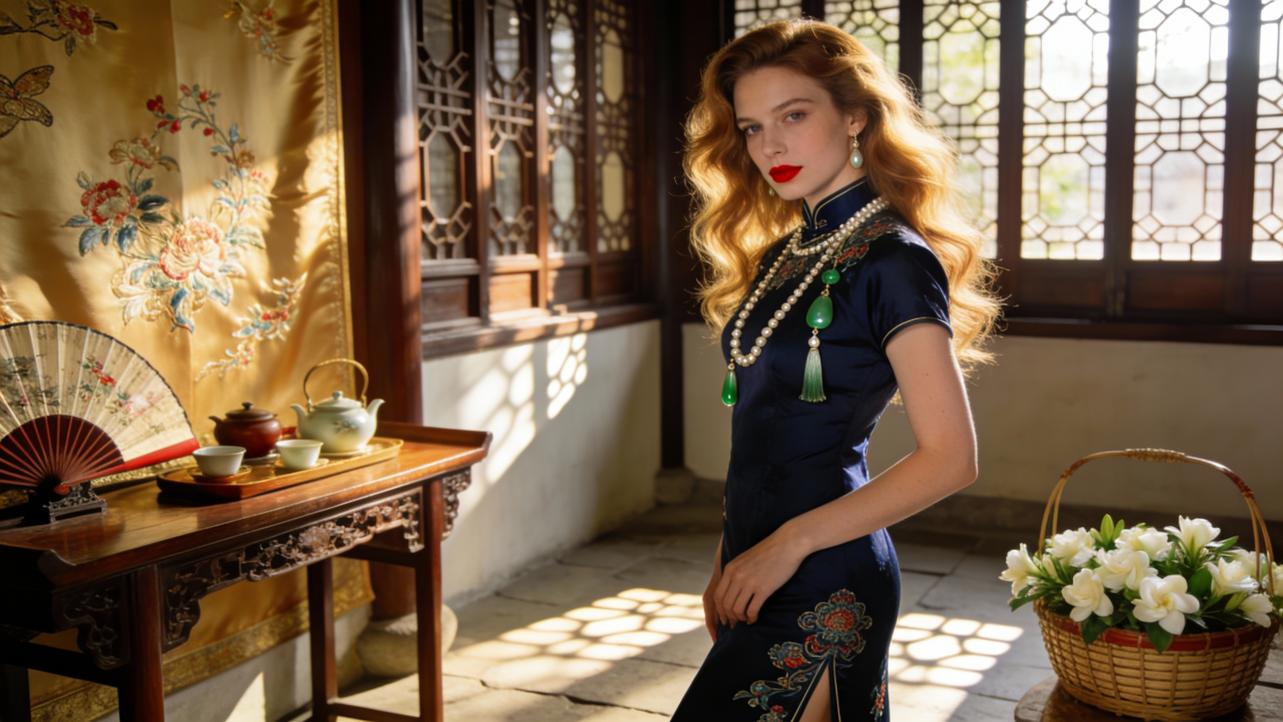
The advantages of jade are powerful. A single jade bangle can carry family history. A pair of delicate jade drops can whisper heritage even on the most modern cut of qipao. Green jade against white, cream, or soft pink silk feels especially pure; against black, it becomes striking and almost cinematic.
However, several sources warn against inauthentic or exaggerated uses. Taobao’s editorial on accessorizing qipaos explicitly cautions against plastic “jade” that discolors the skin and oversized dragon pendants that read as costume. DHgate’s advice likewise favors delicate gold‑or‑jade studs over large, swinging pieces for high‑collared dresses.
Imagine a white silk qipao with subtle jacquard clouds for a city hall wedding. A slim, high‑quality jade bangle and small jade‑and‑gold drop earrings will give you all the oriental charm you need. A huge, neon‑green “jade” statement necklace in an unconvincing material will not.
Gold Jewelry: When You Want to Shine
Gold is, in many ways, the festive heartbeat of Chinese jewelry traditions.
Love & Co., in a detailed guide on styling gold jewelry for Chinese New Year, frames gold as the natural choice for this celebration because it symbolizes prosperity, wealth, and good fortune. They recommend focusing on gold bracelets and earrings with traditional cheongsams and matching necklace lengths to necklines elsewhere, reserving statement pendants for open collars.
Elucid Magazine reinforces gold’s symbolic association with luck and fortune in the context of qipaos, pointing to refined golden earrings and bracelets as iconic pairings. LUXE ORIENTA suggests matching gold jewelry to warm‑toned embroidery, while NewHanfu recommends gold or pearl earrings for bold red dresses.
Gold’s advantages are obvious. With a red or black qipao, gold jewelry can look regal, not flashy, provided it is slim and considered. It plays beautifully with warm lighting at banquets and evening receptions. Its auspicious symbolism aligns perfectly with weddings and New Year events.
Yet, as Taobao and DHgate both stress, the line between opulent and overdone is thin. Chunky chains, oversized novelty pendants, and stacks of clanking bangles can cheapen a silk qipao instantly. Love & Co. advocates serpentine bangles, delicate earrings, and stackable thin rings instead of heavy, maximalist pieces.
Consider a wine‑red brocade qipao for a Chinese New Year gala. One pair of bold but cleanly designed gold earrings and a single sculptural bangle might be all you need. Add a heavy gold choker, multiple wide bangles, and a huge zodiac pendant, and the dress disappears under the jewelry.
A Quick Comparison of Pearl, Jade, and Gold
Jewelry type |
Cultural emphasis (from sources) |
Best with… |
Key strength |
Main watch‑out |
Pearls |
Purity, longevity, sincerity, achievement (Pearl Falco) |
Pastels, floral prints, vintage‑inspired qipaos |
Soft, flattering glow; timeless |
Overly layered strands can look costume‑like |
Jade |
Beauty and wisdom; deep heritage value (East Meets Dress, DHgate) |
White, cream, pale tones; minimalist cuts |
Strong cultural resonance; heirloom feel |
Fake or oversized pieces can look inauthentic |
Gold |
Prosperity, wealth, good fortune (Love & Co., Elucid Magazine) |
Red, black, warm embroidery; festive occasions |
Regal brightness; auspicious symbolism |
Chunky or noisy styles can overpower the dress |

Matching Jewelry to Your Qipao’s Design and Occasion
A qipao for a tea ceremony is not the same as a qipao for a cocktail bar. The jewelry should change with it.
Reading the Neckline and Embroidery
Multiple styling sources agree that the neckline is your first decision point.
LUXE ORIENTA advises that with high‑neck embroidered qipaos, you should either skip necklaces or choose thin, minimal chains, letting earrings and wristwear do the work. Love & Co. suggests bracelets and earrings as the focus when the collar is traditional and high, using necklaces mainly with more open necklines or modern cuts. NewHanfu’s accessory guide mirrors this advice: simple pendant necklaces for closed necks, statement necklaces only when the neckline opens up.
Embroidery density is your second cue. A heavily embroidered silk in rich colors already functions like jewelry. Smart guidance from NewHanfu and DHgate recommends keeping jewelry minimal in this case: pearl or jade studs, a single slim bracelet, and perhaps one ring. For plain or minimally embellished qipaos, statement earrings or a bolder pendant are more acceptable.
You might, for example, wear a black silk qipao with gold phoenix embroidery to a formal dinner. The collar is high, the embroidery dense. Pearl studs, one gold bangle, and a smooth satin clutch will allow the phoenixes to shine. Swap that for a plain navy velvet mini qipao with a lower neckline for a party, and you could introduce larger geometric earrings inspired by contemporary jewelry trends highlighted by institutes such as IED, which notes that bold, unconventional forms are increasingly common in modern design.
Dressing for Weddings, New Year, Office, and Casual Days
East Meets Dress focuses on weddings. They highlight gold and jade necklaces with dragon‑and‑phoenix motifs, matching bracelets, and symbolic bangles—often worn in pairs to represent future wealth—especially with bridal qipaos and qun kwa. The effect is ceremonial and deeply rooted in tradition. A bride in a red qun kwa might wear gold dragon‑and‑phoenix earrings, paired bracelets on both wrists, and perhaps a delicate jade pendant on a short chain, all echoing the embroidered motifs.
For Chinese New Year, Love & Co. places gold at the center. Their recommendations lean into auspicious symbols such as zodiac animals, butterflies for transformation, and key motifs for “unlocking” opportunity. They also suggest matching necklace length to necklines and keeping gold pieces sleek for everyday wear after the holiday. Pair a red brocade qipao with a snake‑themed gold bangle if you are celebrating a Snake year, for instance, balancing symbolism and sophistication.
Office and daytime qipao looks, described by LUXE ORIENTA and Elucid Magazine, ask for restraint. Neutral or muted dresses in cotton blends or lighter silks work beautifully with small pearl studs, a slim gold or silver bracelet, and perhaps a minimalist watch. Anything louder may undermine professionalism. Customer reviews from brands such as Beth and Brian Qipao show that many women successfully wear qipaos for ceremonies and then restyle them for repeat occasions by toning down jewelry choices.
Casual or street‑style qipaos—often cotton or linen—invite playful but still curated jewelry. DHgate’s guides suggest pairing them with simple studs, a few slim rings, and maybe a small pendant, avoiding chunky statement pieces that clash with the dress’s refined lines. NewHanfu adds that trendy hoops or tassel earrings can work with simpler dresses or modern events, as long as the rest of the jewelry stays minimal.
A real‑world contrast illustrates this. For a Sunday dim sum in a simple blue cotton qipao, you might wear silver hoops, two thin stacking rings, and white sneakers. For an evening wedding reception in a crimson silk qipao, you would switch to delicate gold earrings and bangles, a structured clutch, and dressier heels, letting the jewelry rise to the occasion.
Modern Twists That Still Feel Authentic
Many contemporary wearers want to honor tradition without feeling trapped in a time capsule. The good news is that both Taobao’s styling essays and DHgate’s accessorizing guides welcome thoughtful modern twists.
One Taobao article encourages adding a contemporary edge through geometric gold ear cuffs worn with classic pearls or mixing old motifs into minimal forms. DHgate suggests layering delicate necklaces—when the neckline allows—and playing with contrasting textures, such as antique‑style silk with modern metallic rings.
Contemporary jewelry commentary from institutions like IED underscores that modern pieces often experiment with geometric shapes, bright colors, and even unconventional materials, while still functioning as jewelry. For qipao styling, this means you can absolutely incorporate a single artistic piece: perhaps a sculptural gold earring or an abstract jade‑and‑metal ring, as long as you keep everything else quiet.
Imagine a black velvet evening qipao with a slightly lower neckline. Instead of a traditional pendant and matching earrings, you might choose one striking pair of asymmetrical gold earrings with a hint of jade, no necklace, and a plain gold ring. The qipao remains the anchor; the jewelry simply pulls it into the present.

How Much Is Too Much? Avoiding Common Mistakes
Several practical guides—including Smart DHgate’s “Effortless Elegance” piece and the Taobao editorial on qipao accessories—list similar pitfalls.
The most common mistake is over‑accessorizing. Stacking multiple necklaces, wearing chandelier earrings, numerous bracelets, several rings, and an ornate hairpiece all at once will almost always clash with a qipao’s disciplined lines. DHgate’s advice is to limit yourself to one or two statement pieces and keep the rest minimal. Smart DHgate emphasizes the same idea: choose one focal point, such as earrings or a bracelet, not everything at once.
Another problem is competing patterns and textures. A Chinese‑printed cheongsam already contains complex visual information. Smart DHgate recommends solid‑color accessories pulled from the dress’s palette and classic pearls or subtle gold jewelry. Adding bold patterned bags or very sparkly jewelry can cause visual noise. NewHanfu likewise warns against over‑decorating heavily embellished qipaos.
Quality is the third trap. Taobao’s article is unusually frank: avoid plastic “jade,” oversized dragon pendants that scream costume, and cheap stackable bangles from tourist markets. Budget‑friendly does not have to mean disposable. DHgate’s guides suggest faux pearls, brass bangles, and resin hair clips as acceptable affordable options—provided they echo the refinement of more expensive counterparts rather than parody it.
Finally, comfort is non‑negotiable. DHgate’s cheongsam FAQ points out that heavy or uncomfortable accessories distract from both the outfit and your confidence. Beth and Brian’s customer reviews show that women value jewelry and bags that feel good to wear throughout long ceremonies and photos. If a pair of earrings tugs on your lobes or a bracelet catches on your embroidered sleeve, it is working against the elegance you are trying to achieve.
A simple test I use is this: once you are fully dressed, step back from the mirror and take a slow breath. If your eye jumps to one or two meaningful jewelry pieces first and then settles on the dress, you are balanced. If it skitters from earring to necklace to bracelet to ring without resting, remove something.

Budget, Heirlooms, and Sustainability
Not everyone will be wearing heirloom jade and high‑karat gold, and not everyone should. Fashion historians note that the rise of costume jewelry in the twentieth century allowed more people to participate in jewelry‑driven style without the expense of precious stones. Contemporary guides from DHgate embrace this reality, highlighting affordable faux pearls and gold‑tone pieces that mimic the feel of high jewelry when chosen thoughtfully.
However, the Taobao editorial’s warning against very cheap, poor‑quality imitations remains important. The difference between well‑made costume jewelry and plastic trinkets is obvious against a qipao’s refined surface. If your budget allows only one or two higher‑quality items, prioritize those that sit closest to the face: earrings and perhaps a simple pendant. Bracelets and rings can be more affordable as long as their finish is good and their design restrained.
The Etsy snapshot of a pearl‑embellished qipao shows another strategy: sometimes the dress itself carries the jewelry. A qipao with built‑in pearl details along the collar or bodice can reduce the need for separate necklaces, freeing your budget for a pair of real pearl studs or a simple bracelet instead. The discount noted in that listing—about a 15 percent reduction from the original price—illustrates that careful shopping can free funds for a single, well‑chosen accessory.
Sustainability and ethics are increasingly important for many jewelry lovers. The IED’s overview of jewelry’s evolution highlights moves by brands such as Pandora toward using only recycled gold and silver and the rise of lab‑grown diamonds as a lower‑impact alternative to mined stones. Designers like Pippa Small collaborate with artisan communities to preserve traditional techniques under fair‑trade conditions. Choosing pieces from such conscious makers aligns beautifully with the deliberate, slow‑fashion spirit many associate with qipaos.
Heirlooms, of course, occupy a special place. A grandmother’s jade bangle or a set of vintage pearls does more than complete a look; it threads your personal history through a garment that already carries cultural memory. When you build a qipao ensemble around an heirloom, let that piece lead. Keep other jewelry quiet and modern so that the heirloom feels intentional rather than costume‑party “old‑timey.”
Two Handy Tables for Fast Decisions
When you are standing in front of your jewelry box with a qipao on the hanger, a few simple references can help you decide quickly.
Qipao Neckline and Best Jewelry Focus
Qipao neckline / style |
Recommended jewelry focus (from multiple guides) |
High mandarin collar, heavy embroidery |
Skip necklace or use a very fine chain; prioritize studs or small drops and slim bracelets |
High collar, minimal embroidery |
Consider tiny pendant if desired; earrings and one bracelet remain key |
Keyhole or modest open neckline |
Delicate pendant or short necklace, medium earrings, one bracelet |
Sleeveless or low modern neckline |
Statement earrings or bolder pendant; keep bracelets and rings simple |
Printed cotton or linen casual qipao |
Minimal studs or small hoops, a couple of slim rings, possibly no necklace |
Matching Dress Color and Fabric to Jewelry Tone
Dress color / mood |
Metal or gem emphasis (per LUXE ORIENTA, NewHanfu, Love & Co., Pearl Falco) |
Red, gold, warm brocade |
Gold jewelry, pearls; auspicious motifs, delicate designs |
Black silk or velvet |
Gold for drama, jade for contrast, or pearls for classic glamour |
Pastels and soft florals |
Pearls, silver, or white gold; light jade accents |
White, cream, or ivory |
Jade as the focal point; pearls for softness; minimal gold or silver |
Bold prints (floral or scenic patterns) |
Simple pearls, small gold or silver studs; solid‑color clutches and shoes |
Casual cotton or linen in muted tones |
Silver, simple jade, or understated costume pieces |
FAQ: Concise Answers for Curious Qipao Lovers
Do I always need a necklace with a qipao?
No. For traditional high‑collar qipaos, multiple formalwear guides actually prefer no necklace at all, directing attention to earrings and bracelets instead. Necklaces become more useful with lower or open necklines.
Is it acceptable to mix pearls, jade, and gold in one outfit?
Yes, if you keep the overall composition restrained. For example, small jade studs, a fine gold bracelet, and a single‑strand pearl necklace can coexist if their designs are all delicate and the dress is relatively simple. When in doubt, let one material lead and use the others sparingly.
Can I wear silver jewelry with a red qipao?
You can, especially if the dress has cool‑toned embroidery or if you are aiming for a modern, understated mood. Traditional styling leans toward gold with red for its auspicious symbolism, but well‑designed silver pieces with clean lines can look sharply contemporary.
Jewelry, at its best, does not shout over a qipao; it leans in and completes the sentence. Whether you choose the quiet glow of pearls, the soulful depth of jade, or the festive gleam of gold, the key is intention: understand your dress, honor its cultural weight, and let each piece you add earn its place.
When you next fasten a jade earring or slide a slim gold bangle over your wrist, do it with the calm conviction that every element—fabric, metal, stone, story—has been chosen, not just worn. That is when the oriental charm of your qipao stops being an aesthetic and becomes an experience.
References
- https://www.gia.edu/doc/Pearl-Fashion-Through-the-Agesv.pdf
- https://www.academia.edu/102652337/The_Changing_Face_of_Precious_Jewellery_as_a_Body_Adornment_An_Exploratory_Study_in_the_Ashanti_Region_of_Ghana
- https://digitalcommons.cwu.edu/cgi/viewcontent.cgi?article=1253&context=all_gradpapers
- https://www.ied.edu/news/evolution-jewellery-art-fashion-technology
- https://digitalcommons.sia.edu/cgi/viewcontent.cgi?article=1142&context=stu_proj
- https://admisiones.unicah.edu/virtual-library/2bvjXf/8OK146/psychology__of_wearing__jewelry.pdf
- https://blogs.chapman.edu/library/2024/03/26/saris-and-stories/
- https://www.newhanfu.com/44188.html
- https://www.bethandbrianqipao.com/collections/qipao-for-events-and-ceremony?srsltid=AfmBOorqC1-EcCNOGW9czgbMx1p4I1OoIgOHvY8UIubRzNn9_dlyeCsG
- https://smart.dhgate.com/effortless-elegance-expert-tips-to-accessorize-your-chinese-printed-cheongsam-dress/