Why Diamond Jewelry Is the Perfect Pairing for Evening Gowns
There is a particular hush that falls over a ballroom when the doors open and a truly considered look enters the room. The gown leads, of course, but it is the diamonds that complete the story. In years of dressing clients for galas, black‑tie weddings, and charity balls, I have seen one truth repeat itself: when evening gowns and diamond jewelry are chosen to complement one another, the result is not just beautiful; it is unforgettable.
Diamonds have a uniquely neutral yet intense radiance. As Messika’s style guide notes, their light works with many metals, skin tones, and colors rather than against them. Retailers like Diamond Gallery Frisco and With Clarity consistently position diamonds as the rare accessory that can move effortlessly from casual to ultra‑formal. When you place that kind of versatility against the drama of an evening gown, you have the ideal pairing—provided you understand how to balance them.
In this guide, I will walk you through why diamonds are so powerful with evening wear, how to choose the right diamond pieces for your gown’s neckline and color, how to avoid over‑doing it, and when another jewel might serve you better. Along the way, I will draw explicitly on contemporary advice from jewelers such as Dvik Jewels, Sabrina A, Latelita, Princessly, VDS Jewels, Jovani, and others who live and breathe formal styling.
The Alchemy Between Diamonds and Evening Gowns
Diamonds and evening gowns share a common language: both are designed for special moments, often under soft, flattering light. Diamonds, described by Messika as exceptional stones with a neutral radiance, act almost like a mirror for your environment. Against rich fabrics, that radiance becomes a kind of spotlight that dances with every movement.
Evening gowns, whether they are sleek satin columns or crystal‑embellished ball gowns, are created to sculpt and frame the body. Promfy’s overview of diamond formal dresses and crystal wedding gowns emphasizes how shimmering embellishments immediately heighten the sense of luxury and formality. Alibaba’s description of diamond evening gowns underscores the same idea: sparkle on fabric transforms a dress from ordinary to statement.
When you introduce diamond jewelry into that picture, three things happen. First, diamonds draw the eye to the face, collarbone, or hands—the areas where we communicate and express emotion. Second, they echo any shimmer already in the dress, from beadwork to metallic threads, creating cohesion. Third, because diamonds are visually neutral, they rarely clash with dress colors, unlike some colored gemstones that can fight with certain shades.
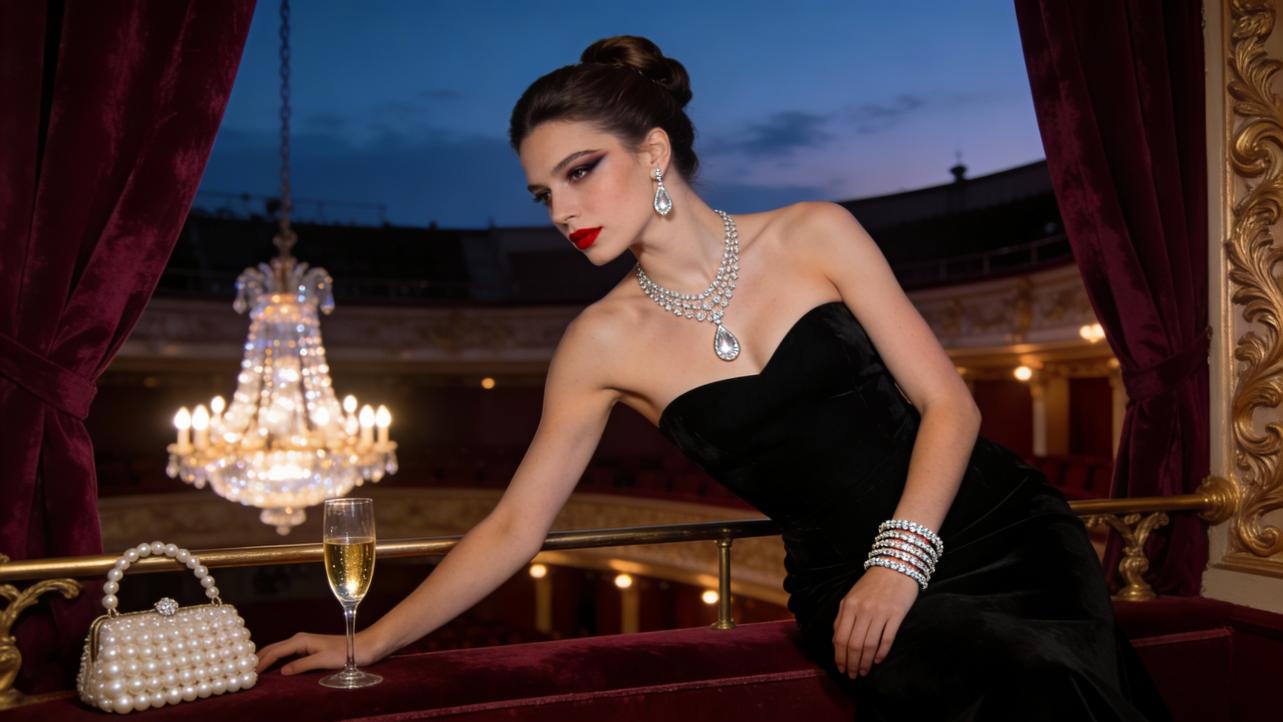
Consider a simple example inspired by VDS Jewels’ and Sabrina A’s styling guides. Visualize a black strapless gown in a clean, architectural cut. On its own, the dress is elegant but quiet. Add a line of bright white diamonds around the neck in a tennis necklace, a pair of drop earrings that catch the light when you turn your head, and a slim tennis bracelet at the wrist. The gown instantly becomes a stage set for the diamonds; the diamonds, in turn, give the dress energy and movement without changing its silhouette.
The synergy also works in the opposite direction. JewelryNest’s piece on diamond necklaces for formal dresses repeatedly frames diamond necklaces as the element that turns a nicely chosen dress into a complete, intentional ensemble. The dress sets the tone; the diamonds finish the sentence.
The magic, however, depends on proportion and placement. That is where neckline, metal color, and styling discipline come in.

Neckline First: Which Diamond Pieces Flatter Your Gown?
Every expert source on formal jewelry repeats the same principle in different words: start with the dress. Robinson’s Jewelers advises matching jewelry to neckline, color, and fabric. Princessly’s bridal guide stresses that neckline should drive necklace choices so you “fill in” exposed skin rather than overlapping fabric. VDS Jewels, With Clarity, and Diamond Gallery Frisco all map diamond necklaces and earrings to specific dress cuts.
Think of your gown’s neckline as the frame, and your diamond jewelry as the artwork within it.
Strapless and Sweetheart Gowns
Strapless and sweetheart necklines show a generous amount of décolletage and collarbone. Princessly notes that strapless gowns, in particular, benefit from shorter diamond necklaces or chokers, while sweetheart necklines suit delicate, romantic pieces. With Clarity echoes this by recommending choker‑length diamond necklaces for strapless and off‑the‑shoulder dresses to frame the collarbone.
On a clean, strapless gown in navy or black, a diamond tennis necklace or a slightly shorter halo‑style piece sits perfectly along the base of the neck, creating a luminous collar of light. Sabrina A highlights tennis bracelets as subtle, continuous lines of diamonds that complement any color palette without overwhelming it; a tennis necklace operates on the same visual logic. Add classic diamond studs or modest drops and you have a look that reads polished rather than busy.
Pros here are obvious. A balanced necklace plus earrings combination can visually lift the face, soften the bare expanse of skin, and make the neckline look intentional rather than unfinished. The main risk is over‑decorating. If you choose a very bold necklace—say, a large diamond statement piece or a richly gem‑set choker—keep the earrings smaller as Latelita, Jovani, and Sabrina A all advise. Otherwise, your neck and ears begin to compete for attention, and the gown loses its role as the backdrop.
Real‑world example: imagine a strapless emerald green gown with minimal embellishment. Pair a mid‑length diamond necklace that sits just above the neckline, in warm yellow gold as Messika suggests for deeper tones, with simple diamond studs. The result is rich, regal, and harmonious. Swap the studs for giant chandelier earrings and the focus jumps upward, away from the graceful line of the gown.
V‑Neck and Plunging Necklines
V‑neck gowns, from subtle V’s to daring plunges, create a natural path for the eye. Diamond Gallery Frisco suggests pendants or lariat‑style necklaces that follow that line. Princessly advises simple diamond pendants for V‑neck wedding gowns, with longer drops for more dramatic plunges. VDS Jewels and With Clarity echo this, recommending pendant and diamond‑by‑the‑foot necklaces that visually mirror the V.
With a moderate V‑neck, a single diamond solitaire pendant on a chain adjusted to end a couple of inches above the deepest point of the neckline is often perfect. The pendant becomes the exclamation point in your silhouette. Dvik Jewels describes lab‑grown diamond pendants as timeless and lightweight options that sit at the neckline and add polish without excess.
For a plunging red gown, VDS Jewels suggests V‑shaped or lariat pendants in white gold or platinum to complement the bold color while elongating the torso. The diamonds echo the sharp line of the neckline, making the look decisive rather than merely revealing.
The advantage of this approach is precision. The jewelry reinforces the architecture of the dress. The primary risk is scale: a chain that is too long can collide awkwardly with the fabric, while one that is too short can sit uncomfortably high on the chest. Adjustable chains, which With Clarity recommends for versatility, solve this problem elegantly by allowing you to fine‑tune length to the gown.
High‑Neck, Halter, and One‑Shoulder Styles
High‑neck dresses and halters bring the visual focus to the shoulders and face and often include interesting fabric or embellishment near the neck. Princessly advises brides in halter or high‑neck gowns to skip necklaces altogether and rely on statement drop earrings and bracelets instead. Diamond Gallery Frisco and Jovani make similar points for crewneck and high‑neck eveningwear: the neckline itself is a feature; jewelry should support, not fight it.
In practice, this means diamonds should move upward and outward. Chandelier or drop earrings, as highlighted by Sabrina A and Lifestyle GCC for formal events, become the star. A slim diamond tennis bracelet or a stack of sleek bangles, mentioned by Dvik Jewels as refined complements to watches and rings, adds movement at the wrist without crowding the bodice.
One‑shoulder gowns require slightly more finesse. Jovani’s accessorizing guide notes that asymmetry around the neck already reads as a statement. In my experience, the surest approach is to keep the neck bare, lean into one substantial diamond earring design, and let a bracelet or cocktail ring quietly repeat the sparkle. If the gown has elaborate shoulder embellishment or crystal detail, this restraint is even more important; Promfy’s description of crystal‑embellished bodices makes clear they are meant to be focal points.
Off‑the‑Shoulder and Portrait Necklines
Off‑the‑shoulder gowns and wide portrait necklines carve out a horizontal line from shoulder to shoulder. With Clarity finds that choker‑length diamond necklaces and short tennis necklaces work beautifully here, framing the collarbones. Jovani’s guide supports pairing such necklines with necklaces that sit relatively high, plus earrings that do not overpower.
For a pale lavender off‑the‑shoulder gown, for instance, consider a rose‑gold diamond choker as VDS Jewels suggests for lighter purples, combined with elongated diamond drops. The diamonds draw light across the shoulders and up to the face, and the rosy metal flatters the romantic color.
Again, restraint matters. If you introduce a bold necklace, soften the earrings. Latelita reminds us that balance is crucial: one major statement piece, and the rest should play supporting roles.
A Quick Reference Table
To crystallize these neckline principles, it can be useful to see how different diamond pieces typically interact with evening gowns.
Diamond piece |
Best gown necklines |
Visual effect |
When to be cautious |
Diamond studs |
All, especially high neck and ornate bodice |
Timeless, polished, never distracting |
Can feel too minimal alone with very bare, dramatic necklines |
Drop or chandelier ears |
Strapless, off‑shoulder, high‑neck, halter |
Draws eye to face, adds movement and glamour |
Overwhelming with heavily beaded necklines or bold necklaces |
Solitaire or drop pendant |
V‑neck, sweetheart, moderate scoop |
Follows neckline, elongates torso |
Interferes with halter or very high necklines |
Tennis necklace |
Strapless, off‑shoulder, deep V |
Continuous halo of sparkle at collarbone |
Too much with crystal‑heavy or diamond‑embellished bodices |
Tennis bracelet |
Any sleeve length that shows the wrist |
Subtle, versatile luxury |
Stacked versions can clash with ornate cuffs or glove details |
Cocktail or halo ring |
Gowns with simpler bodices and sleeves |
Single bold focal point at the hand |
Competes with multiple other large diamond pieces |
Diamond brooch |
Plain waistlines, jackets, wraps, hairstyles |
Vintage flair and creative focal sparkle |
Redundant on very embellished gowns or already detailed belts |
These are not rigid rules. As VDS Jewels, Lifestyle GCC, and Diamond Gallery Frisco all emphasize in different ways, your personal style and the event’s tone ultimately guide you. But understanding the dialogue between neckline and diamond piece gives you a sophisticated baseline.

Dress Color, Metals, and Skin Tone: Making Diamonds Work Harder
Once you have matched jewelry to neckline, the next question is color: what metal and diamond combination sings with your gown and skin tone?
Both Lifestyle GCC and Robinson’s Jewelers recommend aligning metals with dress temperature. Warm‑toned gowns—reds, oranges, yellows—harmonize naturally with yellow or rose gold. Cool‑toned outfits—blues, purples, some greens—often look more refined with white gold or platinum. Messika’s diamond pairing guide adds detail: yellow gold is especially flattering on deeper, matte complexions and dark hair, while white and pink gold are versatile for both light and dark skin.
VDS Jewels goes even deeper into dress color, offering practical pairing ideas:
For a black gown, bright white diamonds in white gold or platinum stand out dramatically. Strapless cuts can support statement or layered necklaces and tennis necklaces, while higher necklines work beautifully with chandelier or drop earrings and a tennis bracelet.
For white or ivory gowns, diamonds create a monochrome, timeless effect. Layered necklaces in varied lengths add depth to simple white gowns, while delicate chains or solitaire pendants suit intricate lace necklines that should not be overshadowed.
For red dresses, which are already bold, VDS Jewels advises letting diamonds enhance rather than overpower. White gold or platinum pendants and refined studs or drops keep things polished. Rose‑gold diamond jewelry is especially flattering for evening wear with red, adding warmth without excess.
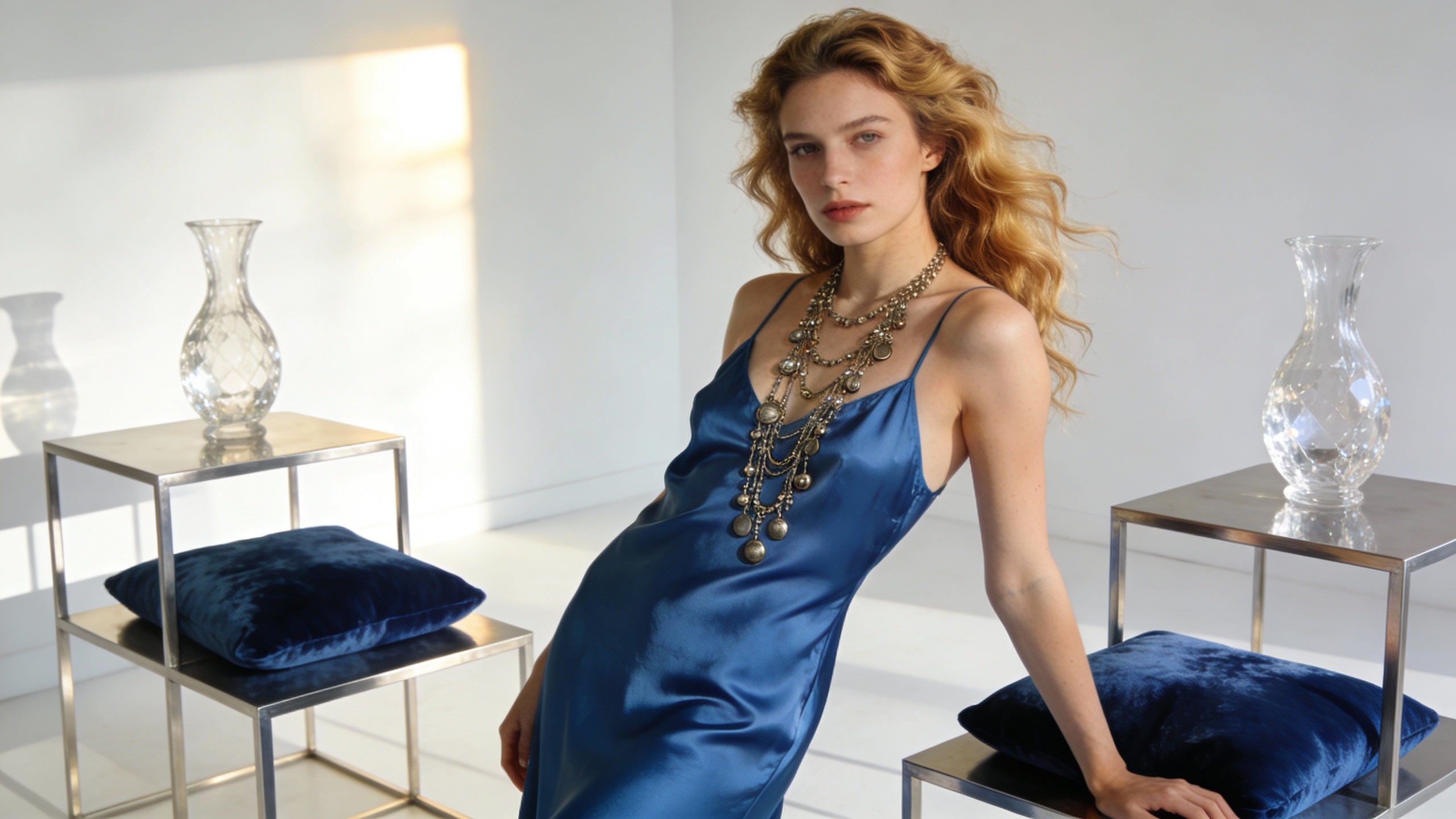
For blue gowns, the metal choice depends on shade. Navy is sophisticated with silver, white gold, or platinum diamond necklaces for formal events. Lighter blues pair well with diamond tennis necklaces that preserve a soft, feminine feel. Diamond hoops suit all blues, with larger hoops for evening and smaller hoops for more restrained settings.
For green dresses, especially emerald green, VDS Jewels suggests yellow‑gold diamond pendants for an opulent, garden‑party feel, while lighter greens like mint or sage prefer cool‑toned metals. Busy prints in any color call for simple studs or a classic solitaire pendant.
For yellow dresses, diamonds concentrate the brightness rather than adding new color. Both yellow gold, for a unified glow, and white gold or platinum, for crisp contrast, work well. Pendant necklaces draw attention to the face; diamond studs and layered necklaces refine everything from sunny cocktail dresses to more formal floor‑length gowns.
For purple gowns, deeper violets look particularly regal with white gold or platinum diamonds, while lighter lavenders take on a romantic softness when paired with rose gold, as VDS Jewels highlights. Chandelier earrings can be spectacular with darker purple gowns; high‑neck versions are often better styled with bracelets and earrings rather than necklaces.
Diamond Gallery Frisco and Messika both encourage considering skin tone alongside dress color. Cool complexions often look luminous with diamonds that appear white or slightly blue in white metals. Warm complexions can benefit from softer diamond hues and golden metals that create a gentle, champagne glow.
A subtle but powerful modern strategy, endorsed by Messika and With Clarity, is mixing metals—pairing, for example, a white‑gold tennis necklace with a yellow‑gold bracelet and rose‑gold ring. When done intentionally and kept within a narrow palette that relates to your gown, this mix looks curated rather than chaotic. The one caveat is context: with extremely ornate gowns or strong, themed embellishment, too many metal colors can make the look feel unfocused.

How Much Diamond Is Enough? Balancing Statement and Restraint
The third key decision question is how far to go. Diamonds are seductive; it is tempting to wear every beloved piece at once. Yet Latelita, Jovani, Robinson’s Jewelers, Sabrina A, and Dvik Jewels all, in their own language, insist on the same principle: choose your focal point and let the rest of your jewelry support it.
Robinson’s Jewelers suggests one or two standout pieces at most, such as a statement necklace with small studs, or chandelier earrings with no necklace. Sabrina A’s fall formal guide mirrors this, recommending one hero diamond piece—drop earrings, a halo ring, or a cocktail ring—balanced by simpler accents. Latelita’s black‑tie advice stresses that jewelry should enhance an outfit without outshining the occasion.
Think of it as editing rather than depriving yourself. If your gown is a simple navy column with minimal seams, it can carry more jewelry: perhaps a diamond halo pendant, a pair of medium drop earrings, and a tennis bracelet. If, however, the dress features heavy crystal embroidery across the bodice, as Promfy and Alibaba describe in their diamond formal dress collections, that same amount of jewelry would tip the look into visual overload. In that case, diamond studs and a single bracelet or ring allow the dress’s embellishment to shine while still giving you the pleasure of diamonds.
A practical way to assess balance comes from Princessly’s bridal advice. They recommend assembling all your jewelry and trying it on with your gown and hairstyle during a fitting. If one or two pieces dominate or the combination feels chaotic, remove the least necessary piece. This is particularly important if you are also incorporating hair ornaments, tiaras, or veils, which Jovani notes can change how jewelry reads on the body.
Personality matters too. Lifestyle GCC and Diamond Gallery Frisco both encourage leaning into your authentic style. If you are naturally minimalist and rarely wear jewelry, you will feel most confident in a single pair of diamond studs and perhaps a pendant. If you live in statement rings and bold earrings, you can absolutely carry a dramatic diamond cocktail ring or chandelier earrings to a gala—just allow one of those elements to lead and let diamonds elsewhere be quieter.
A simple thought experiment illustrates the power of editing. Imagine a silver, one‑shoulder, sequin gown. If you add a diamond choker, large chandelier earrings, a tennis bracelet, and a cocktail ring, every inch of your upper body sparkles independently. Now imagine wearing only slim drop earrings and a strong cocktail ring. The look is still rich in diamonds, but the focus moves to your face and the expressive movement of your hands, while the gown’s sequins do the rest. Same jewels, different choices, dramatically different impact.
Building an Elegant Evening Diamond Wardrobe
If you love evening gowns, it is worth curating a small but strategic set of diamond pieces that can adapt to many dress styles. With Clarity calls diamond necklaces long‑lasting, timeless accessories that transition from day to night. Diamond Gallery Frisco and Dvik Jewels position diamonds in general as versatile, suitable for nearly any occasion. Sabrina A and JewelryNest show how a handful of classic designs can be recombined endlessly with formal dresses.
Across these sources, certain categories emerge as especially useful with evening gowns. Diamond studs, celebrated by Sabrina A and Dvik Jewels, are the ultimate utility piece: comfortable, appropriate for black‑tie or business dinners, and compatible with virtually every neckline. A solitaire or halo diamond pendant on an adjustable chain, highlighted by Dvik Jewels, Princessly, VDS Jewels, and With Clarity, handles everything from V‑neck cocktail dresses to soft sweetheart gowns.
A tennis bracelet, which Sabrina A defines as a continuous line of diamonds, offers subtle yet unmistakable luxury. It never interferes with necklines, works with sleeveless, cap‑sleeve, or long‑sleeve gowns, and pairs easily with watches or rings. A single statement piece—either a pair of drop or chandelier earrings as Latelita and Jovani favor for galas, or a bold diamond cocktail ring as Sabrina A describes—gives you the option to create drama when the dress is simple.
If you prefer colored accents, several guides, including those from Princessly, Latelita, JewelryNest, and VDS Jewels, recommend mixing diamonds with sapphires, emeralds, or other stones. A diamond‑and‑sapphire pendant, for instance, can be magnificent on a black or deep green gown, while a diamond halo around a colored center stone in a ring gives you both brilliance and hue.
From a practical standpoint, consider how often you might wear each piece. If you invest in diamond studs and wear them once a week for ten years, that is more than five hundred outings, from morning meetings to midnight dances. A tennis bracelet worn twice a month for five years accompanies you to about one hundred twenty occasions. These are not just purchases; they are companions to your memories. This cost‑per‑wear perspective, while simple, highlights why so many jewelers, from Dvik Jewels to With Clarity, emphasize quality and comfort in their recommendations.
Lab‑grown diamond pieces deserve special mention. Dvik Jewels positions lab‑grown diamond earrings, necklaces, and bracelets as ideal formal accessories, offering the same visual impact and design language as traditional diamonds. With Clarity also discusses lab diamonds as core options within their customizable necklace collections. For many, they offer a way to enjoy larger or more numerous pieces without the same financial or emotional weight as heirloom stones.

When Diamond Jewelry Might Not Be the Best Choice
For all their virtues, diamonds are not mandatory for every gown or every evening. Several credible sources remind us that other jewelry families sometimes better serve the story you want to tell.
Latelita and Lifestyle GCC both highlight pearls as timeless options, particularly effective with darker gowns and vintage‑inspired aesthetics. In a Roaring Twenties‑themed event, Jovani and Latelita lean toward long pearls and art deco pieces; layering diamonds heavily in that context might look more modern than you intend. In such cases, a strand of pearls or a geometric colored gemstone necklace can be more historically faithful and thematically cohesive.
Princessly’s bridal guide emphasizes personal comfort and authenticity. If you rarely wear jewelry and feel overstated in bright, high‑sparkle pieces, you may find that a single modest gemstone pendant or a family heirloom in a colored stone feels more “you” than a full diamond suite. Diamonds can always return for another occasion.
There are also practical considerations. For destination weddings, beachside galas, or events where you will be moving through crowds or changing locations frequently, some people prefer to leave irreplaceable heirloom diamonds at home. In these cases, well‑made lab‑grown diamond pieces, diamond‑simulating crystals as seen in Alibaba’s and Promfy’s descriptions of embellished gowns, or fine fashion jewelry can echo the look with less anxiety.
The point, as Diamond Gallery Frisco wisely notes about diamonds in everyday styling, is that fashion should feel enjoyable and confidence‑boosting, not stressful.
FAQ: Fine‑Tuning Diamonds with Evening Gowns
Can I wear diamond jewelry with a gown that already has crystal or “diamond” embellishments?
Yes, and many do—but with restraint. Promfy and Alibaba describe diamond and crystal gowns as designed to stand out on their own, with shimmering bodices and long‑lasting sparkle. Latelita and Jovani both caution that heavily embellished dresses call for simpler jewelry. In practice, this usually means choosing only one or two diamond pieces: perhaps studs and a slim bracelet, or a delicate pendant with bare wrists and minimal rings. The goal is to let the dress’s built‑in sparkle be the star, while your diamonds quietly echo the light rather than competing with it.
Are lab‑grown diamonds appropriate for black‑tie and formal galas?
Absolutely. Dvik Jewels’ entire discussion of formal jewelry revolves around lab‑grown diamond studs, necklaces, bracelets, and rings, all presented as refined, elegant choices for galas, business dinners, and weddings. With Clarity similarly includes lab diamonds among their recommended options for both casual and formal diamond necklaces. From a styling perspective, lab‑grown and mined diamonds play exactly the same role with evening gowns: both deliver brilliance, neutrality, and longevity. The choice comes down to personal values and budget, not formality.
How do I avoid my diamond necklace clashing with my gown’s neckline or hairstyle?
Princessly recommends bringing all planned jewelry to your final fitting and trying it on with the dress and hairstyle you intend to wear. This is excellent advice for evening gowns as well. If a necklace disappears under fabric when you move, sits awkwardly on a halter, or fights with an elaborate up‑do or hair accessory—as Jovani warns can happen—switch to earrings and bracelets instead. Adjustable chain lengths, which With Clarity highlights as a key feature of modern diamond necklaces, are especially useful here. They allow you to fine‑tune where the pendant falls so it sits comfortably above a V‑neck, within a sweetheart, or just at the collarbone of a strapless gown.
Closing
Pairing diamond jewelry with an evening gown is not about adding more sparkle for its own sake; it is about composing a story in light, fabric, and movement. The diamonds frame your features, honor the architecture of the dress, and quietly record the memories you make while wearing them. When you choose each piece with intention—guided by neckline, color, occasion, and your own sensibility—diamond jewelry becomes not just the perfect pairing for evening gowns, but the finishing touch that makes the evening truly yours.
References
- https://www.alibaba.com/showroom/diamond-evening-gown.html
- https://www.amazon.com/Diamond-Dresses/s?k=Diamond+Dresses
- https://catchallstore.com/collections/diamond-dresses?srsltid=AfmBOopU4lxCVmbA9eA72vZnFSf0mJtzt-BNfnj0uXB0uRdUC6K7IOX9
- https://designformal.com/collections/glitz-prom-dresses?srsltid=AfmBOoqpLG2Uu8gkSkX6ISL3JMDE1UUtKfWOPz9WFEr_9qSKHAsrVeK3
- https://www.etsy.com/market/diamond_formal_dresses_for_women
- https://www.messika.com/us_en/diamond-jewelry-pairing-messika-guide
- https://www.promfy.com/special-occasion-dresses/diamond
- https://www.angara.com/blog/how-to-pair-your-outfits-with-different-types-of-diamond-rings/?srsltid=AfmBOorhp_XpmjYpROyVBt0TXgOzY3iKhwHQF2Whr4aqW9NaNuocCpsq
- https://applesofgold.com/jewelry/the-dos-and-donts-of-wearing-jewelry-for-formal-events/?srsltid=AfmBOoo3I2RBJ6pe9bRHYZW3O8ZZsXK2I2u9Y8IwW-ChY6YLX1y7QBRm
- https://aviradiamonds.com/blogs/jewellery/perfect-jewellery-to-wear-with-gown?srsltid=AfmBOoq7f8ArozK0X_KErd1UNO6fqESUe9zRxK4UdZYstAr_nb-hjZxC