What Elegant Jewelry Options Suit Charity Dinners?
Charity dinners are some of the most emotionally charged evenings in a social calendar. The room is filled with purpose as much as with candlelight; checks are written, stories are shared, and causes close to the heart are given a stage. In spaces like these, jewelry does not simply decorate. It signals respect for the occasion, expresses your personality, and, at its best, quietly supports the mission at the center of the night.
Over years of observing guests glide through black-tie galas, semi-formal fundraisers, and intimate benefit dinners, I have seen one truth hold: the most elegant jewelry at a charity dinner is never the loudest. It is the piece that feels inevitable with your gown, that moves comfortably as you lean in to listen, and that reinforces, rather than competes with, the spirit of giving around you.
This guide draws on practical wisdom from specialists in gala and black-tie jewelry, including education from Roma Designer Jewelry, Latelita, Suzanne Kalan, Dorano Jewelry, and others, as well as the fundraising insights of AmFund and Jewels With A Purpose. Together, they form a clear answer to the question: what jewelry truly suits a charity dinner?
The Spirit of the Charity Dinner
A charity dinner is not just a party with a dress code. As Roma Designer Jewelry’s fundraiser-focused guide emphasizes, galas and benefit dinners are formal or semi-formal events where the cause comes first and the dress code exists to honor that seriousness. Latereverafter’s black-tie charity gala advice echoes this: your appearance is part of how you show respect for the evening and its beneficiaries.
That does not mean dressing in a dull, anonymous way. Instead, it means that the goal is polished elegance rather than exhibitionism. You want your jewelry to say, “I dressed up because this night matters,” not “I came to be the main attraction.” Formal guides consistently warn against very flashy, overly “sexy,” or cluttered combinations of huge hoops, chunky long necklaces, and stacks of bracelets. Those can feel more nightclub than nonprofit.
Think of charity-dinner jewelry as a visual version of good manners. It should feel generous rather than self-centered; refined, but never stiff; and confident enough to let the story of the cause outshine the sparkle of your stones.

Reading the Dress Code Before You Choose a Jewel
Before you reach for a single necklace, read the invitation. Event type and dress code are the frame that determines which jewelry is genuinely appropriate.
Education pieces from Roma Designer Jewelry, Latereverafter, and Latelita all converge on the same structure. Black tie typically means floor-length or extravagantly formal gowns for women and tuxedos or dark suits for men. Formal or “evening attire” relaxes things slightly, allowing elegant party dresses or sophisticated jumpsuits, provided the look remains polished. Semi-formal or cocktail charity dinners, often smaller or more casual fundraisers, offer even more room to play, so long as you avoid anything that looks casual or daytime.
For black-tie charity galas, sources like Latelita and Roman Malakov emphasize classic luxury. Diamonds, pearls, and refined gemstone pieces in gold or platinum feel right at home here, especially with floor-length gowns in black, navy, or other deep hues. The tone is timeless and dignified. For formal but not strictly black-tie dinners, Roma Designer Jewelry suggests that elegant jumpsuits and party dresses can be paired with slightly bolder jewelry, provided you keep each look cohesive and avoid gaudy excess.
Color strategy matters as well. Latereverafter’s gala advice notes that black is always a safe evening choice, but rich jewel tones and metallics can be equally dressy. Suzanne Kalan’s gala guidance goes further, suggesting that bold-colored dresses like red or purple shine with carefully chosen complementary jewelry, while muted dresses in navy or black can handle vivid colored stones. Atolea Jewelry’s event guide supports this, recommending that jewelry tones harmonize with outfit colors and textures so the entire look feels intentional.
In other words, before you ask, “Which earrings?” ask, “What level of formality, what color story, and what message does this event’s dress code invite?” The jewelry answer flows naturally from there.

Core Principles of Elegant Charity-Dinner Jewelry
Across many brands and stylists, three principles emerge for choosing jewelry that truly suits charity dinners: balance, quality and comfort, and tonal harmony.
Balance is the first rule. Latelita, Roma Designer Jewelry, and Dorano Jewelry all make the same point in different language. If your gown is heavily embellished, beading and sequins already provide visual drama, so you should reach for more delicate jewelry: diamond or pearl studs, a simple tennis bracelet, perhaps a slim pendant if your neckline allows. If your dress is a minimalist column or a sleek black sheath, you have more room for jewelry to carry the statement, whether that means chandelier earrings, a sapphire tennis necklace, or a single bold cocktail ring. The outfit and the jewelry should never compete to be the lead.
Quality and comfort come next. Atolea Jewelry’s event-focused guidance stresses choosing pieces that are lightweight enough for long evenings, with secure clasps and comfortable settings. Ventura Joyería underlines the idea of quality over quantity, especially when discussing Cuban-style jewelry for special events. One or two beautifully made pieces in real gold, sterling silver, or well-crafted overlays feel—and look—far more elegant than a handful of flimsy accessories. At a charity dinner, you may be seated for hours, applauding, raising glasses, and moving from table to table. If your earrings pinch or your bracelet threatens to snag, your discomfort will show.
Finally, tonal harmony ties the look together. From Atolea to Suzanne Kalan, the advice is consistent: match warm-toned dresses with yellow or rose gold, and cool-toned outfits with white metals like silver, platinum, or white gold. Latelita reiterates that metal color should align with dress tone, and Roma Designer Jewelry points out that real gold and silver almost automatically elevate a gala look in a way imitation metals rarely do. Coordinating metal across your earrings, necklace, and bracelet helps your jewelry read as a single, thoughtful story rather than a random assortment.
Necklaces That Honor the Cause, Not Just the Collarbone
Necklaces are often the most obvious focal point, but at charity dinners they must be chosen more carefully than almost any other piece. Several sources emphasize that neckline should drive the decision. Roma Designer Jewelry and Latelita both recommend that low or plunging necklines can support bolder or longer necklaces, while high necklines often look better with no necklace or a short, subtle collar piece.
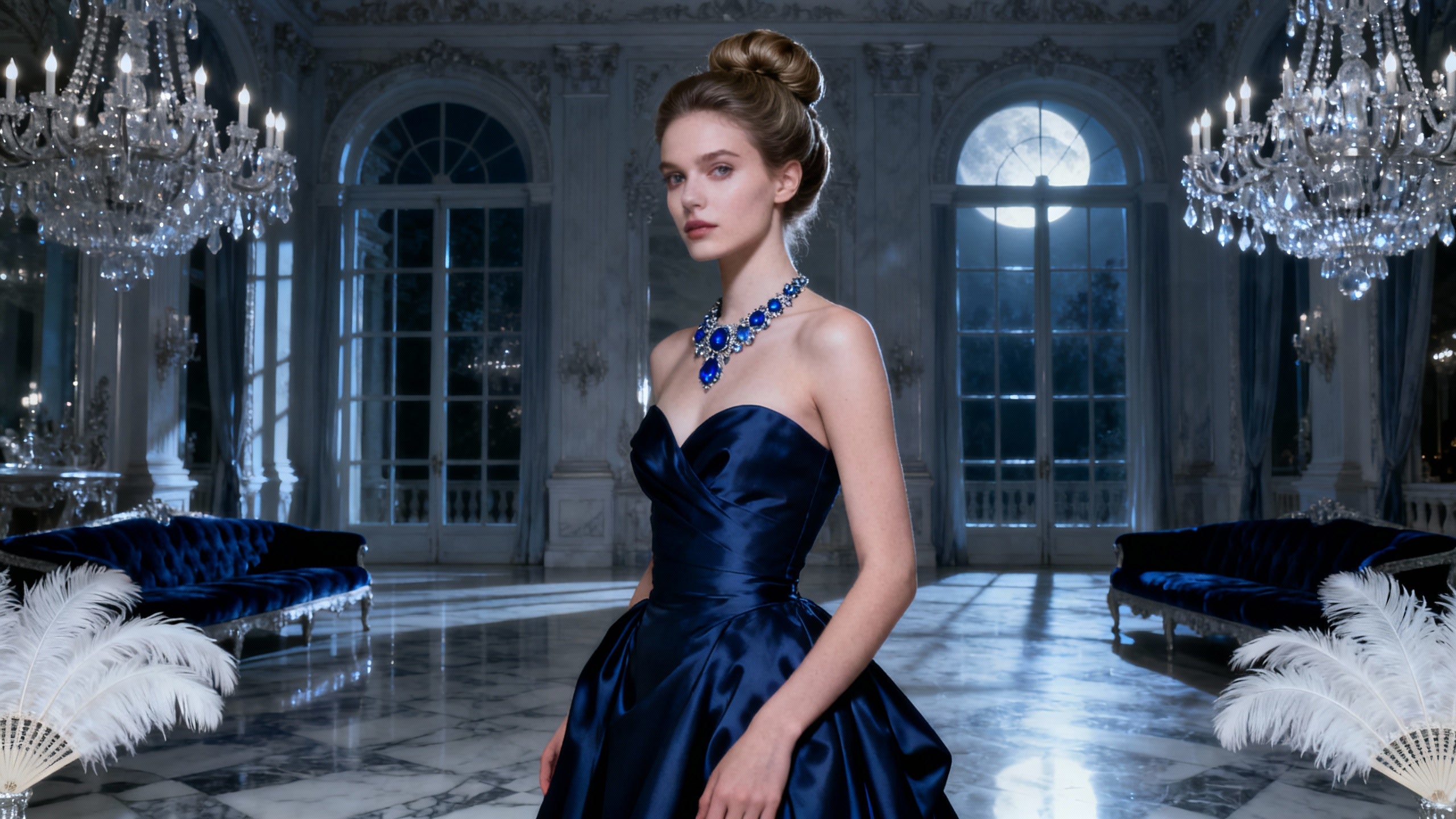
Classic diamond necklaces, as highlighted by Roman Malakov and Latelita, are nearly fail-safe for black-tie fundraising galas. A single row of diamonds or a refined drop design adds sparkle that feels luxurious yet traditional. Latelita describes tennis necklaces—a continuous line of diamonds or gemstones—as an especially elegant choice that provides wrist-like tennis bracelet glamour at the neckline. Suzanne Kalan’s sapphire tennis necklaces extend that idea with colored stones, using rows of baguette-cut sapphires in 18k gold to bring refined color into gala outfits without sacrificing formality.
Pearl necklaces remain another charity-dinner staple. Latelita notes that pearls, especially worn with black, navy, or emerald gowns, create a deliberate, classic contrast. Pearls communicate a certain timeless seriousness that sits beautifully with evenings devoted to philanthropy, particularly those benefiting traditional institutions or long-established causes.
Collar and choker styles hold a special place when paired with modern charity gowns. Roma Designer Jewelry highlights collar necklaces as versatile pieces that can function either as simple metallic bands or as serious statement designs, depending on whether they are plain gold or silver or set with jewels. Suzanne Kalan’s guidance aligns: high necklines love a close-fitting collar or choker; more open necklines can handle longer lines or even layered strands. Latelita warns only against over-layering delicate chains, especially at gala dinners, to avoid a cluttered look.
The recurring pattern is clear: let your neckline and the event’s formality dictate whether your necklace whispers in diamonds, speaks in sapphires, or chooses silence and lets earrings or bracelets play the lead.

Earrings: The Most Visible Gift to the Room
If you wear only one category of jewelry to a charity dinner, make it earrings. Roma Designer Jewelry describes earrings as essential for gala looks, while Latelita and Dorano Jewelry treat them as primary vehicles for sparkle and personality.
For conservative, black-tie-focused charity dinners, diamond or pearl studs are the workhorses. Latelita calls diamond earrings a safe and versatile option that adds light without flash, particularly when you choose studs for high necklines and small drops for lower or off-the-shoulder gowns. Latereverafter’s black-tie advice similarly favors large stud earrings in pearls or faux diamonds with a delicate bracelet and perhaps a small necklace, underlining the “less is more” principle.
When the evening allows more expression—art auctions, creative community benefits, slightly less formal fundraisers—statement earrings come into their own. Latelita recommends chandelier styles for gala dinners, especially with strapless or minimalist gowns where the earrings can truly frame the face. Dorano Jewelry highlights statement chandelier designs and luxury studs as key choices for black-tie events, particularly when worn with updos that expose the neck and shoulders.
Roma Designer Jewelry brings a modern twist with ear climbers. These are described as a fresh alternative to traditional drop earrings, running along the ear instead of dangling directly downward, and they are singled out as gala-appropriate statement pieces when chosen in refined metals and stones. The same guide suggests tasteful multicolored earrings and colored studs to introduce color in a controlled, coordinated way.
An interesting nuance appears in Roma Designer Jewelry’s discussion of mismatched earrings: pairing a more elaborate piece on one side with a simpler stud on the other, as long as the metal and color palette match. This can be an excellent choice for a contemporary charity dinner in the arts or fashion space, where a touch of boldness feels aligned with the cause. The key is the same as everywhere else: intentionality. The earrings should feel designed, not haphazard.
Hairstyle is the final factor. Ventura Joyería notes that updos spotlight longer earrings, while bold makeup calls for more delicate jewelry to keep the face balanced. Dorano Jewelry echoes this: elaborate chandelier earrings shine when paired with simple bodices and hair worn up, while detailed bodices or hair worn down may be better suited to studs or small drops.

Bracelets and Rings: Subtle Signals of Refinement
Bracelets and rings tend to be noticed during handshakes, applause, and the quiet pauses over dessert, which makes them ideal for charity dinners where hands are frequently in motion—signing pledge cards, clinking glasses, or scanning programs.
Tennis bracelets are a recurring recommendation from Latelita and Roman Malakov. A single line of diamonds or gemstones at the wrist adds measured sparkle that complements rather than competes with a formal gown. These pieces are particularly effective when your dress has a high neckline and you have skipped a necklace; they draw the eye to the hands and wrists without adding another focal point near the face.
Dorano Jewelry also praises sleek bracelets and cuffs for black-tie events, especially with sleeveless dresses. Ventura Joyería’s emphasis on Cuban bracelets for special events adds a slightly different flavor: expertly crafted Cuban chains can serve as statement pieces with cultural resonance, blending tradition and modernity in a way that feels powerful at charity evenings rooted in community.
Rings at charity dinners sit at the intersection of elegance and practicality. Roman Malakov suggests that black-tie events are the ideal setting for your most cherished rings—cocktail rings, diamond bands, and bold gemstone rings that provide impact without tipping into casual territory. Dorano Jewelry reinforces this, encouraging guests to wear engagement rings, heirloom pieces, or bold modern designs, provided these are balanced with simpler earrings or necklaces.
Jewels With A Purpose, which specializes in jewelry for fundraising auctions, highlights cocktail rings among the best-selling silent auction items, alongside statement earrings and necklace sets. Their experience suggests that guests love rings that are immediately wearable and photogenic, but AmFund notes that for auction inventory, bracelets, earrings, and necklaces have the advantage of fitting most buyers without sizing. That guidance is more about the jewelry on the table than on your own hand, but it is useful if you are also helping plan the event.
Birthstone jewelry deserves a special mention. M.S. Brown Jewelers’ formal-event guide dedicates a section to the significance of birthstones, describing birthstone jewelry as pieces that incorporate gemstones associated with a person’s birth month and noting that, for centuries, people have cherished them as symbols of luck, health, and prosperity. In the context of a charity dinner, a single birthstone ring or pendant can be the most deeply personal piece in your ensemble. The key, as the M.S. Brown guidance suggests, is subtlety: one or two coordinated birthstone pieces preserve an elegant, focused look while allowing you to carry your own story into the evening.

Color, Gemstones, and the Question of Diamonds at Charity Events
Diamonds may be the default answer for formal jewelry, but charity-dinner settings introduce a compelling twist: colored stones often make a stronger impact, especially when jewelry enters the fundraising itself.
On the style side, Latelita, Suzanne Kalan, and Dorano Jewelry all celebrate colored gemstones as a way to inject personality into gala outfits. Latelita recommends ruby-red earrings, emerald rings, and sapphire pieces that either match the gown color for cohesion or contrast it for drama. Suzanne Kalan’s gala jewelry positioning turns colored sapphire tennis necklaces into centerpieces that play with vivid hues while keeping lines clean and classic. Dorano Jewelry suggests pairing yellow gold or sapphires with navy or royal blue dresses, diamonds or rubies with red gowns, and bold colorful stones with white dresses for a striking effect.
Atolea Jewelry adds color psychology into the conversation, noting that reds convey confidence and pastels suggest calm, while advising that jewelry tones should flatter your skin tone and avoid clashing with the outfit. Ventura Joyería advises aligning gemstone color with both clothing and complexion, especially when wearing bold Cuban pieces that already draw attention.
Auction professionals bring a more strategic perspective. AmFund, which has extensive fundraising experience, reports that colored stone jewelry consistently outperforms diamond jewelry at auctions, even when high-end diamonds are on offer. Their explanation is twofold. First, colored stones stand out more visibly as auction staff move display boxes around the room. Second, human nature intervenes: diamonds often attract self-described experts who scrutinize carat, cut, color, and clarity to the point of diminishing perceived value, while colored stones are usually judged more generously and emotionally.
Jewels With A Purpose, focused on philanthropic jewelry for fundraising events, also notes that timeless yet visually interesting pieces—often featuring simulated diamonds, mother-of-pearl, and trend-conscious designs—perform exceptionally well. Their guidance to select versatile day-to-evening pieces with broad appeal reinforces the idea that color and design can be equally, if not more, important than the presence of natural diamonds in a charity context.
The resulting picture is nuanced. For your own outfit, diamonds remain a safe, sophisticated choice, especially at very traditional or black-tie charity dinners. For jewelry that needs to be seen across a ballroom or sought after in a silent auction case, colored gemstones often tell a more compelling, less intimidating story.

When Your Jewelry Also Supports the Cause
An elegant jewelry choice for a charity dinner can go beyond aesthetics and into direct impact. Jewels With A Purpose uses the term “philanthropic jewelry” for pieces that are selected or crafted so each one directly benefits a nonprofit cause. In their model, the winning bidder literally wears their generosity; the piece becomes a reminder of the night they made a difference.
From a guest’s perspective, wearing jewelry from a brand that gives back, or from a previous fundraiser’s auction, can be a subtle yet powerful gesture. It signals that your relationship with the cause is not limited to the current table sponsorship. From an organizer’s perspective, curating jewelry for auctions involves a distinct set of criteria. Jewels With A Purpose recommends versatile designs that move easily from day to evening, quality materials like 925 sterling silver and gold overlays, and a blend of classic shapes with on-trend motifs such as paperclip chains or mother-of-pearl details.
Display and practicality matter as well. AmFund strongly advises presenting jewelry in portable display boxes rather than on live models. Boxes can be carried through the room so every table gets a close view, whereas models can be blocked by conversation, clothing, or hair. They also note that bracelets, earrings, and necklaces outperform rings in the auction setting because they fit most buyers immediately and can be worn the same night, turning the winner into a “walking billboard” for the organization.
If you are both attendee and volunteer, consider aligning your personal jewelry with the event’s fundraising strategy. Wearing a striking colored-stone piece when the auction features similar items can help guests imagine themselves in those designs. Conversely, if most auction lots are classic diamond and silver sets, arriving in a wildly unconventional, oversized statement piece may inadvertently compete with, rather than support, the offerings.
A Quick Comparison of Elegant Options for Charity Dinners
You can think of your choices through a simple comparison of how different jewelry directions behave in a charity-dinner environment.
Jewelry focus |
Best suited to |
Advantages at charity dinners |
Potential drawbacks to watch |
Classic diamonds & pearls |
Traditional black-tie galas |
Timeless, instantly formal; endorsed by Latelita and Roman Malakov as fail-safe for black tie |
Can feel predictable; diamonds may invite over-analysis in auctions |
Colored gemstones |
Creative galas, art benefits |
Highly visible across a room; AmFund notes colored stones often outperform diamonds in bidding |
Require careful color coordination with gowns to avoid clashing |
Minimalist metal pieces |
Semi-formal dinners, business-linked fundraisers |
Quietly polished; align with Roma Designer Jewelry’s guidance on refined gold and silver pieces |
Risk of fading into the background if dress is also very understated |
Statement sets and cocktail rings |
Fashion-forward charity events, silent auctions |
Photogenic, exciting; highlighted by Jewels With A Purpose and BaubleBar for high-impact moments |
Too many statement pieces at once can look busy or gaudy |
Used thoughtfully, any of these directions can be perfectly appropriate for a charity dinner. The elegance comes from how well the choice fits the dress code, your outfit, and the tone of the cause.
Building a Small Charity-Dinner Jewelry Wardrobe
If you attend charity dinners regularly, it is worth curating a focused set of pieces that can adapt to different causes and dress codes. Latereverafter recommends gradually investing in evening accessories rather than scrambling before each event, and the same philosophy applies to jewelry.
A practical approach, inspired by guidance across Latelita, Roma Designer Jewelry, Ventura Joyería, and T-Bird Jewelers, is to establish a foundation and then add accents. A foundation might include diamond or pearl studs, a slender tennis bracelet, and a simple pendant or collar necklace in your preferred metal. These handle traditional black-tie dinners and conservative corporate fundraisers with ease.
Accents can then shift the mood: a pair of chandelier earrings or ear climbers for creative galas, a colored gemstone cocktail ring for art or children’s charities, and perhaps a Cuban bracelet or chain for events that celebrate cultural heritage, as described by Ventura Joyería. A birthstone piece from a guide like M.S. Brown Jewelers adds personal meaning that can travel from one cause to another without ever feeling out of place.
Throughout, Atolea’s advice about comfort, durability, and proper cleaning should not be ignored. Long evenings magnify small irritations, and nothing undermines an elegant entrance faster than a broken clasp or a stone that has lost its luster. Dorano Jewelry’s recommendations to have vintage and heirloom pieces professionally cleaned and repaired before black-tie events are particularly wise for charity dinners, where you may be photographed or introduced to donors and partners.
FAQ: Fine-Tuning Jewelry Choices for Charity Dinners
Is it better to wear statement jewelry or keep everything minimal at a charity dinner?
The most reliable approach is to choose one focal category. Latelita, Roma Designer Jewelry, and Dorano Jewelry all encourage selecting either statement earrings, a standout necklace, or a bold ring and keeping the rest of your jewelry restrained. At a charity dinner, that balance feels especially appropriate because it allows you to express personality without distracting from the program or appearing overdressed.
Are diamonds always the best choice for a fundraising gala?
Diamonds are a very safe choice for what you personally wear, particularly at formal and black-tie dinners, and multiple sources affirm their timeless appeal. However, fundraising organizations with extensive auction experience, such as AmFund, have observed that colored stone pieces often outperform diamond items in bidding. That does not diminish the elegance of wearing diamonds; it simply means that when jewelry becomes part of the fundraising inventory, colored gemstones can sometimes engage guests more enthusiastically.
Can I wear trendy or mismatched pieces to a charity dinner?
You can, as long as the trend is executed with intention and the rest of your look remains polished. Roma Designer Jewelry specifically mentions mismatched earrings as a chic, fashion-forward option when the two pieces share a metal and color palette. Jewels With A Purpose and BaubleBar both highlight on-trend designs as effective in gala settings, provided they are well made and not excessively large or flashy. If the event is very traditional, keep trends subtle; if it leans creative or themed, you have more freedom to play.
How important is it that my jewelry brand or piece supports a cause?
It is not mandatory, but it can be deeply meaningful. Jewels With A Purpose has shown that philanthropic jewelry—pieces directly tied to nonprofit support—can transform accessories into tangible reminders of generosity. Wearing jewelry purchased at a previous auction or from a brand known for giving back can be a quiet way of aligning your style with your values. At the same time, simply choosing jewelry that helps you feel confident, respectful, and engaged with the evening also honors the cause.
In the hush that falls before a paddle-raise or the moment the auctioneer calls a final bid, the right jewelry does something subtle yet powerful. It steadies your posture, lifts your chin into the light, and lets you inhabit the role you came to play: a guest who is present, generous, and fully in tune with the occasion. Choose pieces that harmonize with the dress code, your own story, and the mission at the center of the night, and your jewelry will do what the best philanthropy always does—quietly amplify what truly matters.
References
- https://www.amfund.org/let-your-jewelry-shine-at-your-auction/
- https://www.doranojewelry.com/how-to-make-a-statement-with-jewelry-at-black-tie-events
- https://www.baublebar.com/collections/special-occasion-jewelry?srsltid=AfmBOoqlxTGrLDa5gnJnoDDUexXuUPFfI1eJHWHJ9gg0ppGED2GW3jmp
- https://www.etsy.com/market/gala_events_jewelry
- https://www.jewelswithapurpose.com/post/the-power-of-philanthropic-jewelry-why-auction-jewelry-boosts-fundraising-events
- https://www.latereverafter.com/how-to-dress-and-accessorize-for-a-black-tie-event/
- https://msbrownjewelers.com/mastering-the-art-of-wearing-jewelry-for-formal-events-a-guide-to-elegance/
- https://atoleajewelry.com/blogs/waterproof-jewelry-blog/how-to-choose-the-right-jewelry-for-events?srsltid=AfmBOoq9ckNJsjd_XSN6T5V6anLbQGgRG-ZWdtRWwtEIGwh_97RW37Ax
- https://www.grownbrilliance.com/blog/6-perfect-jewelry-pairings-to-elevate-your-formal-event-look/
- https://www.latelita.com/blogs/news/the-best-jewellery-for-formal-events-how-to-shine-at-every-occasion?srsltid=AfmBOopcFVzHW7kyH2An2pig_g875ac49QGJzNNkP4g3Z1aaHefRdtya