How to Simplify Jewelry Pairing for a Printed Dress
Printed dresses are visual poetry: florals that feel like a garden at golden hour, stripes that borrow from architecture, abstracts that look stolen from an art gallery. The challenge is not whether jewelry belongs with them—it absolutely does—but how to make the pairing feel effortless instead of exhausting.
After years of fitting rooms and front-row photos, I can tell you this: simplifying jewelry for prints is not about memorizing a hundred rules. It is about asking a few smart questions in the mirror and letting those answers guide you.
In this guide, I will walk you through those questions one by one, drawing on practical advice from boutiques like Gleamora and Charlie & Co., color experts such as Mvraki’s stylist team, and print-focused guidance from High Latitude Style, Victoria Cruz Jewelry, and others. By the end, you will have a calm, repeatable ritual for accessorizing any printed dress.
Start With a Three-Question Framework
Whenever I work with a printed dress—whether it is a palm-leaf maxi for vacation or a polka-dot sheath for the office—I begin with three questions.
First, how busy is this print? A wild leopard, an oversized tropical floral, or a dense abstract behaves very differently from a scattered micro-floral or subtle stripe. Gleamora, Charlie & Co., Aureus Boutique, and High Latitude Style all agree on one thing: the louder the print, the calmer the jewelry should be.
Second, what is the color story? Do you want your jewelry to echo one of the hues in the dress, or to offer contrast? BrightonTheDay’s approach is to pull out one or two colors from the fabric and repeat them, while Mvraki’s color-theory guide encourages you to use the color wheel intentionally rather than guessing.
Third, where do you want the eye to land? Mvraki calls this visual hierarchy: choose a single focal zone—face, neckline, or hands—and let everything else support it. Gleamora’s “one hero piece” rule echoes this beautifully.
If you can answer those three questions, you can dress almost any print without feeling overwhelmed. Now let us unpack them in detail.
Question 1: How Busy Is Your Print?
Before you reach for earrings, take a clear-eyed look at the dress itself. Gleamora and Charlie & Co. both stress that you must “read” the print before you touch your jewelry box.
Busy prints are those that command attention on their own. Think large tropical florals, animal prints, dense geometrics, or small but tightly packed motifs—paisleys, micro-florals, fine stripes, and newspaper-style designs. High Latitude Style notes that even a simple two-color black-and-white dress can become visually busy if the pattern repeats quickly or uses strong contrast. With these dresses, accessories pile up very quickly.
By contrast, subtle prints breathe. Tiny dots scattered on a lot of background, watercolor florals with ample negative space, or a soft tonal stripe all behave more like solids from a distance. Aureus Boutique points out that these delicate patterns can “handle” bolder jewelry without tipping into chaos.
There is no precise formula, but here is how the styling consensus falls.
Bold, Loud Prints: Let the Dress Speak
When the print is clearly the star, jewelry must play a supporting role. Gleamora advises minimalist or sleek pieces with animal, oversized floral, and tribal prints, while Victoria Cruz Jewelry sums it up bluntly: with strong prints, “less is more.”
That could mean slim gold hoops or tiny studs at the ears, a fine chain with no pendant, and perhaps a single delicate bracelet or ring. Charlie & Co. suggest treating jewelry as a “supporting symphony” to the dress’s visual music, not a competing solo.
Consider a saturated jungle-leaf wrap dress in emerald and citron. If you add large green earrings, a statement necklace, stacked bangles, and embellished sandals, you are no longer wearing the dress—the dress is wearing you. Instead, borrow from Victoria Cruz’s approach: small gold studs, a slender gold bangle, and perhaps one ring with an understated green stone. The print still sings; the jewelry simply tunes the performance.
The advantage of this restraint is elegance and ease. The drawback is that if you under-accessorize too far—no earrings, no bracelet, nothing near the face—the outfit can feel unfinished. The happy middle lives in a few refined, well-placed pieces.
Soft or Subtle Prints: Your Opportunity to Play
When the print is gentle—micro-florals, pale stripes, small polka dots—your jewelry can safely step forward. Gleamora, Charlie & Co., Aureus Boutique, and Shiels all note that delicate patterns pair beautifully with more expressive pieces, as long as you keep the proportions in mind.
Atolea suggests using statement earrings to energize a soft floral; layered necklaces can also work if the neckline allows. Shiels recommends gemstone accents—amethyst with purple florals, sapphire with blue blooms, emerald with leafy details—to bring out tones that might otherwise whisper.
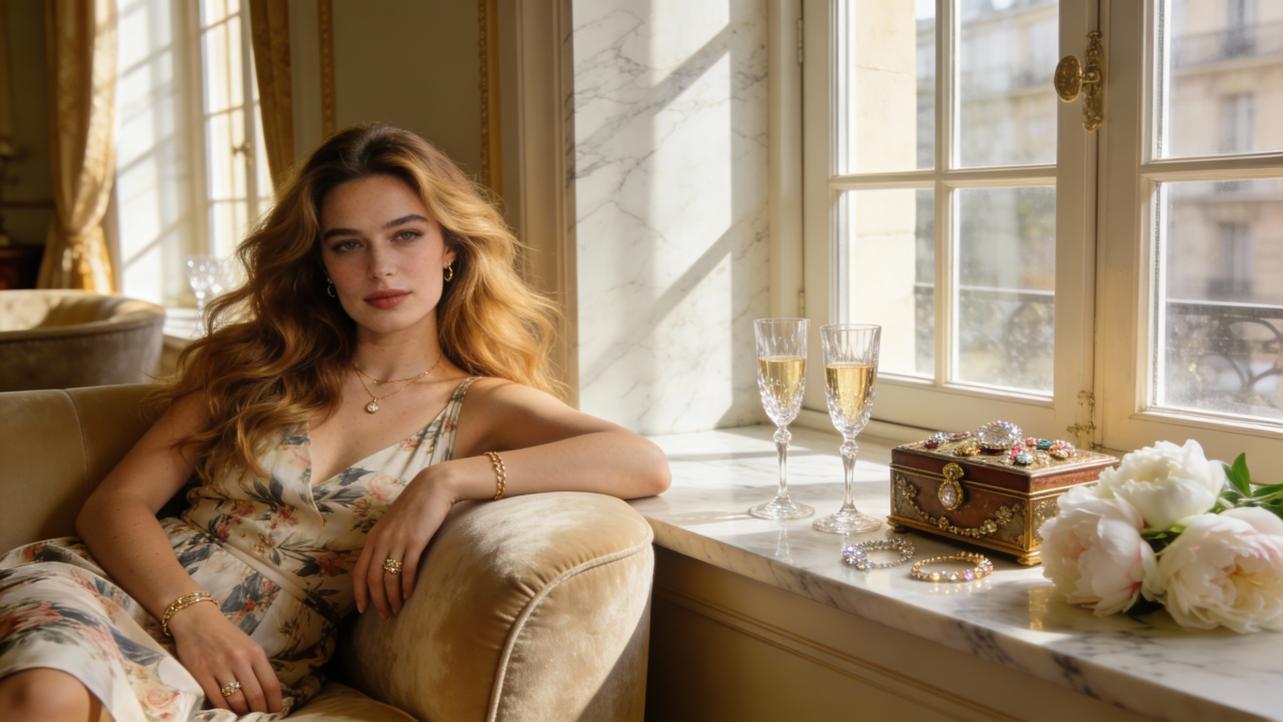
Imagine a faded blush micro-floral tea dress. Here you might wear medium-sized hoops in rose gold, a slender necklace with a single stone that echoes a pink or green from the print, and a small ring stack. The print is lyrical rather than loud, so the jewelry can bring structure and personality.
The benefit of this approach is that your jewelry can communicate mood: romantic, boho, or polished. The risk lies in forgetting that “subtle” is relative. Even quiet prints become busy if you stack three bold pieces at once.
Monochrome Prints: Your Easiest Playground
Monochrome prints—black and white stripes, neutral polka dots, single-color geometrics—are often the simplest to accessorize. Gleamora notes that they invite colorful or metallic contrast, while Aureus Boutique encourages adding a pop of color or texture through jewelry.
High Latitude Style offers a useful nuance: a black-and-white polka-dot dress paired with a bright pop of color can slide quickly into retro costume. If you want that 1950s mood, lean into it deliberately. If not, consider neutral metals, pearls, or subtle gemstones instead.
Picture a black-and-white striped midi. One route is modern minimal: sleek gold hoops, a single gold cuff, a bare neckline. Another is color-playful: emerald earrings and a ring with green enamel, echoing Mvraki’s complementary color advice by pairing green with the neutral base. In both cases, you keep the number of focal points low so the pattern still reads clean and graphic.

Question 2: What Is Your Color Story?
Once you understand the print’s busyness, turn to color. Here, BrightonTheDay, Gleamora, Charlie & Co., Mvraki, and Shimansky all converge on a simple idea: your jewelry should either echo one or two colors from the dress, or offer controlled contrast, rather than trying to “match everything.”
Pull One Color, Not the Whole Bouquet
BrightonTheDay’s styling method is wonderfully straightforward. She chooses one dominant hue from a colorful dress—often the shade her eye lands on first—and repeats it in accessories while letting the rest of the palette sit quietly. Gleamora and Aureus suggest the same for printed dresses; Shiels extends it to gemstones with floral prints.
Think of a multicolor floral with coral, lavender, leaf green, and ivory. Instead of hunting for earrings that include all four shades, choose one. Perhaps you pick the leaf green and wear small green stone studs plus a slim ring with similar tones, while the rest of your jewelry remains simple gold. You have honored the print’s complexity without creating a color circus.
Mvraki’s color-theory guide supports this visually. When garments already use several hues, it recommends repeating just one print color in a small jewelry area and letting metals, pearls, or clear stones fill in, which prevents visual noise.
Match Metal to Mood and Temperature
Multiple sources agree that your metal choice should respond to the outfit’s color temperature and mood. Gleamora, Smart.DHgate, Mosuo’s spring-dress guide, and Shimansky’s spring palette breakdown all land in similar territory.
Warm prints—reds, oranges, yellows, earthy florals—come alive with yellow gold or warm-toned pieces. Shimansky notes how green dresses glow beside warm metals and yellow diamonds, and Mosuo suggests gold and warm stones for peach, beige, and coral dresses.
Cool prints—blues, greens, purples, icy tones—feel crisp and modern with silver, white gold, or platinum. Gleamora recommends silver for cool-toned and black-and-white prints, and Smart.DHgate echoes this guidance for striped or geometric dresses in blue and green.
Mixed or pastel prints can go either way. Mvraki reminds us that undertones and personal coloring matter. If you are unsure, start with neutral metals and let the stones carry temperature: a silver setting with a warm citrine, or gold with a cool-toned aquamarine.
Here is a compact overview you can refer to when you are standing in front of your closet.
Print palette or mood |
Metals that usually flatter |
Gem accents that work well |
Why it simplifies things |
Warm florals, reds, terracotta |
Yellow gold, bronze, warm tones |
Citrine, garnet, warm pearls |
Metals and stones echo the warmth, creating a cohesive glow |
Cool botanicals, blues, purples |
Silver, white gold, platinum |
Sapphire, amethyst, blue or green gems |
Keeps the overall look fresh and polished rather than heavy |
Soft pastels and vintage florals |
Rose gold, delicate gold or silver |
Pearls, moonstone, pale gemstones |
Adds romance without shouting over the print |
Graphic black-and-white or stripes |
Any metal, kept sleek |
Clear stones, single-color accents |
Lets the pattern stay graphic while jewelry adds sheen and structure |
This table is not a law; it is a starting point. The real test is the mirror. But aligning metal temperature with the dress’s palette instantly reduces your options to a calm, curated handful.
When to Use Contrast
Sometimes you want your jewelry to spark against the dress rather than simply blend. Mvraki advocates using complementary or split-complementary color schemes for this: pairing a bold clothing hue with its opposite or near-opposite on the color wheel, but keeping jewelry pieces refined in scale.
Shimansky gives a powerful example with yellow dresses. Instead of more yellow, they recommend cool stones like sapphires or tanzanite against the warm fabric. Be On Park’s shade-pairing guide goes further, championing green with purple, turquoise with coral, and orange with pink as high-impact but wearable combinations.
Picture an orange-and-pink abstract print. Instead of searching for orange jewelry, you might follow Be On Park’s idea and introduce turquoise earrings, treating turquoise as a versatile pseudo-neutral accent. The print still leads, but the jewelry adds a deliberate, editorial twist.
The pro of contrast is drama and individuality. The con is that it requires a little more judgment. If you are still building confidence, start with echoing one dress color and using metals as your “neutrals.” When that feels easy, introduce a single contrasting stone as your hero piece.

Question 3: Where Do You Want the Eye to Land?
Even the most thoughtful color choices fall flat if everything shouts at once. This is where visual hierarchy comes in. Mvraki recommends choosing one focal area and one standout piece. Gleamora’s “one hero piece” rule says the same in different words: decide whether the earrings, necklace, bracelet, or ring will take the lead and let the rest stay supporting.
Neckline and Earrings: Framing Your Face
Gleamora, Charlie & Co., Mosuo, and Inside Out Style all emphasize the dance between neckline, earrings, and necklaces. Their guidance aligns closely.
V-neck and scoop dresses are natural partners for pendant necklaces that echo the V or gentle U shape, placing color at the center of the chest and elongating the line. Strapless and off-the-shoulder cuts are ideal stages for either a statement necklace that sits across the décolletage or bold earrings with a bare neck. High necklines, halters, and very busy bodices often look best with no necklace at all, shifting attention to earrings and bracelets instead.
Imagine a printed wrap dress with a modest V-neck. A single pendant that repeats one color from the print, plus simple studs, is usually enough. If your hair is worn up, you might choose slightly longer earrings and skip the necklace altogether, especially with high necklines where Gleamora recommends focusing on the ears rather than crowding the collar.
The advantage of aligning jewelry with neckline is that the overall silhouette feels intentional rather than accidental. The only disadvantage is that you must sometimes leave a favorite piece at home when it fights the cut of the dress.
Hands, Wrists, and the Power of Rings
Hands are more expressive than most people realize. Mvraki notes that ring and bracelet colors are highly visible when you talk, gesture, or hold a glass. Atolea encourages stackable bracelets and rings as low-risk ways to accessorize prints without overwhelming them, as long as you balance chunkier items with thinner companions.
With a busy print, a slim gold bracelet and a small ring stack can add polish without competing near the face. With a quieter print, you can let a single bold ring become your hero piece, keeping earrings and necklaces subdued. Gleamora highlights gold-tone bracelets and stackable rings as print-friendly trends for exactly this reason.
The “One Hero Piece” Rule in Action
Gleamora’s checklist, The Dress Outlet’s prom jewelry guide, and Aureus Boutique’s print-pairing advice all endorse one simple strategy: choose one item to shine and keep everything else restrained.
If your printed dress already has drama, your hero piece might be a pair of earrings. Think shoulder-grazing hoops with a subtle monochrome floral, supported only by a thin bracelet. If the print is calmer, your hero piece could be a sculptural necklace or a wide cuff. In both cases, Smart.DHgate and The Dress Outlet urge you to avoid stacking several bold pieces alongside a bold dress unless you are intentionally creating a maximalist mood.
The benefit of this approach is clarity. The viewer’s eye knows where to rest; the outfit feels composed. The risk, if you ignore it, is that everything competes and nothing truly stands out.
Question 4: What Is the Occasion and Time of Day?
Context matters. The same printed dress can feel brunch-appropriate or gala-worthy depending on the jewelry. Gleamora, Shiels, Smart.DHgate, and The Knot’s wedding-guest guide all frame jewelry choice as a balance between setting and personal style.
Daytime calls for subtlety. Gleamora recommends simple studs, delicate chains, and thin bangles—pieces that “enhance rather than dominate” for brunches and outdoor events. Shiels suggests pearls or light gemstones for formal daytime occasions, but still within a refined scale. Smart.DHgate echoes this for casual printed dresses, favoring small hoops, minimal necklaces, and modest rings.
Evening invites more drama, but not chaos. Gleamora opens the door to statement necklaces, dramatic earrings, and gem-encrusted cuffs for night events, with the caveat that they must still harmonize with the print. The Knot’s advice to wedding guests is similar: statement clutches and sparkling jewelry are welcome, but over-accessorizing and bridal-style white pearls or lace should be avoided so you do not compete with the couple.
Consider a navy-and-ivory floral midi. For a Sunday brunch, you might wear tiny pearl studs, a fine gold chain, and a slim watch. For an evening wedding, elevate the same dress with slightly larger pearl drops, a delicate lariat necklace, and a single diamond-like tennis bracelet, drawing on Shiels and The Knot’s suggestions. The dress remains the same; the jewelry quietly changes the story.
The upside of factoring in time and place is that your wardrobe becomes more versatile. The only downside is that it asks a moment of honest reflection: am I dressing for the room I am actually going into, or the fantasy in my head?

Question 5: What Is Your Personal Style?
All of these principles are tools, not handcuffs. High Latitude Style reminds us that accessorizing is not a math equation; it is personal. The author even frames it as a choice between Coco Chanel’s “take one thing off” and Iris Apfel’s “more is more, and less is a bore.” Be On Park’s shade-pairing guide takes the same stance on color: there is no “right” or “wrong,” only what feels like you.
If your instinct leans minimalist, let it. You might follow Victoria Cruz Jewelry’s route of small gold hoops, fine bracelets, and a single colored ring with every printed dress, varying only the stone color to echo the print. The benefit is a signature look that never feels overdone. The trade-off is that you rely on subtler statements, so choose pieces with beautiful proportions and finish.
If you are drawn to maximalism, lean into it thoughtfully. High Latitude Style suggests that dramatic and eclectic personalities can treat accessories almost like mixed prints, layering bold pieces as long as the look feels “grounded” through repeated colors, shapes, or metals. Be On Park’s fearless color mixing—turquoise with coral, chartreuse with brown—shows that jewelry can be the playground where your personality truly arrives.
The key is attitude and intention. When you like what you see in the mirror, the jewelry is wearing with you, not against you.
Real-World Pairing Examples
Abstract advice is helpful; concrete outfits are better. Here are a few combinations drawn from the principles above and the guidance of brands like Gleamora, Charlie & Co., Shiels, and Mvraki.
Picture a saturated tropical wrap dress in emerald, lime, and cobalt, worn to a beachside dinner. The print is bold and busy. Following Gleamora and Victoria Cruz, you treat the dress as the statement. You choose tiny gold studs, a slim gold bangle, and a single ring with a small blue stone that quietly echoes the cobalt in the leaves. Your hero piece is the ring; everything else is whisper-light. The result is polished and effortless, not over-planned.
Now imagine a muted blush micro-floral midi dress for a spring garden wedding. The print is gentle, the occasion romantic. Shiels recommends pearls and pastel stones for this mood. You slip on short pearl drop earrings, a fine rose-gold bracelet, and a simple pendant with a tiny pink gemstone. The hero is the earrings, framed by a soft updo. The dress feels sweeter, the jewelry adds a subtle vintage charm.
Consider a graphic black-and-white striped sheath for the office. This is a strong pattern but not chaotic. High Latitude Style cautions against loud color pops that turn stripes into costume, so you choose a sleek silver collar necklace that mirrors the clean lines, plus small silver studs. Mvraki’s note on visual hierarchy keeps you from reaching for bright earrings or a bold cuff. The outfit looks modern and authoritative—ideal for a presentation—without feeling stiff.
Finally, think about a multicolor abstract print dress in coral, magenta, teal, and ivory, worn to an evening gallery opening. Following BrightonTheDay and Mvraki, you pick one hue to highlight: teal. You choose medium teal stone earrings as your hero piece and let the rest of your jewelry be slim gold. The dress and the art share the spotlight; your jewelry simply guides the gaze up to your face.

A Simple Three-Step Ritual for Any Printed Dress
If you remember nothing else from this guide, remember this short ritual you can run through in front of your closet.
First, read the print. Decide honestly whether it is bold or subtle, and whether it is monochrome or multicolor. With bold or dense prints, keep jewelry minimal and refined; with softer prints, allow yourself one bolder piece.
Second, choose a color path. Either echo one color from the print in a small jewelry area or introduce a complementary contrast in a single hero piece. Match metals to the print’s temperature—gold for warmth, silver for coolness, rose gold and pearls for romance—using the table above as a quiet reference.
Third, nominate a focal point. Decide whether your hero will be earrings, a necklace, a bracelet, or a ring, guided by your neckline and the occasion. Then let everything else stay slimmer, simpler, or even absent. This follows the visual hierarchy Mvraki describes and the “one hero piece” rule from Gleamora and Aureus, which together keep even the busiest prints feeling intentional.
Run through those three steps a few times and they stop feeling like rules. They become instinct.
FAQ: Common Questions About Jewelry and Printed Dresses
Can I wear pearls with a printed dress?
Yes, and they are often a beautiful choice. Allure Bridals frames pearls as timeless and versatile, and Shiels recommends them for floral dresses and formal events. With very detailed or romantic prints—lace-like florals, vintage-inspired patterns—keep the pearls delicate so they echo rather than compete with the fabric. Pearl studs with a printed dress are almost never wrong; dramatic multi-strand chokers are best reserved for simpler prints or solid dresses.
Is it acceptable to mix metals with a printed dress?
It is not only acceptable; it can be very chic when done deliberately. Atolea and Mvraki both encourage mixing gold, silver, and rose tones, provided it looks intentional and is mostly contained within one area, such as a bracelet stack or layered necklaces. With printed dresses, mixed metals work best when your stones or enamel still echo one hue from the print, so the metals read as sophisticated texture rather than random clutter.
What jewelry should I avoid with a very busy print?
Gleamora, Charlie & Co., High Latitude Style, and Victoria Cruz all caution against over-accessorizing in this situation. Avoid wearing large statement earrings, a bold necklace, and multiple chunky bracelets all at once with a loud print. Skip shoes or bags in equally busy patterns. Instead, select one refined hero piece and keep the rest minimal: small studs with a slim bracelet, or a simple pendant with bare wrists. The idea is not to deny drama, but to focus it.
Jewelry has always done more than sparkle; as fashion historians at Academia.edu remind us, it has signaled power, love, and identity across centuries. When you pair it with a printed dress thoughtfully, you are not merely “matching accessories.” You are editing a story about yourself into something clear, striking, and entirely your own.
The next time you slide into a printed dress, do not reach for everything. Pause, ask your three questions, choose your hero piece, and let the rest fall away. Elegance lives in that moment of restraint.
References
- https://www.gia.edu/gia-news-research-design-inspiration-historic-jewelry
- https://www.academia.edu/126893232/The_Role_of_Jewelry_in_Fashion_History
- https://dl.tufts.edu/downloads/n8710280d?filename=xs55mq137.pdf
- https://lsa.umich.edu/content/dam/kelsey-assets/kelsey-images/education/university-college/kelsey-prize/2021-2022/Leaym%20-%20The%20Crown%20Jewel.pdf
- https://brightontheday.com/how-i-accessorize-a-colorful-dress/
- https://smart.dhgate.com/effortless-tips-to-perfectly-match-jewelry-with-any-dress-style/
- https://www.fashiongonerogue.com/fashion-tips-how-properly-match-jewelry-your-outfits/
- https://highlatitudestyle.com/how-to-accessorize-a-busy-print-dress/
- https://www.theknot.com/content/wedding-guest-jewelry-accessories
- https://allurebridals.com/blogs/inspiration/a-bride-s-guide-matching-jewelry-to-dress-tone-style