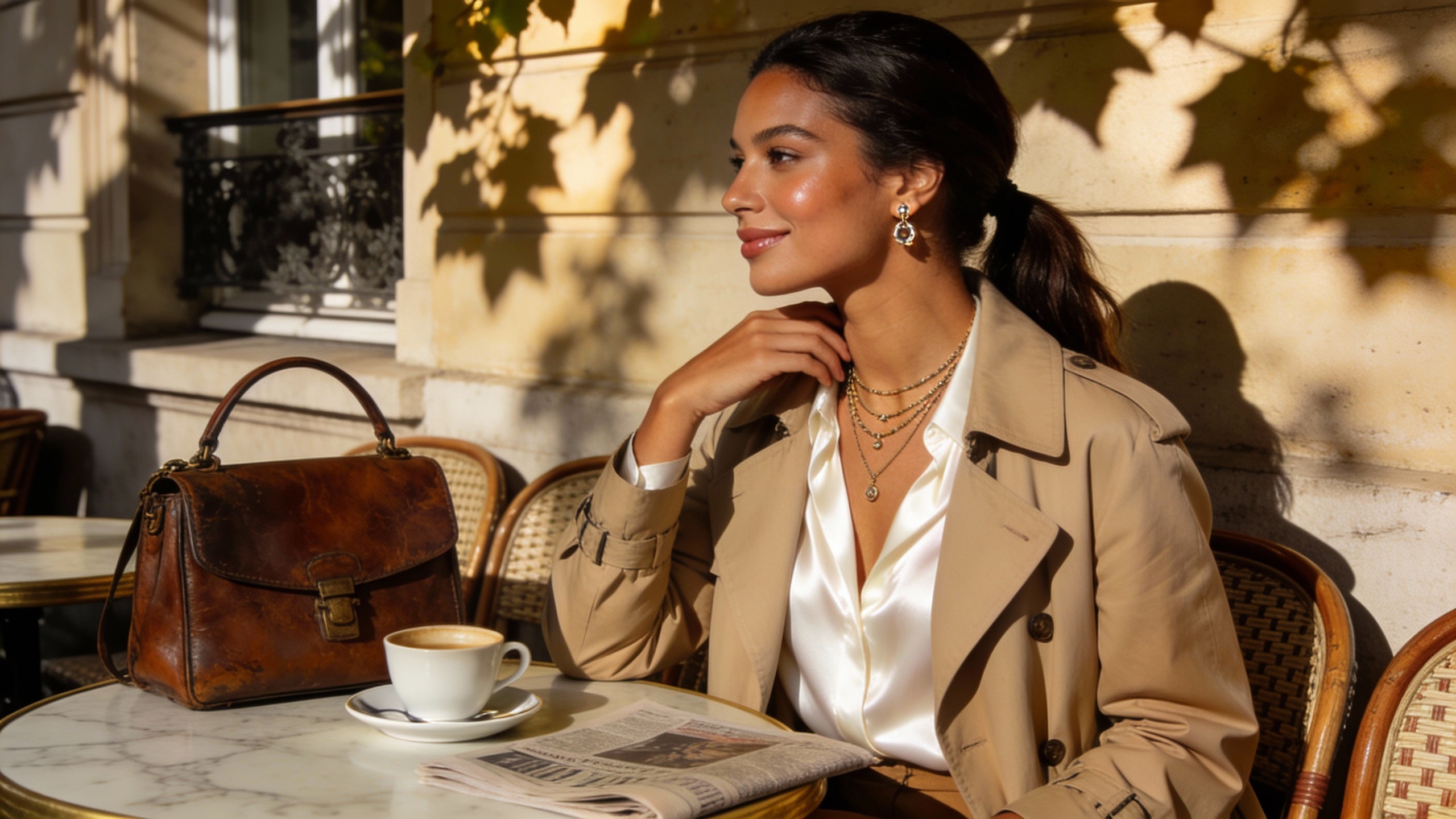
What Hidden Jewelry Tricks Work Best Under a Blazer?
Summary: The most effective jewelry under a blazer is subtle, strategic, and slightly secret—think tiny “base layer” pieces, precise necklace lengths, discreet bracelets, and powerful rings that flash only when you move.
Build a Quiet “Base Layer” You Rarely Take Off
The most polished blazer looks rarely start with a statement piece; they start with a quiet foundation.
Zoë Kravitz told Vogue she wears the same tiny studs and pinky ring almost every day. That kind of jewelry “uniform” works beautifully under a blazer: it’s refined, personal, and never fights your tailoring.
From business-focused guides like BusinessWomen and Rubans to power-suit editors at Sumissura, the through line is clear: keep the office “rule of three” in mind—no more than three pieces at once, and let one lead.
Choose:
- One pair of small studs or huggies you can sleep in.
- One slim ring or pinky ring with meaning.
- One fine chain that can sit under a collar or peek between lapels.
These pieces are your private armor; your blazer simply frames them.

Necklines, Lapels and the Invisible Necklace Game
Under a blazer, your neckline is architecture—and your necklace should respect the lines.
Caratly recommends layering fine chains when a blazer is worn open or with a deep V. The trick is proportion: one chain that hits just above the lapel break, and a second a couple of inches lower. They read as intentional when you move, not cluttered when you’re still.
With crew necks and turtlenecks, Northeastern Fine Jewelry suggests letting the knit be your “canvas” and placing a chain or pendant on top. A slightly chunky gold or silver chain over a black turtleneck, then a blazer over that, gives an elegant column of metal right where the lapels open.
Metal color matters, especially with neutrals:
- With a gray blazer, Grandiani shows how warm gold wakes up the cool tone for evening, while silver keeps the look sleek and monochrome for interviews.
- With beige or camel, gold feels rich and classic; silver leans modern and understated.
The hidden trick: match necklace length to the shape of your lapel. Aim for the pendant or shortest chain to sit in the “V” the blazer creates, so it flashes precisely where the eye is already drawn.

Sleeves, Cuffs and Secret Bracelet Strategies
Long sleeves and structured jackets can swallow bracelets if you’re not deliberate. The goal is not “stacked and jangling”—it’s “one glint of intention.”
Caratly’s stylists pair rolled-up blazer sleeves with ultra-slim diamond bracelets, turning the wrist into a subtle focal point when you gesture. BusinessWomen and Rubans both warn against noisy stacks at work; they pull focus in meetings.
Borrow a few pro tricks:
- Let a single tennis bracelet or fine chain bracelet disappear under the cuff, with just a fraction showing when you reach for a glass or keyboard.
- Push up one sleeve slightly higher than the other so a bracelet or watch is clearly visible on only one wrist; keep the opposite wrist bare.
- If your sleeves are tailored and slim, wear one bracelet over the cuff (never mid-forearm). It should sit just at the wrist bone, like a deliberate “finish” to the sleeve.
Tennis bracelets against a soft knit under a blazer, as Northeastern Fine Jewelry notes, give a delicious contrast: cozy texture, sharp tailoring, and a disciplined line of sparkle.

Rings, Brooches and Other Power Micro‑Details
When your blazer is buttoned and your neckline is minimal, your hands and lapel do the storytelling.
Brittany’s Fine Jewelry points out that rings come into their own when necklines or collars are tricky. Under a blazer, one modern statement ring or a slim stack of bands can carry the entire jewelry narrative. Caratly specifically calls out how rings catch the eye during toasts, handshakes, and when holding a clutch.
Brooches are another underused secret. Both Brittany’s and Sumissura frame them as contemporary, not fussy, when used sparingly. Pin a sleek metal, pearl, or geometric brooch low on the lapel or near the waist, not high on the shoulder—this keeps the shoulder line sharp while adding a single point of interest when the blazer moves.
Rubans suggests coordinating metals: if your watch and rings are gold, choose a gold-tone brooch; if your everyday pieces are silver, keep the brooch in that family so the whole look feels curated, not cobbled together.

Mixing Metals, Managing Color and a Quick Edit
Artizan Joyeria makes a compelling case for mixed metals—gold and silver chains, dual-tone bangles, and sculptural two-tone pieces feel very 2025 when the mix is intentional. They suggest anchoring everything around one central piece, then echoing both metals lightly elsewhere.
Rubans, working from a stricter corporate lens, prefers sticking to a single metal for formal suits. Note: these views aren’t opposites; they simply speak to different dress codes. Conservative office? One metal. Creative field or evening event? Mixed metals can look exquisitely modern.
Before you button up and head out, a 30‑second checklist helps:
- One clear focal point only (ring, earring, or brooch—never all three).
- No more than three pieces visible at a glance.
- Bracelets quiet enough not to jingle when you type or present.
- Necklace sitting cleanly within the lapel line, not fighting it.
- Metals either harmonized or deliberately mixed, never accidental.
Under a blazer, jewelry works hardest when it whispers. The most sophisticated looks aren’t the ones shouting over your tailoring—they’re the ones that reward a second glance.

References
- https://fashionhistory.fitnyc.edu/1820-1829/
- https://magazine.immaculata.edu/summer-2024/fashion-trends-through-the-years-at-immaculata/
- https://openlab.citytech.cuny.edu/brivera1-eportfolio/files/2025/05/FashionShowCritic_BUF2203_BethelieRivera.pdf
- https://blogs.oregonstate.edu/nexus/2025/01/22/the-predicted-fashion-trends-of-2025/
- https://blogs.shu.edu/stillmanexchange/2023/05/09/k-pop-group-newjeans-is-the-new-face-of-luxury/