How To Balance Boldness and Elegance With Suit Shorts and Jewelry
There is a particular kind of hush that falls over a summer terrace when someone arrives in a perfectly cut short suit. The blazer catches the light, the shorts stride instead of skimming, and then you notice the jewelry: a single luminous earring, a slim watch, a ring that gleams when fingers brush a glass. It is a look that is both audacious and undeniably refined.
That tension between boldness and elegance is the heart of modern dressing. Suit shorts challenge traditional tailoring in the same way a sculptural earring challenges the idea that jewelry must always be discreet. Styled carelessly, the combination can feel costume-like or juvenile. Styled well, it becomes one of the most sophisticated warm‑weather looks you can own.
Drawing on contemporary tailoring guides from houses like President Tailors and Hockerty, short-suit styling inspiration from GQ, Marie Claire, Who What Wear, and personal-style writers such as An Indigo Day and Distinctly Southern Style, alongside jewelry and color guidance from Lackore Couture, Marion Cage, Sweet Salt Clothing, and Sumissura, let us build an approach that is artistic, practical, and deeply wearable. We will also keep one eye on sustainability, informed by research from Yale’s Moving the Needle initiative, Aalto University, and the University of San Francisco, because true elegance today takes responsibility seriously.
The Short Suit: Bold By Design, Elegant In Execution
Before you can balance anything, you must understand its weight. A short suit, often called a Bermuda shorts suit, is simply a tailored blazer worn with matching or coordinating shorts instead of trousers. President Tailors traces the look back to tropical business dress in Bermuda and parts of the Caribbean, where knee‑length tailored shorts with jackets and long socks were once considered proper office attire. Hockerty makes the same point: this is not a novelty item, but an evolution of suiting born from hot climates and practicality.
Contemporary designers have pushed the idea into fashion-forward territory. President Tailors highlights the way modern labels, from Thom Browne to Dior and Prada, have cut the proportions slimmer and sharper. GQ underscores the stakes: done badly, a short suit can evoke a school uniform or a rock guitarist’s stage costume rather than a serious outfit. Done well, with clean tailoring and sophisticated accessories, it becomes an expression of “effortless sophistication.”
Fit is the first pillar of elegance. President Tailors and Hockerty both emphasize a slim, well‑tailored blazer with defined shoulders and sleeves ending just above the wrist, and shorts that sit just above the knee. Too long, and the look slouches into weekend cargo territory. Too short, and it loses the gravitas that makes a blazer-and-shorts combination feel like clothing rather than beachwear. Hockerty advises treating suit shorts like warm-weather dress trousers: flat or lightly pleated fronts, clean lines, and a trim but comfortable fit through the thigh.
Fabric and color quietly determine how bold the suit feels before you add a single ring. President Tailors suggests breathable fabrics such as linen, cotton blends, and tropical wool; Hockerty adds seersucker for texture and ventilation. Both recommend light neutrals and pastels—beige, sky blue, soft gray—for daytime and more saturated shades like navy or charcoal for evening or formal moments. Distinctly Southern Style shows how a neutral J.Crew blazer with everyday shorts and espadrilles can read casual-dressy in Florida heat, while Marie Claire highlights longer Bermuda shorts styled monochromatically for polished city looks. The common thread is structure on top, ease on the bottom.
Picture a navy cotton short suit: the blazer skims the hip, the shorts hit just above the knee, the fabric has enough weight to keep its line even in an evening breeze. Slip into minimalist loafers or sleek leather sneakers, as President Tailors and Hockerty both suggest, and already you have a foundation that can handle a bold cuff or a luminous pendant without losing its composure.

Where Suit Shorts Shine – And Where They Do Not
Boldness is not only about design; it is about context. The same short suit that feels perfect at a rooftop cocktail party can feel strangely unfinished in a traditional boardroom.
President Tailors calls the short suit ideal for summer weddings, garden parties, rooftop events, and coastal gatherings, precisely because it balances formal and casual elements: a structured, almost classic upper half with a relaxed lower half. Marie Claire echoes this with Bermuda-short outfit formulas for beach days, business casual, and going‑out evenings, and Who What Wear positions tailored shorts as a polished alternative to denim within the “clean girl” aesthetic. Distinctly Southern Style and An Indigo Day both style short suits as casual-dressy heroes for hot climates, often worn with tees or tanks and easy sandals, then elevated with smarter shoes at night.
In creative or relaxed offices, a blazer-and-tailored-shorts combination can make sense if you are attentive to polish. Who What Wear recommends pairing tailored shorts with a T‑shirt and blazer for casual business meetings, while Marie Claire shows a matching vest and Bermuda shorts styled with pumps and a laptop bag for offices with flexible dress codes. In those environments, jewelry becomes a powerful regulator of formality: swap fashion sneakers for loafers and add a classic watch and subtle earrings, and suddenly the outfit feels meeting-ready without the weight of a full suit.
The cons emerge when the dress code is rigid. Traditional corporate environments, conservative law offices, and certain formal ceremonies still expect full-length trousers or skirts. Christopher Allen Clothiers points to tuxedos and classic suits as the expected base for formal events, accessorized with bow ties, cufflinks, and shirt studs. In those rooms, shorts of any kind, no matter how impeccably tailored, will read as underdressed or provocatively nonconforming. At black-tie weddings or solemn occasions, leave the short suit at home and channel your daring through jewelry instead—a sculptural earring, a modern cuff, a striking ring pattern.
As an example, imagine a summer garden wedding with a semi-formal dress code. A guest arrives in a pale gray linen short suit, crisp white shirt, and light brown loafers. The shorts fall at mid‑thigh, not much longer than casual chino shorts. There is no sock in sight, and the jewelry is minimal. The outfit feels more like a weekend brunch than a ceremony. Adjust the hem to just above the knee, add a tonal belt, swap the shirt for one with a slightly stiffer collar, and introduce a mother-of-pearl dress watch and a muted gemstone ring. Without changing the fundamental idea of the look, you move it decisively into elegant territory.

Jewelry’s Job: Dialing Boldness Up or Down
If the short suit is the canvas, jewelry is where you choose your brushstrokes. Suit-accessory guides from Black Lapel, Trendhim, Wessi, Nick’s Menswear, and Hollomen all repeat one key lesson: restraint is more powerful than abundance. Black Lapel explicitly recommends wearing only a small number of accessories at once to avoid overpowering a well-fitted suit; Lackore Couture gives similar advice for jewelry across settings, urging you to focus on one or two key pieces that frame the face or enhance the outfit rather than competing for attention.
The short suit is visually assertive on its own. The bare leg, the disrupted line of tailoring, the lighter, summery fabrics—all of that is already bold. That means your jewelry should decide whether to lean into that boldness or to counterbalance it with simplicity. Lackore Couture suggests choosing jewelry according to the dominant color of your outfit and the occasion: bold necklaces or sophisticated earrings for formal events, delicate pieces for casual gatherings, understated jewelry in professional environments. Marion Cage makes a similar point about appropriateness: small hoops, studs, and delicate pendants in offices; long dangles and stacked rings when you step out for dinner or drinks.
Scale is your friend. With shorts, Sweet Salt Clothing notes that dangling earrings and a short, neutral-metal necklace can dress up non-denim shorts without pushing the outfit into full-evening territory. On a short suit, that translates beautifully. Think of a cream linen suit with knee-length shorts, a silky tank, and stacked bangles in warm gold at the wrist. The shorts speak of modernity, the gold signals intention, and the overall effect is softly dramatic instead of busy.
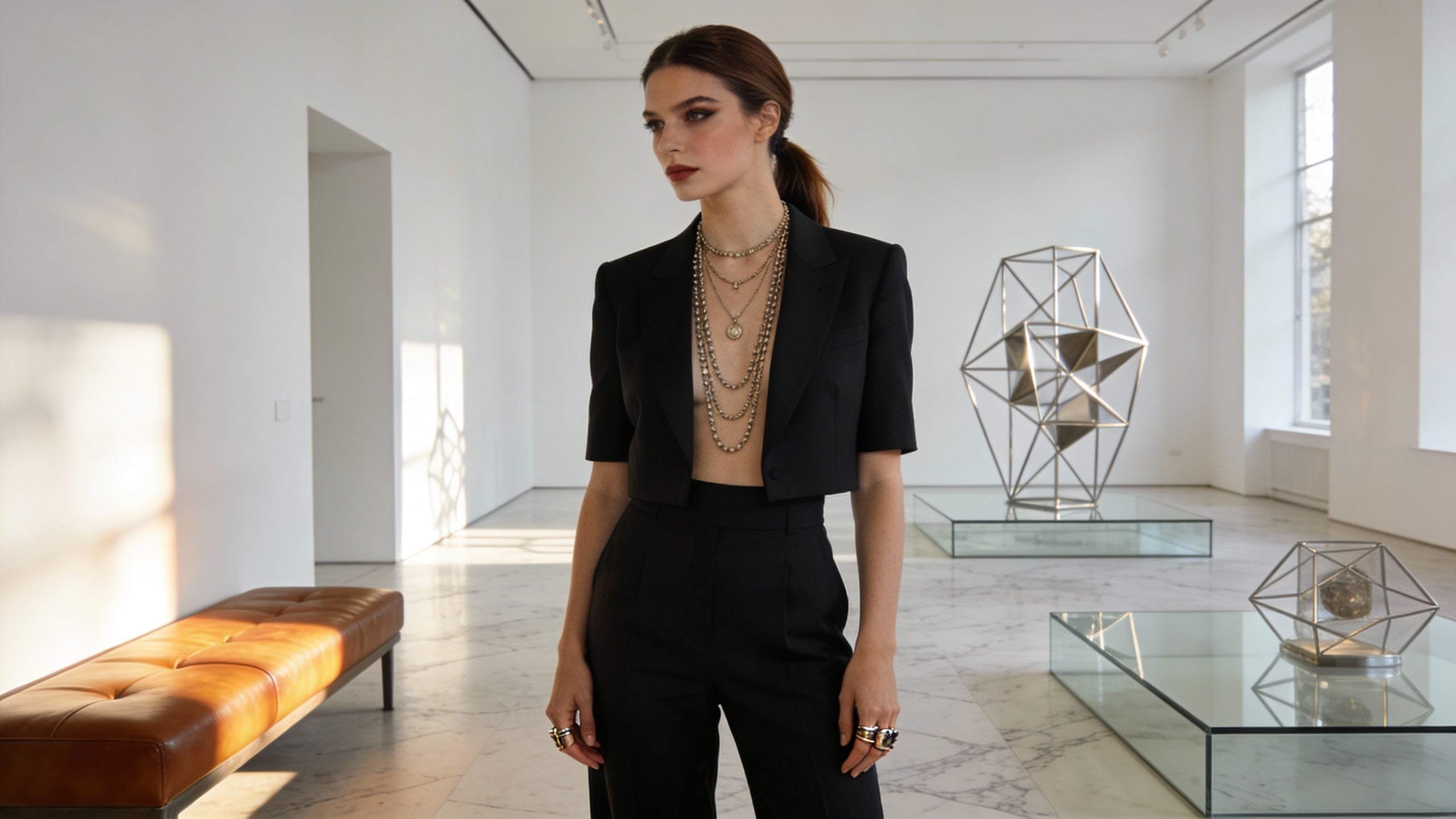
At the dressiest end of the spectrum, Sumissura’s approach to women’s suits is illuminating. They highlight statement necklaces and elegant earrings as primary jewelry in formal or business settings, along with sophisticated bracelets and classic watches. The key idea is that one piece leads and the others support. If your short suit is in a deep navy with sharp pleats, you might choose a single strand of luminous pearls or a sculptural collar necklace to sit against the neckline, and then keep earrings to simple studs. If instead your jacket is vivid fuchsia linen, let that be the headline and keep jewelry to fine hoops and a thin bracelet.
Consider a city rooftop party at golden hour. You are wearing a black double-breasted short suit, influenced by the tuxedo shorts that Pharrell Williams once wore on the red carpet. The shorts fall mid‑thigh, the jacket is sharply tailored, and you choose pointed slingback heels, echoing Marie Claire’s monochromatic styling advice. Here, the boldness is already cranked high. The elegant choice is a single focal jewelry element: perhaps a pair of long, linear earrings that catch the light each time you turn your head, paired with a slender silver watch. Add a heavy necklace and extra rings, and the look tilts toward costume; keep the rest quiet, and the earrings sing.

Five Real-World Outfit Balances: Suit Shorts and Jewelry
Sometimes the most useful guidance is concrete. The following combinations draw directly from the styling patterns in President Tailors, Hockerty, An Indigo Day, Distinctly Southern Style, Marie Claire, Who What Wear, Lackore Couture, Marion Cage, Sweet Salt Clothing, and Sumissura. Each balances a bold element with an elegant counterweight.
Occasion / Mood |
Suit Shorts & Clothing |
Jewelry Strategy |
Why It Works |
Summer wedding, garden setting |
Beige linen short suit, white shirt, leather loafers |
Pearl or diamond studs, slim dress watch, subtle ring |
Neutral suit keeps shorts refined; classic jewelry feels formal without heaviness. |
Creative office, presentation day |
Navy cotton short suit, tucked silk tee, low block heels |
Small hoops, delicate pendant above neckline, simple bracelet |
Boldness in shorts; jewelry stays professional and face-framing. |
Rooftop cocktails at sunset |
Black tailored short suit, strappy heels or sleek sneakers |
Long statement earrings, minimalist watch |
All drama at ear level; rest of look reads sharp and intentional. |
Beach-town dinner on vacation |
Pale-blue blazer, white tailored shorts, woven sandals |
Layered thin necklaces, stack of slim bangles |
Relaxed suiting plus playful but lightweight jewelry suits the informal setting. |
City weekend brunch |
Oversized blazer, tailored Bermuda shorts, crisp tank, flats |
One chunky bracelet or ring, tiny studs |
Clean lines and a single bold accessory feel modern and unfussy. |
Imagine stepping into that creative office scenario. You choose a navy short suit, guided by Hockerty’s advice that solid neutrals are best for beginners. You add a silk tee, as An Indigo Day suggests for dressing a short suit up, and low block heels. For jewelry, you take Sumissura’s counsel and keep your pieces coordinated but understated: small gold hoops, a short pendant that hits well above the neckline, and a single delicate bracelet. The result is thoughtful, polished, and modern. The boldness lies in wearing shorts to a meeting at all; the elegance lies in how little you need to add to make it look intentional.
Color, Skin, and Metal: A Science-Backed Approach to Elegant Boldness
Color is where jewelry can either harmonize beautifully with a short suit or leave it feeling chaotic. Lackore Couture and Marion Cage both root their advice in classic color theory: start with the dominant color of your outfit, then decide whether you want complementary contrast or a gentler, analogous harmony. Sweet Salt Clothing frames the color wheel in exactly these terms, describing complementary opposites as high-contrast and attention-grabbing, and analogous neighbors as softer and more cohesive.
Research into clothing aesthetics, published in an academic paper on color choices for fair and tanned skin tones, goes a step deeper. The authors point out that people across many contexts tend to favor blue and blue‑green hues, with reds also popular and yellows often less so overall. They also question the rigid seasonal or “warm vs cool” personal-color systems that are popular in styling, noting that guidelines for detecting undertones are often subjective and inconsistently applied. Their work suggests that overall lightness and saturation may matter as much, or more, than chasing a perfectly “warm” or “cool” hue.
Taken together with the practical color matching suggestions from Lackore Couture, a few principles emerge. If your short suit is in a cooler shade—navy, charcoal, ice gray—cool-toned jewelry such as silver, white gold, or platinum feels naturally elegant, especially with stones in blues, greens, and violets. Lackore Couture specifically points out that blue stones like tanzanite and blue topaz sit beautifully with navy and even with yellow clothing, while amethyst and citrine can add striking contrast against cool-toned outfits. With warm-colored suits—terracotta, camel, warm beige—yellow gold or rose gold can make your skin look luminous, and warm stones like citrine feel at home.
Skin tone and tanning complicate the picture, especially in summer when short suits are most appealing. The color-aesthetics research explains that variations in (particularly lighter) skin color are driven by melanin, hemoglobin, and carotenoids, which change how light or dark, and how red or yellow, the skin appears. Rather than relying on rigid undertone labels, notice how your skin looks next to your suit fabric. If a navy short suit makes your legs appear golden and radiant, you can amplify that with yellow-gold jewelry. If a pastel suit leaves you looking washed out, choose jewelry with a bit more saturation—perhaps emerald earrings or a rich garnet ring—to put color back into your overall look.
Marion Cage recommends ensuring that necklace lengths sit clearly above or below the neckline, never awkwardly grazing it. On short suits, where necklines are often V‑shaped or crew‑neck tees, this matters. A deep V-neck under a blazer calls for a pendant that finishes above the point of the V; a crew-neck tee pairs best with a pendant that drops at least a couple of inches below the collar, as both Marion Cage and Lackore Couture emphasize. With tailored shorts, Sweet Salt Clothing suggests opting for shorter necklaces when you are dressing shorts up; longer layers skew more casual and bohemian.
As a concrete example, think of a pale lavender linen short suit worn at dusk. Your skin is lightly sun-kissed from a weekend outdoors. Lavender, a cool color, risks dulling that warmth. Slip on slim yellow-gold hoops and a short necklace with a warm citrine or honey-colored stone near the collarbone. The gold echoes the warmth in your skin, the stone adds a subtle complementary contrast to the lavender, and the whole look feels intentional rather than accidental.

Sustainable Boldness: Choosing Pieces With a Future
Boldness is exhilarating, but there is a quieter question worth asking: will you still want to wear this short suit–and‑jewelry combination in three summers? And what does it mean for the planet if the answer is no?
Yale’s Moving the Needle initiative on sustainable fashion reminds us that this industry is more than just visual pleasure. Fashion is a global business worth roughly $2.5 trillion, employing over 75 million people, and it generates about 92 million tons of waste each year while contributing an estimated 4–8% of global greenhouse gas emissions. Aalto University’s research on sustainable fashion goes further, noting that the textile and fashion sector is one of the oldest and largest industrial systems in the world and uses more water than any industry except agriculture. They calculate that the global textile and fashion production volume exceeds 30 million tons annually and that efficient mass manufacturing has led to overconsumption and large streams of post-consumer waste.
In the United States alone, Aalto’s work reports that the average person discards roughly 70 lb of textiles and clothing per year, about 85% of which ends up in landfills. Finnish consumers discard close to 40 lb annually, with about three quarters going to landfill. The University of San Francisco’s exploration of sustainable and ethical fashion highlights how tragedies like the Rana Plaza factory collapse sharpened public awareness of supply chains, and it cites a Nielsen report showing that around 72% of millennials and over half of Baby Boomers are willing to pay more for products from companies with a positive social and environmental impact.
What does this mean when you are standing in front of a mirror debating whether to buy a vivid short suit and another set of earrings to go with it? It suggests that boldness should be measured not just in how daring a piece looks, but in whether you are willing to commit to it over time. Designers and researchers such as Kirsi Niinimäki at Aalto University talk about sustainable fashion as a shift toward quality, longevity, and new business models, emphasizing that unsold garments can account for 5–10% of fashion production and that overproduction is a serious issue.
From a practical perspective, adopt a cost-per-wear mindset, both financially and emotionally. Suppose you invest in a beautifully cut navy short suit for $300.00 and a pair of excellent gold-plated hoops for $80.00. If you wear the suit once a week from late May through early September, that could easily be 15 wears in a single season; repeat that over three summers, and you are at 45 wears, bringing the cost to about $6.67 per wear. If those hoops become your default for workdays and evenings, and you reach for them 60 times a year over three years, they cost a little over $0.40 each time you put them on. Compare that to buying three cheaper, trend-driven short suits and four sets of novelty earrings that only feel right for a handful of outings each before they look dated or fall apart.
Sustainable brands highlighted by the University of San Francisco, such as Indigenous and Reformation, demonstrate that it is possible to create stylish, well-cut garments with organic or reclaimed materials, but they also illustrate the price challenge: tees around $70.00, wrap dresses over 100.00 range. Many consumers respond by buying fewer, higher-quality items when they can. Short suits and jewelry should follow the same logic. Choose fabrics, metals, and designs you will be delighted to repeat with different tops, shoes, and bags. Let your jewelry be the element that refreshes your short suit from one season to the next, rather than buying a new set of clothes for every event.
A Framework For Balancing Boldness and Elegance
By now, the principles are clear, but decisions still have to be made in real time: in the dressing room, before a wedding, in front of hotel-room mirrors. Think of your outfit as a conversation between three voices: the suit, the jewelry, and the context.
Begin by naming your boldest element. It might be the cut of the shorts, the saturation of the blazer, or a single dramatic piece of jewelry. If your suit is vivid and your shorts are abbreviated, as in some of the looks GQ highlights on red carpets, let your jewelry whisper: cool studs, a slim watch, perhaps a narrow ring. If your suit is in a soft neutral and the shorts are knee-length, you have room to be more adventurous with jewelry, as Sumissura and Lackore Couture both encourage. Perhaps a statement necklace over a simple tank, or layered fine chains and a standout cuff.
Next, match formality. Christopher Allen Clothiers, Black Lapel, and HolloMen all emphasize that accessories must suit the occasion as much as the garments do. For black-tie, tux-like styling, they recommend bow ties, shirt studs, and elegant cufflinks, and caution against visible belts or casual watches. Translate that thinking to short suits by considering the jewelry materials. For semi-formal dress codes, prioritize pieces in precious metals or their close cousins: gold and silver-toned items, pearls, and faceted gemstones. Save leather chords, oversized beads, and novelty motifs for vacations and relaxed evenings.
Finally, check balance in the mirror. Marion Cage’s neckline guidance is invaluable: pendants should sit clearly above or below the neckline. Lackore Couture warns against over-accessorizing; to avoid it, consciously remove one piece and see if the outfit improves. Black Lapel’s notion that a jacket looks “naked” without at least a simple pocket square can also be applied to jewelry: if your short suit and shoes are impeccable but there is no metal or mineral in sight, the outfit can feel unfinished. A single ring, bracelet, or earring might be all that is needed.
Imagine standing at your door before a summer date night. You are wearing cream tailored shorts, a matching blazer over a black tank, and strappy sandals. On your dresser lies a small pile of jewelry: large hoops, a chunky necklace, a cuff bracelet, and a handful of rings. You try on the necklace and the cuff together; the look suddenly feels heavy, almost theatrical. You remove the necklace, leaving the cuff and a pair of medium hoops. Instantly, the outfit breathes. That small subtraction is the difference between trying hard and looking as if the ensemble simply came together.
FAQ: Suit Shorts, Jewelry, and Your Most Common Questions
Can I wear a short suit and bold jewelry to a wedding?
Yes, if the dress code is semi-formal or creative and the couple is stylistically adventurous. President Tailors specifically positions the short suit as appropriate for summer weddings and garden parties, provided the tailoring is sharp and the fabrics are refined. For jewelry, think in terms of one statement and several supporting players. A pearl or diamond stud with a sophisticated bracelet can be perfect with a neutral short suit; if you choose chandelier earrings or a bold necklace, keep the rest very simple. For black-tie weddings, follow Christopher Allen Clothiers’ lead and choose a traditional tuxedo or long suit, saving the short suit and louder jewelry for the rehearsal dinner or after-party.
What if I am self-conscious about my legs but love the short-suit trend?
In that case, lean into Bermuda lengths and jewelry that draws the eye upward. Marie Claire champions knee-length Bermuda shorts as a polished, comfortable alternative to tiny shorts, and Who What Wear suggests pairing tailored shorts with relaxed tailoring on top for a balanced silhouette. Choose shorts that end just above the knee, as President Tailors and Hockerty recommend, and then emphasize your face and hands: notable earrings, a special ring, or a beautiful watch. This lets you participate in the trend without feeling overly exposed, and the jewelry becomes the focal point instead of your hemlines.
Is it stylish to mix metals with a short suit?
Absolutely, as long as there is some logic to the mix. Lackore Couture encourages coordinating metals with both skin undertone and outfit tone but does not forbid mixing, and Sumissura suggests blending gold and silver bracelets around a unifying stone or design. With short suits, this can be a wonderful way to keep things modern. For instance, you might wear a silver watch with a gold ring and earrings if all pieces share a minimalist aesthetic. What matters is cohesion in style and scale, not rigid metal-matching. Let your blazer buttons and belt buckle guide you; if they are gold-toned, include at least one gold element in your jewelry to make the mix look deliberate.
Closing Thoughts
Suit shorts and jewelry are, at their best, a dialogue between courage and grace. Contemporary tailoring authorities remind us that the short suit is no longer a novelty; it is a considered answer to heat, movement, and modern dress codes. Jewelers and stylists, from Lackore Couture to Marion Cage and beyond, show how a single exquisite piece can shift an outfit from casual to compelling.
When you dress, think like a curator, not a collector. Let one thing speak loudly—a perfect hemline, a gleam of metal at your wrist, a stone that remembers the sea—and allow the rest to support its voice. Boldness becomes elegance not by being diminished, but by being framed with care.
References
- https://www.academia.edu/68551167/Sustainable_Fashion_New_Approaches
- https://revista.drclas.harvard.edu/fashionably-ethical-indigeneity-ethical-and-sustainable-fashion-in-peru/
- https://digitalcommons.macalester.edu/cgi/viewcontent.cgi?article=1002&context=idim_honors
- https://news.mit.edu/2024/4d-knit-dress-future-of-fashion-0307
- https://cbey.yale.edu/programs/moving-the-needle-an-exploration-of-sustainable-fashion
- https://pmc.ncbi.nlm.nih.gov/articles/PMC8597069/
- https://www.pwcva.gov/assets/2021-04/005202.pdf
- https://openscholar.uga.edu/record/18278/files/lawless_erin_201512_ms.pdf
- https://ecommons.cornell.edu/bitstream/1813/10748/1/Dombek-Keith%20MA%20Thesis.pdf
- https://static.csbsju.edu/documents/environmental%20studies/curriculum/395/2009/hammerschmidt_2009.pdf