Lab Diamond Tennis Bracelets for Anniversaries: Classic Celebration
Few gifts encapsulate an anniversary’s promise quite like a diamond tennis bracelet. A seamless line of fire circling the wrist, it is both unfailingly classic and disarmingly modern—especially when set with lab-grown diamonds that deliver identical sparkle with a contemporary conscience. This guide brings together first-hand insights from the bench with reputable knowledge from gemological authorities to help you choose, wear, and care for a lab diamond tennis bracelet that marks a milestone with enduring grace.
What “Tennis Bracelet” Really Means
A tennis bracelet is a flexible line bracelet set with matched diamonds or gemstones in a continuous, symmetrical row, engineered to move with the wrist while maintaining visual rhythm. The term gained cultural currency in 1987 when tennis champion Chris Evert paused a U.S. Open match to retrieve her bracelet after the clasp came undone, a moment that turned the once “line” or “eternity” bracelet into a household name. The design’s appeal lies in its quiet equilibrium: low-profile links, consistent stone size, and a clasp that locks without interrupting the line. Sources such as With Clarity and The Diamond Store USA describe prong, channel, and bezel settings as the most common constructions, each balancing scintillation, protection, and style.
Lab-Grown Diamonds, Explained
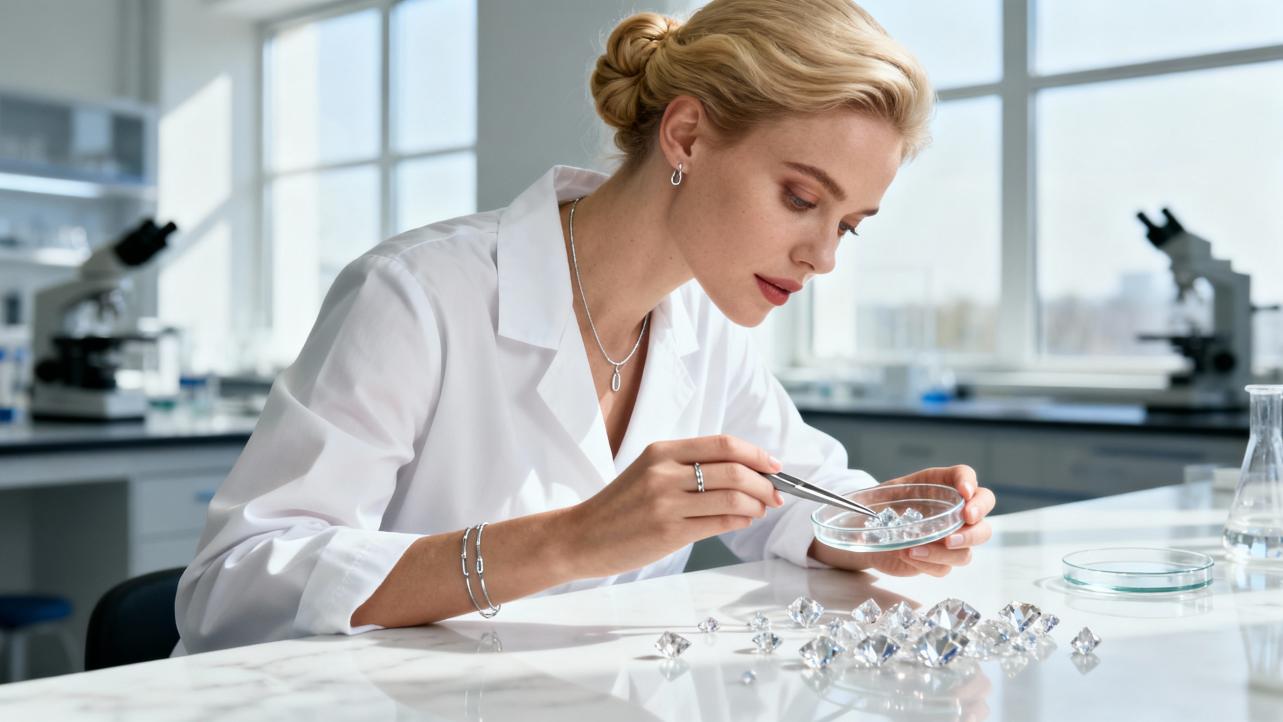
Lab-grown diamonds are crystallized carbon with the same chemical formula, crystal structure, optical behavior, and hardness as mined diamonds. Methods include HPHT, which replicates the Earth’s pressure and temperature, and CVD, which deposits carbon atom by atom in a vacuum. These processes produce stones that grade on the same 4Cs scale used by GIA—cut, color, clarity, and carat weight—and can be laser-inscribed and reported by GIA or IGI. GIA emphasizes that cut governs brightness, fire, and scintillation; color is measured on a D–Z scale; clarity is assessed at 10×; and carat is a weight, not size.
From workshop experience and industry notes, there are subtle method-linked tendencies that may appear: CVD growth can show brownish undertones that are often post-treated, while HPHT stones can contain minute metallic inclusions; these traits are not defects per se but rather growth fingerprints that grading reports will describe. Such nuances are common knowledge among gemologists yet still on a stone-by-stone basis.

Why a Lab Diamond Tennis Bracelet Feels Right for Anniversaries
Anniversaries call for pieces that carry forward—timeless in silhouette, personal in meaning, and reliable in daily life. Lab diamonds satisfy these criteria while adding a modern value layer. They typically offer comparable beauty for less outlay, allowing you to prioritize craftsmanship, increase total carat weight, or choose higher cut quality for visible brilliance. Multiple market sources indicate that lab-grown options are significantly less expensive than mined counterparts, often in the 20–40% range; some retailers claim closer to 30% of the mined price. Because retailer positioning and wholesale inputs vary, exact percentages tend to fluctuate and still need to be verified for a given vendor and quality tier.
There is also the ethical dimension. Lab-grown production is traceable and consistent, and while environmental claims deserve careful scrutiny, many manufacturers emphasize lowered land disturbance and regulated labor conditions. The net sustainability picture can be promising but is complex; any specific footprint comparisons may depend on energy sources and production practices and thus still needs to be verified via third-party audits.

Anatomy and Craft: Settings, Metals, Clasps, and Fit
The setting establishes both the look and the long-term security of a tennis bracelet. Prong-set designs maximize light entry and give the classic “floating” sparkle; channel-set links protect girdles and edge surfaces while retaining sleek lines; bezel-set cups surround each stone for maximal protection and a modern, graphic rhythm. White gold, yellow gold, rose gold, and platinum are standard metals; 14k white gold balances durability and luster for everyday wear, while platinum adds heft and exceptional resistance to wear. The clasp is more than a closure—it is insurance. Box clasps with a figure-eight safety or double-safety configuration are the most reassuring for daily wear; lobster clasps are simple and sturdy, often favored in sportier interpretations.
Fit should be secure yet fluid. The familiar “one finger under the bracelet” test is reliable: your index finger should slide between bracelet and wrist without forcing. Most women’s lengths land around 7 to 7.5 in, and your jeweler can add or remove links to tune balance and drape. Wearing on the non-dominant wrist reduces knocks; pairing with a watch works beautifully when metals harmonize and the bracelet sits just above the watch to avoid mutual abrasion.
Buying Guide: The Milestone-Worthy Choice
Approach the bracelet as both an engineering object and an heirloom-level adornment. Start with the eye, then confirm with paperwork and policy.
Begin by deciding on the bracelet’s character. A lower-profile prong line bracelet glows discreetly in daylight and dazzles under evening lights, whereas a channel-set style leans modern and robust for daily wear. If you plan to stack bracelets, favor consistent stone size across pieces for symmetry or mix metal tones intentionally for contrast.
Next, set quality priorities. On the wrist, consistent white balance and even sparkle matter more than extreme clarity. A near-colorless range with excellent cut choices produces a crisp, icy line without overpaying for invisible grades. Because tennis bracelets use dozens of stones, ask the seller how they match for color and clarity and whether the total carat weight is balanced by precision cutting; this consistency is the real elegance multiplier.
Then, ask for documentation and policies. Reputable sellers provide grading reports from recognized laboratories for principal stones or at minimum a detailed invoice describing total carat weight, color/clarity ranges, and metal. A fair return window and a workmanship warranty show confidence. An in-house maintenance plan—complimentary inspections, sizing, and clasp tightening—signals long-term support.
A concise way to cross-check your decision is to look at three dimensions at once—what you see, what you get, and how it lasts.
|
Decision Factor |
What to Look For |
Why It Matters |
|
Cut and Stone Matching |
Bright, even scintillation; tight symmetry across links |
Visual unity on the wrist depends on both cut precision and uniformity |
|
Setting Engineering |
Smooth seats, secure prongs, clean solder joints, protective channel or bezel where needed |
Comfort, snag resistance, and stone security over time |
|
Clasp & Safety |
Box clasp with double safety or secure lobster; firm “click” |
Prevents loss during everyday movement |
|
Documentation |
Lab reports for key stones; detailed quality description |
Verifies grades; supports insurance/appraisal |
|
Aftercare |
Routine checks offered; resizing and repair capacity |
Extends lifespan and preserves value |
Retail context helps, too. With Clarity lists diamond line bracelets in the 3,250.00 range depending on total carat and metal, illustrating how cut, carat, and workmanship steer price. Price ladders also reflect GIA’s “magic sizes” phenomenon: stones just above thresholds command premiums, so in line bracelets, choosing slightly under magic points can optimize value without sacrificing look.
Pros and Cons of Lab Diamond Tennis Bracelets
Lab diamond tennis bracelets offer a compelling matrix of beauty, value, and ethics with a few practical trade-offs. In daily wear, lab stones are Mohs 10—just as resistant to scratching as mined diamonds—and they clean and flash identically when well cut. Pricing advantages mean you can direct budget to stronger settings and superior clasping, often the wisest investment for longevity. On the other hand, resale markets for lab-grown diamonds remain less mature than for mined stones; while durability is the same, secondary-market pricing is likely lower and still needs to be verified across platforms. If your first priority is decades of wear rather than resale, the calculus tends to favor the joy-per-dollar of lab-grown.
A tight snapshot clarifies the differences you will actually feel on the wrist.
|
Aspect |
Lab Diamond Tennis Bracelet |
Natural Diamond Tennis Bracelet |
|
Composition |
Pure carbon diamond; HPHT or CVD origin |
Pure carbon diamond; geological origin |
|
Sparkle & Wear |
Identical optical performance when 4Cs are matched |
Identical optical performance when 4Cs are matched |
|
Price Position |
Generally significantly lower; ranges tend to vary by vendor |
Typically higher for equivalent 4Cs and craftsmanship |
|
Ethics & Traceability |
Factory-controlled sourcing; clarity of origin |
Mining frameworks vary by region and program |
|
Resale Dynamics |
Secondary-market values possibly lower; evolving |
More established second-hand market |
|
Certification |
GIA/IGI reports available; laser inscriptions common |
GIA, AGS (legacy), other major labs |
Care and Maintenance: Keep the Sparkle for a Lifetime
Diamonds are the hardest transparent material, but settings are not indestructible. As London Diamonds and Lumeniri note, jewelry longevity is about protecting both the stone and the architecture that holds it. The most effective routine blends gentle home care with periodic professional oversight.
For routine home cleaning, use the classic bowl-and-brush method endorsed by reputable jewelers like Ritani. Mix a few drops of mild dish soap in warm water, soak the bracelet for roughly 15–20 minutes, and gently guide a soft-bristle brush around the prongs, seats, and undersides where oils hide. Rinse over a plugged sink or a bowl and pat dry with a lint-free cloth. Avoid hot water shocks, harsh chemicals, toothpaste, bleach, or abrasive powders; these can etch metals or creep into joints. I prefer a baby-soft toothbrush reserved for jewelry to avoid introducing grit, and I always support the link under the brush head so the pressure works against my fingertip rather than levering on the setting.
Frequency depends on wear. For daily pieces, a quick warm-soap clean every couple of weeks and a deeper soak monthly will keep buildup at bay. Earrings and bracelets in particular collect residue on contact surfaces; that is normal, not neglect. Professional cleaning and inspection every 6–12 months is prudent; jewelers will check for micro-movement in seats, re-tip worn prongs, tighten safeties, and steam-clean the line. Ultrasonic machines can be useful if the settings are secure, but if a jeweler finds even slight looseness, they will skip ultrasonics to avoid shaking stones free. This judgment call is where expertise earns its keep.
Storage is part of care. Store the bracelet alone in a soft-lined compartment or dedicated pouch so diamonds do not abrade other pieces, and lay it flat rather than bent to relieve link stress. After wear, a quick wipe with a microfiber cloth removes perspiration films that dull brilliance. For travel, a structured jewelry roll prevents links from kinking and isolates the clasp from snagging fabrics.
Insurance is the quiet backbone of fine jewelry ownership. Home policies often exclude or limit jewelry; a dedicated jewelry policy after an appraisal can provide worldwide coverage for loss, theft, and damage. Nektá New York and Jewelers Mutual are examples of providers often mentioned by jewelers; premiums are typically a small percentage of appraised value.

My Bench Notes: First‑Hand Tips That Make a Difference
Prong checks are faster than they seem. In bright light, look for a crisp “U” profile on each prong across the line; flattened or asymmetrical tips signal wear. A gentle shake close to the ear can reveal a faint rattle; if you hear it, stop wearing the piece until a jeweler inspects the seat. When brushing, let the bristles—not your hand—do the work, and focus under each stone where the seat meets the pavilion. Clasp behavior tells truths; a box clasp should click audibly and require a deliberate press to release. Many losses happen at the gym or in the garden, not at dinners—remove the bracelet before impact-prone or chemical-heavy moments and put it on last after lotions, fragrance, and hair products. These tiny habits preserve both beauty and structure.
Price, Value, and Resale
From a wearer’s perspective, value is realized on the wrist every day. Lab diamonds shine in this calculus because they deliver the same on-skin experience at generally lower acquisition cost, letting you direct budget to craftsmanship and design. Secondary-market pricing for lab-grown pieces remains an evolving story; it is more certain that resale is less predictable than for mined stones. If you are buying for life-in-use rather than for future liquidation, this matters less; if resale is strategic, consult a jeweler who regularly trades pre-owned line bracelets to set expectations. Either way, ensure documentation, regular appraisals, and insurance so the piece’s value is recognized and protected over time.
Quick Comparison: What You Feel, See, and Live With
Use this at-a-glance grid to align your anniversary priorities with what you will actually experience.
|
Priority |
What to Emphasize |
Practical Implication |
|
Everyday elegance |
Excellent cut, even color across stones |
Brighter, cleaner line in all lighting |
|
Longevity |
Secure prong or channel setting, double-safety clasp |
Lower risk of loss; fewer repairs |
|
Value focus |
Lab-grown stones with strong make |
More carat weight or better craftsmanship for the budget |
|
Low maintenance |
Slightly lower profile setting; platinum or 14k |
Reduced snag risk; durable metal choice |
|
Stacking |
Consistent stone size; harmonious metals |
Balanced layered look without scratching |
Takeaway
An anniversary tennis bracelet should feel inevitable the moment it slips into place—balanced, luminous, and secure. Lab-grown diamonds make that feeling more attainable by channeling budget toward craftsmanship rather than scarcity premiums, while preserving the exact same performance on the wrist. Trust your eye for sparkle, your hand for fit, and your jeweler for engineering. Anchor those choices with GIA’s 4Cs language, thoughtful aftercare, and proper documentation, and the bracelet you exchange this year will be the one you still reach for on many future anniversaries.
FAQ
Are lab diamond tennis bracelets as durable as mined diamond versions?
Yes. Lab-grown and mined diamonds share the same crystal structure and hardness, rating 10 on the Mohs scale as GIA describes. Durability in daily life depends more on setting quality and clasps than on diamond origin, so prioritize sound engineering and a secure safety mechanism.
How should I size a tennis bracelet for daily wear?
Aim for a secure drape that allows one finger between bracelet and wrist without forcing. Most women’s bracelets measure 7 to 7.5 in; your jeweler can add or remove links to fine-tune. Wearing on the non-dominant wrist and just above a watch reduces wear.
How often should I clean and service it?
At home, a warm water and mild dish soap soak with a soft brush every couple of weeks keeps oils at bay for daily wear. Schedule professional cleaning and inspection every 6–12 months to tighten prongs and safeties and to steam-clean where a brush cannot reach, as retailers like Ritani recommend.
Can I use an ultrasonic cleaner on my bracelet?
Only if a jeweler verifies the settings are solid. Ultrasonic vibrations can shake loose a stone that already has micro-movement. When in doubt, skip ultrasonics and use the bowl-and-brush method or professional steam cleaning; this caution is widely echoed by Lumeniri and other fine jewelers.
What 4Cs do you recommend for a bracelet’s stones?
For bracelets, consistent cut and color harmony matter most to the eye. Choose excellent make for brightness, near-colorless stones for an icy line, and clarity that is eye-clean at bracelet viewing distance. GIA’s framework is the best language for comparing options, and your jeweler should explain how they match stones across the line.
How much less expensive are lab diamond tennis bracelets?
Market observations suggest a meaningful savings—often 20–40%—with some retailers citing around 30% of mined pricing for comparable 4Cs; these figures will vary depending on the supplier, stone selection, and metal, and verify for any specific build. The most consistent benefit is the freedom to favor stronger craftsmanship or increased total carat weight within the same budget.
Sources referenced for foundational guidance include GIA for the 4Cs and durability, With Clarity and The Diamond Store USA for history and construction details, Ritani for practical care cadence, and Lumeniri and London Diamonds for everyday handling and maintenance nuance.
References
- https://www.gia.edu/diamond-quality-factor
- https://www.academia.edu/10448144/cIBJO_Diamond_Commission_The_Diamond_Book_Table_of_Contents
- https://scholar.stjohns.edu/cgi/viewcontent.cgi?article=1481&context=theses_dissertations
- https://scholarship.law.wm.edu/cgi/viewcontent.cgi?article=1291&context=wmblr
- https://admisiones.unicah.edu/fulldisplay/naAPlg/3OK070/LabGrownDiamondGuide.pdf
- https://smart.dhgate.com/essential-care-tips-for-maintaining-the-shine-and-durability-of-your-lab-diamond-tennis-bracelet/
- https://www.angara.com/blog/how-to-clean-tennis-bracelets/?srsltid=AfmBOooErzZWQSI5n8Kl4dUezNyFP0EP32Q9eSrhEZ3zfXT3gHWRfaZH
- https://brdiamonds.com/blogs/news/ultimate-lab-grown-diamond-care-guide?srsltid=AfmBOorW2ofHhkV-UEN5BniPcC5R4rdIFHaUAdXtuHnulzbscPOOTLbQ
- https://cherivajewels.com/blogs/news/lab-grown-diamond-jewelry-cleaning-home?srsltid=AfmBOorf37DGg2zYMCuGRds1W-1OKKdEszy_RQFjXosNj6I_sYiaNyfX
- https://diamondrensu.com/blogs/lab-grown-diamonds/lifetime-of-lab-grown-diamonds?srsltid=AfmBOorM6-iTckqfUzcWVFKHhYb7GA0d3m10Q8GraepshrIMxmKjW1OR