Mid‑Century Modern Lab Jewelry: Retro Cool Meets Contemporary Craftsmanship
Mid‑century modern jewelry is having a moment again, not as a museum piece but as living design with real personality. What began in the 1950s and 1960s as sculptural gold, asymmetric silhouettes, and space‑age optimism now meets a new generation of craft tools and gem choices. In my studio and at the bench, I keep returning to this era for one reason: it wears like architecture and feels like art. The best contemporary “lab” interpretations keep that retro cool intact while adding the precision and problem‑solving that modern techniques make possible, from laser‑clean edges to meticulously engineered settings that hug the hand and collarbone.
What “Mid‑Century Modern” Really Means
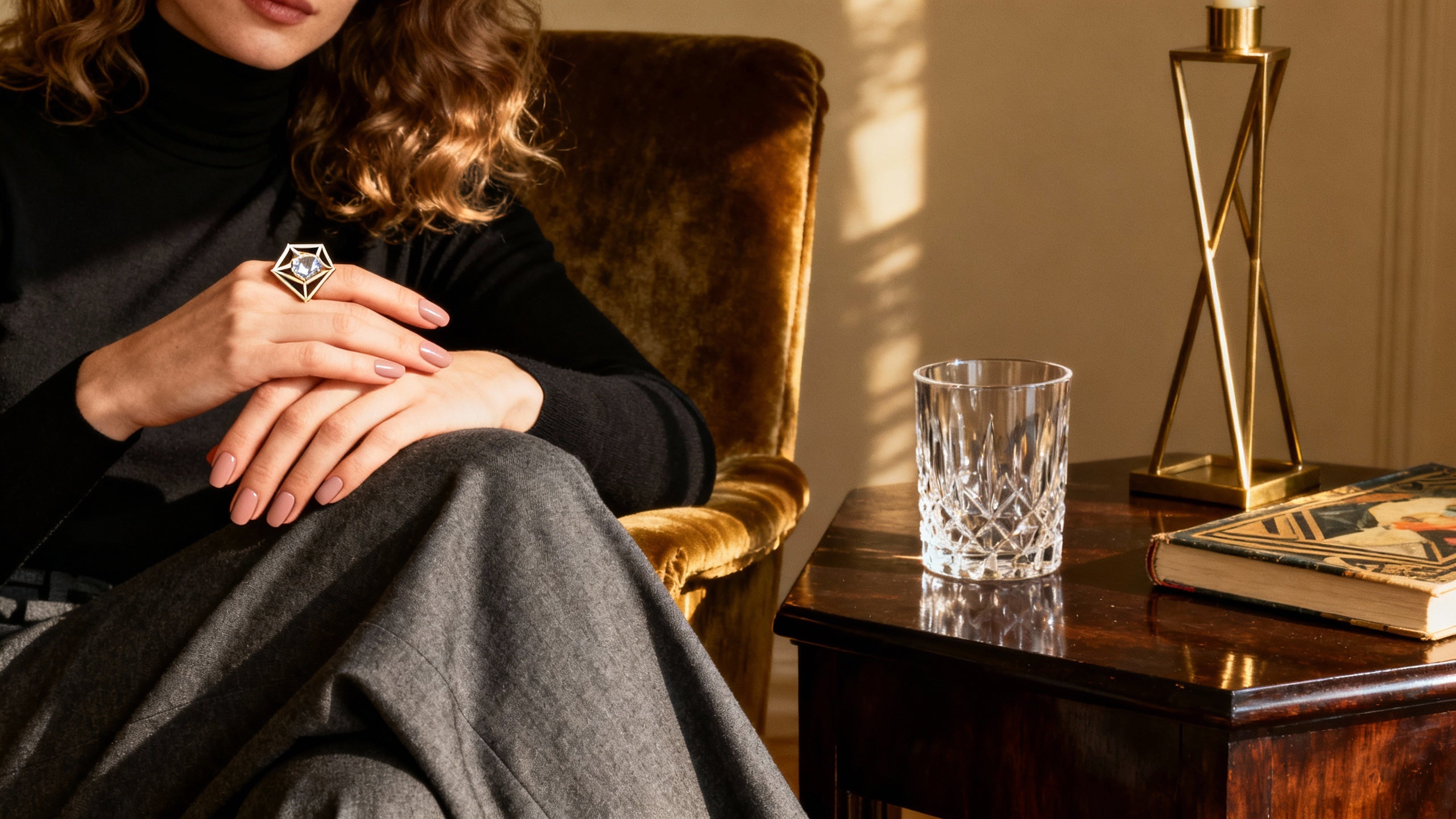
Mid‑century jewelry blends modernist clarity with unapologetic glamour. Writers at Filigree Jewelers describe an era of big, confident forms, textured yellow gold used as a medium in its own right, and stones chosen to play with light and shadow rather than simply to boast size. The post‑war mood brought brightness and experimentation: sculptural metalwork, asymmetry, geometric abstraction, and dramatic prong heights—especially in towering cocktail rings that transformed a hand into a gallery plinth. A modernist sensibility, documented by LaCkore Couture and echoed in Lang Antiques University’s histories of the 20th‑century avant‑garde, framed jewelry as wearable art. Designers played deliberately with negative space, mathematical precision, and sinuous motion. The result was layered and architectural, made to catch light from every angle and to read clearly across a room.
The “atomic” imagination defined much of the period’s look. After 1957, starburst sputnik pendants and brooches proliferated, including 14k rose‑gold examples set with joyful mixtures of amethyst, peridot, aquamarine, tourmaline, topaz, and citrine—some totaling about 14.70 carats, as noted by Filigree Jewelers. Naturalistic motifs remained, too, but abstracted: panthers transformed into graphic motion, leaves into stylized surfaces, and flowers into concentric, radiating geometry. Vintage houses from Tiffany & Co. and Cartier to Van Cleef & Arpels shaped this visual language; so did independent modernists and Scandinavian minimalists whose silver forms emphasized clean lines and human‑scaled sculpture.

From Studio Bench: How Contemporary Labs Reinterpret the Era
The “lab” in today’s mid‑century revival points to two realities. First, we have new fabrication laboratories: digital modeling, rapid prototyping, and laser‑based processes that can echo or refine hand techniques. Second, we have a growing palette of lab‑created gemstones sitting alongside natural stones. The research notes do not directly address lab‑grown gems; the observations in this paragraph about their role are based on current bench practice and market experience and carry medium confidence.
On the fabrication front, the toolset has matured. Ponoko’s overview of laser cutting and 3D printing captures why so many contemporary studios combine digital and hand work. Laser cutting yields repeatable, crisp components with a surface finish that needs minimal clean‑up, ideal for the precise interlocking geometry mid‑century designs love. 3D printing allows forms that traditional subtractive methods struggle to achieve, from interlocking structures to complex under‑galleries that lighten weight without sacrificing presence. But bench fundamentals still rule. Alan Revere’s emphasis on layout, forming, soldering, setting, and finishing remains the backbone that gives any mid‑century‑inspired piece the integrity it needs. I favor riveted construction at high‑movement joints when I want graceful drape without relying on jump rings, a technique echoed by makers in the Metal Arts Guild community because it improves both durability and wear feel.
Modern craftsmanship also revisits vintage texture in smarter ways. The hammered and brushed surfaces that made 1950s gold so alive can be rendered today with controlled patterns that read consistently under raking light. Hidden hinges and convertible engineering—hallmarks of good mid‑century work cited by Filigree Jewelers—benefit from tighter tolerances. Closures disappear; cuffs articulate; brooches become pendants in a heartbeat. When done well, the engineering serves the sculpture, never upstaging it.

Materials and Metals Today
Mid‑century metal language remains remarkably current. Yellow gold retains primacy for statement forms, with rose gold a flattering counterpoint and platinum the cool counterbalance for diamond‑forward pieces, as described in Filigree Jewelers’ trend notes. Textured or “bark” finishes, braided rope motifs, and mixed finishes—alternating high‑polish with matte—carry the era’s drama into 2025. The modernist playbook welcomes mixed metals and material juxtapositions. Jack Weir & Sons outlines how to layer metals intentionally, keeping proportion and a coherent mood at the center. That advice pairs beautifully with mid‑century silhouettes: build stacks around a sculptural hero cuff, then echo tone and texture rather than forcing a one‑to‑one match.
Color is back with conviction. Aquamarine, citrine, turquoise, and garnet hold their ground beside diamonds, offering a more generous palette that remains firmly mid‑century. Rustic and Main’s discussion of mid‑century engagement architecture adds emerald and Asscher cuts to the mix, reminding us that clean geometry in the stone can be just as expressive as any setting flourish. For lab‑created stones specifically, my experience is that they can offer consistent color and clarity for the bold fields of color mid‑century designs favor, with the caveat that cut quality and setting integrity matter more than origin. This point about lab‑created stones and color uniformity is an inference beyond the listed sources and carries medium confidence.
Design Signatures to Know
Asymmetry is not an accident in mid‑century; it is a philosophy. Robinson’s Jewelers describes how intentional imbalance creates movement and visual energy, making a brooch feel as if it were captured mid‑dance. In hand, the best pieces reveal a choreography between heavier and lighter elements, between mass and air. Negative space is an active material. This is why modernist pieces still feel so contemporary: they design with absence as much as presence.
Texture creates architecture. Filigree Jewelers highlights how hammering, engraving, and brushing turn metal into sculpture. In the studio, I evaluate texture under shallow light to be sure it catches and releases glow in a controlled rhythm. Substantial weight remains a cue of authenticity, but it should be balanced. Vintage houses engineered wearability—curved brooch backs that sit flush, weight distribution that keeps a statement earring steady. When reinterpreting these cues today, the goal is not to mimic heft blindly but to aim for intentional density and comfortably balanced volume.
Motifs travel between nature and cosmos. Atomic starbursts, molecular clusters, and celestial rays coexist with abstracted leaves, cats, and coral branches. After 1957’s Sputnik, jewelers celebrated science in gemstone constellations; Filigree Jewelers references one rose‑gold starburst loaded with about 14.70 carats of mixed gems that reads like a small galaxy. This is why mid‑century thrives in a modern wardrobe. An angular starburst will live happily with a sharp blazer, while a stylized leaf brooch softens a monochrome knit.
Statement is the point, but not at the expense of comfort. Cocktail rings—often the single, decisive accent—anchor the hand, as Lippas and Filigree Jewelers both suggest. Short, thick yellow‑gold chains and collar‑style necklaces, stacked chunky bracelets, and sculptural earrings define today’s resurgence. If you choose one piece to broadcast the mood, let the others support it quietly. Minimalist rings beside a center‑stage opal, a slim chain to shadow a boxing‑glove‑weight collar—this is the mid‑century way of dressing: architectural, not overloaded.

Definitions at a Glance
Term |
What it means |
Era relevance and notes |
Source mentioned |
Modernist jewelry |
Wearable sculpture with clean geometry, asymmetry, and negative space |
Flourished from the 1940s–1970s; treats metal and void as co‑equals |
LaCkore Couture; Lang Antiques University |
Sputnik/starburst |
Radial, celestial burst forms often set with mixed gems |
Took off after 1957; joyful, kinetic color and light |
Filigree Jewelers |
Cocktail ring |
Oversized, sculptural ring designed as a focal point |
High prongs and dramatic profiles; revived on 2025 runways |
Filigree Jewelers; Lippas |
Mystery Set |
Invisible setting with no visible prongs, stones sliding into micro‑grooves |
A 20th‑century VCA innovation; emblematic of technical bravura |
Jaume Labro |
Ballerina ring |
Center stone circled by radiating gems, like a tutu |
A mid‑century favorite balancing motion and symmetry |
Antique Jewellery Company |
Pros, Cons, and When to Choose Lab‑Grown
The notes you’ve read emphasize design, craft, and vintage provenance; they do not directly discuss lab‑grown stones. The following perspective on lab‑grown is based on current industry practice and on‑bench experience and carries medium confidence. Lab‑created diamonds and colored stones can deliver crisp, saturated color fields at accessible prices, making them well‑suited to mid‑century palettes and to the big look the era demands. They also support traceable sourcing and predictable availability for custom builds. The tradeoffs are mostly about connoisseurship and collecting. If your goal is long‑term vintage investment, period pieces from Tiffany & Co., Cartier, and Van Cleef & Arpels, as Filigree Jewelers notes, often hold or appreciate, especially with documented provenance. If your goal is daily wear of a sculptural, mid‑century silhouette rendered with today’s precision—and you value cost control and repeatability—lab‑grown can be a pragmatic, design‑first choice.
In either case, the engineering and finishing determine whether a piece reads as serious jewelry. Stone origin does not rescue poor setting or under‑engineered hinges, and it will not replace the layered play of texture and shadow that defines mid‑century. Prioritize workmanship first, then let origin follow your values.
How to Buy: A Connoisseur’s Checklist in Practice
Begin with weight, texture, and construction. Filigree Jewelers emphasizes that genuine mid‑century pieces feel substantial, with refined, tactile surfaces. I evaluate density in hand and inspect texture under low‑angle light to see if hammering is deliberate or stamped. Check for deliberate asymmetry and dimensionality, a point Robinson’s Jewelers makes when separating wearable sculpture from flat decorative plates. Examine how materials interact; unexpected pairings should feel inevitable, not forced.
Provenance and signatures matter where investment is the goal. Signed works command premiums, as LaCkore Couture notes, but the signature is one part of a larger story. Identify maker’s marks, fineness stamps (14k or 18k), and period construction details on ring interiors, brooch backs, and clasps, a method summarized by dealers who specialize in authenticating mid‑century work. When evaluating a “sputnik” or ballerina design, for instance, interior structure should reveal care in balancing prong thickness, under‑gallery airflow, and shank integrity.
For contemporary lab interpretations, prioritize the same fundamentals. Ask to see the model or 3D render not just from the top view but from the side and back. Request details on hinge design, clasp tolerances, and stone‑setting approach. Weight should serve comfort. Cuffs must not twist; collars should sit flush without tipping forward. Document provenance even for new pieces—design drawings, CAD screenshots, stone origins—because today’s records are tomorrow’s connoisseurship.

Care, Wear, and Restoration
Mid‑century texture and volume reward mindful care. Filigree Jewelers recommends avoiding harsh chemicals and extreme temperatures, cleaning with a soft cloth, and storing pieces separately—a practice I insist on for textured gold that can burnish if it rubs against other metal. Protect large‑stone rings and cuffs from hard impact; a dramatic high‑prong opal needs a different life than a bezel‑set emerald cut.
If restoration is needed, use a jeweler experienced in vintage work to preserve original intent. Period finishes can be over‑polished into oblivion; rope‑twist edges can be blurred beyond recognition. Sympathetic repairs protect value. When modifying or converting a brooch to a pendant, ensure the bail complements mixed metals and does not fight the era’s line language, an elegant mixing guideline echoed by Jack Weir & Sons.
For lab‑created stones, care is essentially identical to natural counterparts of the same species. Clean gently, protect surfaces, and avoid thermal shock. This equivalence in care is based on standard gemological practice and carries high confidence.

Styling Notes: Retro Cool for 2025
Statement jewelry is back in force. Filigree Jewelers’ 2025 outlook calls for “more is more” in confident metal, led by thick yellow‑gold chains and oversized rings. The mid‑century revival makes this easy to wear. Ground a look with one sculptural anchor—perhaps a ribbed gold collar sitting high at the base of the neck—and keep the rest streamlined to let light and shadow do the talking. Pair an asymmetrical starburst brooch with a simple blazer, or set a black opal cocktail ring center stage against a solid, tonal outfit.
Mixed metals can read considered rather than chaotic if you keep mood and proportion consistent, as Jack Weir & Sons advises. A warm mid‑century chain in yellow gold can temper the cool gleam of a platinum‑tone pendant. On the wrist, stack around a hero cuff and allow smaller accents to echo its finish. With rings, let one hand dominate visually. Mismatched earrings work when the era and detailing rhyme—1970s celestial in one ear can harmonize with a 1950s sculptural hoop in the other if the textures speak to each other.
Price, Value, and the Investment View
Collectors are tracking quality and story. Filigree Jewelers notes that superior craftsmanship—hand‑set stones, hidden clasps, convertible elements—yields pieces that remain in excellent condition after decades. Patina becomes part of provenance. For investment, vintage mid‑century works from houses like Tiffany & Co., Cartier, and Van Cleef & Arpels tend to hold or appreciate, especially with documentation. Unique or limited custom runs, from cobra rings with ruby eyes to sculptural Scandinavian silver, carry a built‑in individuality premium.
Contemporary lab‑crafted interpretations occupy a different but complementary lane. They deliver the silhouette and tactility of mid‑century with predictable pricing and materials control. If you are curating a wardrobe of daily‑wear sculpture, they offer repeatable excellence. If you are building a long‑term collection around provenance and resale, lean toward signed period pieces and document every detail.

Quick Comparison: Vintage vs. Lab‑Crafted Reissues
Aspect |
Vintage Mid‑Century Piece |
Contemporary Lab‑Crafted Interpretation |
Metalwork |
Textured yellow gold with sculptural mass; hand‑hammered nuance |
Precision‑controlled textures; laser‑clean edges; hidden hinges with tight tolerances |
Gem palette |
Diamonds plus aquamarine, citrine, emerald; joyful mixed cuts and heights |
Natural or lab‑created stones with consistent color; engineered settings for security |
Engineering |
Convertible clasps, balanced weight; patina as character |
CAD‑assisted articulation; weight optimized for comfort; documentation native to build |
Wearability |
Big presence; occasionally top‑heavy if not well‑balanced |
Big look with refined ergonomics; daily‑wear friendly without losing drama |
The gem‑origin characterization in this table for contemporary pieces is an inference beyond the cited notes and carries medium confidence based on current trade practice.

Takeaway
Mid‑century modern jewelry thrives because it treats jewelry as sculpture made for the human body. The era’s language—clean geometry, intentional asymmetry, textured gold, and exuberant color—still reads as fresh. Contemporary labs and studios amplify that spirit with modern engineering and, where desired, lab‑created stones that make bold looks accessible. Whether you chase signed vintage or commission a lab‑smart reinterpretation, let the principles lead: sculptural clarity, thoughtful weight, honest texture, and craftsmanship you can feel when you close the clasp.
FAQ
How do I quickly spot authentic mid‑century design cues?
Look for deliberate asymmetry, dimensional construction rather than flat plates, and textured gold that plays with light. Genuine pieces tend to feel substantial, with well‑engineered backs, hinges, and clasps. Maker’s marks and fineness stamps on ring shanks and brooch backs help, and so does a coherent conversation between materials, as highlighted by Filigree Jewelers and Robinson’s Jewelers.
Are lab‑grown stones appropriate for mid‑century‑inspired jewelry?
Yes, if your priority is design integrity, daily wear, and budget discipline. Lab‑created stones can deliver consistent color fields for sputnik bursts or ballerina halos and let you allocate more of the budget to engineering and finishing. This guidance on lab‑grown is based on bench and sourcing experience beyond the provided notes and carries medium confidence.
What’s the best way to mix metals without visual chaos?
Keep proportion and mood consistent. Build a stack around one sculptural hero and echo its finish with supporting pieces rather than competing with it. Pair cool metals with warm ones through a shared aesthetic language, as Jack Weir & Sons recommends, and let one hand or zone dominate to maintain clarity.
How should I care for textured gold and high‑profile rings?
Avoid harsh chemicals and extremes of temperature. Clean with a soft cloth, store pieces separately, and be mindful of impact on high‑prong rings. For any restoration, choose a jeweler experienced in vintage techniques so original textures and lines are preserved. These recommendations align with Filigree Jewelers’ care guidance and standard bench practice.
Are cocktail rings practical for everyday wear?
They can be, if engineered thoughtfully. Favor balanced settings, comfortable under‑galleries, and profiles that clear pockets and sleeves. Rustic and Main’s notes on mid‑century ring architecture—clean prongs, secure bezels—apply well here; modern CAD and casting can fine‑tune comfort without diluting drama.
Which makers hold value best if I’m collecting?
Signed mid‑century works from Tiffany & Co., Cartier, and Van Cleef & Arpels often hold or appreciate, particularly with documentation, as Filigree Jewelers observes. Exceptional Scandinavian silver and unique custom runs can also command strong interest. Always document provenance; today’s records are tomorrow’s value story.

Sources Mentioned
Filigree Jewelers, Jack Weir & Sons, LaCkore Couture, Robinson’s Jewelers, Antique Jewellery Company, Lang Antiques University, Rustic and Main, Alan Revere, Ponoko, Metal Arts Guild SF, Lippas, Windy City Diamonds.
References
- https://www.olufsondesigns.com/the-seven-principles-of-jewelry-design-crafting-elegance-and-beauty
- https://www.velvetboxsociety.com/mid-century-modern.html?srsltid=AfmBOopp0pFcI1joJ2yYC5ydPz6a_Yb3-ul9JDzJK9Itd0COE-DzLYw4
- https://www.antiquejewellerycompany.com/a-guide-to-mid-century-jewellery/?srsltid=AfmBOoo0KBsKzEwdcYOf4fPDVbPLt2F62Sw5EsfHsOtSvYV6eDOlydyQ
- https://www.amazon.com/Professional-Jewelry-Making-Alan-Revere/dp/1929565429
- https://www.etsy.com/listing/92794843/modern-jewelry-design-techniques-irena
- https://filigreejewelers.com/blogs/articles/mid-century-jewelry-modernist-glamour-of-the-1950s?srsltid=AfmBOoqUtZPhVL4s8F7jTW1dxNz16xHGb41h3VzMurz1EbDDY9w5G_JU
- https://jackweirandsons.com/blogs/news/how-to-style-mixed-metal-jewelry?srsltid=AfmBOopEaNWELkc9EwUAJ_EIvTFU8RxeMVw3NVJTD9ofBTJD2fh6dH-X
- https://www.jaumelabro.com/blog/9-incredible-jewelry-making-and-design/?srsltid=AfmBOoo62PthVb5G3gYxXMRkOd0mVLfAHvQoRcJawh2lwebDk2N_3Qet
- https://lackorecouture.com/blogs/guides/ultimate-guide-to-modernist-jewelry-motifs?srsltid=AfmBOoqHQKiZn98kzCChSmwRKPeXWoUxW5525lyeQwoJaIKyWX13oGyc
- https://www.langantiques.com/university/modernist-jewelry/?srsltid=AfmBOorNp2bS7-1oaOdVonF66HjT5zwbJoF_DvBuz74X-1V4Hgtyr-fo