On-Camera Jewelry Secrets: How Live Streamers Look Their Best
Live streaming has turned our screens into intimate stages. Whether you are hosting a “shop-the-look” show, teaching a masterclass, gaming, or simply meeting clients on camera, your jewelry becomes part of your visual signature. It frames your face, telegraphs your taste, and silently tells viewers who you are before a single word leaves your lips.
As someone who has styled jewelry for livestream sellers, digital-first jewelers, and on-air personalities, I have learned that what works beautifully in person can fall flat, flicker, or even distract once the red “live” light turns on. The camera has its own aesthetic rules, and jewelry that respects those rules can transform both your presence and your performance.
This guide will walk you through those rules with practical, camera-tested advice, grounded in what jewelry and livestream experts have already observed, from Blue Nile and Earth Song Jewelry to JoyJoya’s livestreaming insights and buyer guidance from DHgate’s Smart Tips series.
Why On-Camera Jewelry Matters So Much in Livestreams
Livestreams sit at the intersection of entertainment, education, and commerce. Data highlighted on the JoyJoya podcast shows that apparel and fashion dominate live-commerce categories and that luxury goods see very high conversion rates when live video is involved. Klarna research cited there found that a majority of shoppers feel livestream shopping improves their online experience, and nearly half would even prefer livestream shopping over in-store visits. Jewelry sits squarely inside that opportunity.
On a typical stream, your viewer sees little more than your face, neck, shoulders, and hands. Jewelry becomes your wardrobe’s leading actor. The right earrings can make you look more alert and present. The right necklace can pull the eye toward the center of the frame and keep viewers focused on you instead of drifting to the chat window. A signature ring that flashes when you gesture can be as memorable as a logo.
Jewelry also plays a crucial role in trust. A DHgate buyer guide on live-stream jewelry shopping emphasizes how viewers scrutinize close-ups, clasps, backs, and finishes to judge quality and authenticity. When you are the seller or brand representative, your on-camera jewelry is not just decoration. It is evidence: of your taste level, your standards, and your respect for your audience’s investment.
Finally, on-camera jewelry supports the deeper emotional role that Bufkor’s merchandising guidance underscores: storytelling. Pieces that carry a story, whether it is about natural stones, craftsmanship, or ethical sourcing, give you something meaningful to talk about when the chat turns quiet. In livestreams, stories sell as surely as stones.
How Cameras Change the Rules for Jewelry
In a studio or at an event, people see you in three dimensions, with abundant visual context. Online, they see you through a tiny window that compresses color, texture, and movement. That has several consequences.
First, small details disappear. Earth Song Jewelry notes that subtle stud earrings which look polished in person can all but vanish on video calls. Viewers notice shape and contrast more readily than fine engraving or micro pavé. That is why bolder, more prominent pieces often read better on camera, so long as they still respect the tone of your content.
Second, light behaves differently through a lens. Blue Nile points out that finishes and lighting can cause either flattering shimmer or harsh glare. Well-cut diamonds and high-polish metal can glow beautifully under balanced light, but if you pair them with a strong ring light at the wrong angle, they may blow out into white streaks that distract from your expression. Earth Song Jewelry therefore often recommends natural stone jewelry for statement pieces, because natural textures deliver color and presence without aggressive camera glitter.
Third, motion is magnified. Plastic Seconds’ exploration of how cam models use jewelry emphasizes how dangling earrings, layered necklaces, and cuffs on the dominant hand can guide attention through movement. The same is true for any livestreamer. A small turn of the head can send drop earrings into motion, punctuating your words. Repeated gestures can make a bracelet or ring a focal point. Used thoughtfully, this motion is a tool; used carelessly, it fragments attention.
Finally, sound cannot be ignored. Blue Nile warns about noisy bangles interfering with microphones, while Earth Song Jewelry notes that bracelets on video calls are often far enough from the mic to be less of an issue. The reality is somewhere in the middle. A single slim bangle will rarely ruin sound, but a stack of heavy metal bracelets clinking near a laptop mic can. Testing your jewelry with your specific setup is essential.
A quick comparison can help crystallize these differences.
Aspect |
In-Person Priority |
On-Camera Priority |
Visibility |
Fine detail and subtle sparkle |
Clear shape, contrast, and scale within the frame |
Light |
Natural reflections, room lighting |
Controlled shimmer, minimal glare under ring lights or softboxes |
Movement |
Natural body motion |
Deliberate use of dangles and gestures to guide attention |
Sound |
Often backgrounded by ambient noise |
Quiet pieces that do not interfere with mics |
Perception |
Overall outfit seen head-to-toe |
Focused view from chest up, emphasizing face, neck, and hands |
Once you accept that the camera rewrites the rules, you can start selecting jewelry with purpose rather than habit.

Matching Jewelry to Your Livestream Goals
Different livestream formats call for different on-camera jewelry strategies. A coach leading a high-ticket mastermind should not look like a late-night club host, and a jewelry seller walking through inventory needs a different visual vocabulary than a gamer or lifestyle creator.
Professional and Work-Focused Streams
For business lives, webinars, and client calls, the aim is polished authority, not spectacle. Blue Nile’s guidance for professional video calls recommends subtle yet visible pieces such as small hoop earrings, medium-sized diamond or lab-grown diamond studs, and classic pearl earrings. These frame the face without dominating the screen.
Earth Song Jewelry stresses that because video flattens detail, you may need a touch more presence than you would choose for the office. A single pair of confident, medium-scale earrings, perhaps combined with a delicate pendant, can read as put-together and intentional. Matched sets help here: a coordinated earring and necklace combination suggests organization and attention to detail.
Kisna’s work-wear jewelry advice aligns with this: simple studs, delicate pendant necklaces, slim bracelets, and streamlined rings in quality materials communicate professionalism. The pieces should enhance your look and echo your personal brand without shouting over your message.
The advantage of this approach is clarity. Viewers focus on your expertise and your words. The risk is disappearing into the background if you go too minimal. If your earrings vanish on screen or your necklace perfectly matches your top so it blends away, raise the scale slightly or introduce color contrast so that your jewelry quietly asserts your presence.
Sales and Shopping Streams
When you are selling jewelry live, your pieces must do double duty. They need to flatter you as host while showcasing the range and quality of your inventory.
The JoyJoya podcast points out that livestream shopping thrives on authenticity, education, and interactive storytelling. McKinsey data discussed there shows that fashion and accessories lead in live-commerce, and luxury goods enjoy especially strong conversion when video is used. In other words, jewelry plus live video is a high-opportunity pairing.
Bufkor’s merchandising guidance offers two especially relevant principles. First, understand your client. Your on-camera jewelry should mirror the aspirations of your target buyer. If you sell minimalist, ethically sourced pieces, your own styling should embody that restrained, conscious luxury. If you specialize in bold gemstone designs, let your on-camera look celebrate color and drama. Second, share a story. Every piece you wear should give you something to say about origins, materials, craftsmanship, or personalization.
The DHgate live-stream buyer guide reminds us that serious shoppers now expect strong proof of quality. As a host, you can preemptively answer their unspoken questions by choosing jewelry that is easy to show clearly on camera. Favor pieces whose settings, backs, and clasps photograph well. During the stream, mirror best practices from that guide by moving close to the lens, rotating the piece, and pausing on details like hinges and closures. This lowers skepticism and mimics the in-store inspection your viewers cannot perform themselves.
For sales-focused streams, distinctive signature jewelry is powerful. As Plastic Seconds notes about cam performers, a recurring necklace or ring becomes a personal trademark that makes you instantly recognizable and deepens familiarity. When you are the face of a jewelry brand, that kind of visual consistency builds trust and recall across multiple episodes.
Entertainment, Lifestyle, and Persona-Driven Streams
Creators, gamers, and adult entertainers often rely on persona as much as product. Plastic Seconds explores how jewelry shapes on-cam personas, particularly for mature cam models, but the lessons apply broadly.
Bold chokers and metallic collars can project authority or edginess. Softer, flowing earrings in warm tones suggest approachability and intimacy. Repeating a unique statement piece becomes a form of branding, while rotating seasonal or themed pieces keeps the look fresh around holidays or special events.
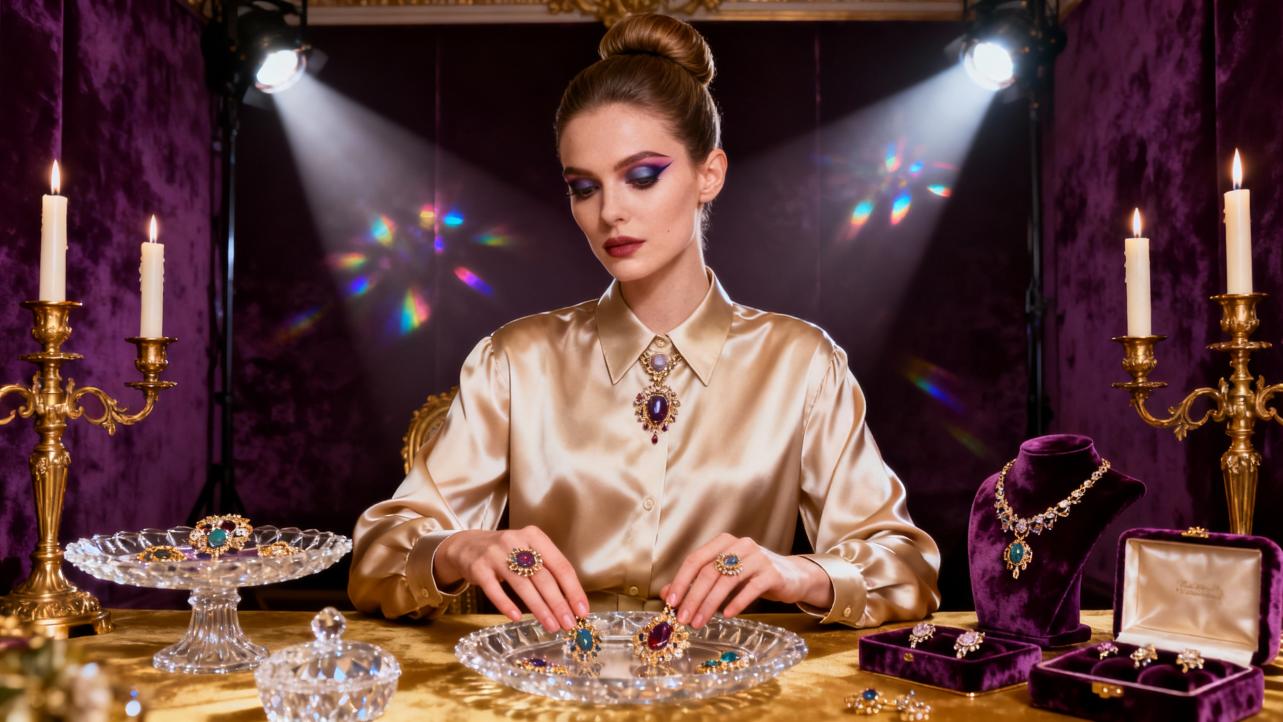
In lifestyle and entertainment streams, you have more freedom to play with layering, stacking, and unconventional placements. The key is coherence. Jewelry, makeup, outfit, and backdrop should feel like one story, not a jumble. A gothic-inspired stream can harmonize dark stones, black metal, and rich burgundy fabrics. A soft, romantic persona might lean into pearls, rose gold, and gentle pastels.
The advantage is emotional impact. Jewelry becomes a prop and a partner in your performance. The risk is clutter. Plastic Seconds rightly warns that too much layering can become visually chaotic on camera. Aim for deliberate density: layers with intention, where each piece is still legible within the frame.
Earrings, Necklaces, Bracelets, Rings: What Works Best On Camera
Different jewelry categories behave differently on screen. Understanding their strengths and pitfalls helps you choose pieces strategically instead of simply grabbing your favorites.
Earrings: Your First On-Screen Storyteller
Earrings are often the most important on-camera jewelry choice because they live so close to your eyes. Viewers look at your face; earrings frame that focal point.
Earth Song Jewelry notes that dangling and chandelier styles are especially visible on video, making them excellent go-to options for important online meetings. Long, single-strand designs or earrings featuring multiples of the same stone deliver a clean line that reads clearly through the lens. Large statement earrings worn alone or with a very subtle necklace can convey confidence and polish.
The same source cautions against overly playful or noisy designs in professional contexts. Earrings that swing wildly, jangle against your headset, or feature too many colors can pull attention away from your message. Similarly, they recommend avoiding unconventional forehead jewelry, tiaras, or extremely flashy facial piercings during workplace calls because these pieces can read as costume rather than professional style.
For men, Blue Nile suggests understated elegance: small hoops or studs in gold or silver, and diamond studs for a more eye-catching yet refined look. The principle is the same across genders. Earrings should highlight the eyes and cheekbones, not compete with them.
On the pro side, earrings are efficient. A single well-chosen pair can transform your entire on-camera look. The only real downside comes when the scale, color, or movement outpace the tone of your stream.
Necklaces: Framing the Face and Neckline
Necklaces control the vertical line of your frame. They can pull the gaze toward your face, accent your collarbones, or even introduce conversation topics.
Earth Song Jewelry emphasizes statement necklaces made from natural stone as particularly camera friendly. Natural textures and shapes allow for scale and color without the camera glitter risk that comes with oversized faceted gems. For hosts who need to be visually distinct in crowded meetings or streams, these pieces offer presence without harsh sparkle.
Blue Nile divides necklace recommendations by context. For professional video calls, they favor delicate necklaces in gold, silver, or platinum with small pendants such as hearts, pavé cross motifs, or vertical bars. These add a refined glimmer that works with many necklines. For dates, they encourage conversation-starting designs like birthstone pendants, gemstone station necklaces, and embellished lockets. For virtual special events, shimmering diamond solitaires, chevron necklaces, and pearl strands or station necklaces take center stage, particularly when paired with earrings that echo their motif.
Necklines matter greatly. V-necks invite pendants that echo the V shape. Crew necks and high necklines often look best with slightly longer chains or bold collars that sit above the fabric. Strapless tops can handle more dramatic bib or multi-strand designs. Blue Nile stresses color contrast here: jewelry should either stand out crisply against fabric or provide an intentional, harmonious echo, not vanish into it.
A concise comparison can help you decide what to wear on different streams.
Necklace Style |
Best For |
On-Camera Benefit |
Watch Out For |
Delicate pendant |
Work calls, coaching, everyday lives |
Tasteful shimmer that flatters many necklines |
Vanishing against busy prints or same-tone tops |
Natural-stone statement |
Brand streams, creative content, sales |
Bold color and scale without harsh camera glitter |
Overwhelming small frames if stones are too large |
Diamond solitaire/chelsea |
Virtual events, launches, celebrations |
Classic, luxurious focal point at the collarbone |
Overexposure under strong frontal ring lights |
Pearl strand or station |
Professional lives, graduations, weddings |
Timeless refinement that reads clearly on camera |
Feeling too formal for casual streams if styled stiffly |
Gemstone station/locket |
Dates, lifestyle content, storytelling |
Built-in conversation starter and visual interest |
Clashing motifs if paired with overly ornate earrings |
As with earrings, restraint usually wins. One necklace styled with intention will almost always look more elegant than three competing chains that blur together on screen.
Bracelets and Bangles: When Your Hands Steal the Scene
Bracelets occupy an interesting territory on camera. They sit far from your face, but they surge into focus when you gesture, type, or show products up close.
In traditional offices, Earth Song Jewelry notes that bracelets can be controversial because of noise and distraction, so the usual advice is to stick to one or two subtle pieces. On video calls, they point out that those rules relax somewhat because bracelets are often far enough from the microphone that they do not register audibly. This allows for flashier bracelets that help you look more put-together, especially if you talk with your hands. Their aromatherapy bracelets and metal bangles exemplify functional styles that still read fashion-forward.
Blue Nile, however, cautions against noisy bangles that interfere with microphones. If you use a laptop mic, desk mic, or keep your hands very close to your face, a stack of metal bracelets can produce a distracting clatter. Both perspectives underscore the same principle: test in your real setup before you go live.
For sales hosts, bracelets can pull attention to items you are holding. A polished cuff near a ring you are demonstrating, for example, creates a glittering frame around the featured piece. For coaches or educators, a single slim bracelet in a brand color can subtly reinforce your visual identity without demanding commentary.
The benefit of bracelets is that they can enliven your gestures and give depth to the lower part of the frame. The downside is noise and visual clutter if you stack too many or mix competing metals and styles.
Rings, Cufflinks, and Tiny Details the Camera Loves
Rings are the jewelry that viewers notice last in person but often remember most in livestream replays. As cameras zoom for product demos or as you emphasize points with your hands, rings flash in and out of focus.
Kisna suggests statement rings with streamlined designs and subtle stones for workwear, which translates perfectly to livestreaming. A single strong ring can serve as a signature, while additional, thinner bands can add rhythm without distraction. Plastic Seconds notes that stacked rings can add depth and sophistication on camera, but again, moderation is crucial to avoid clutter in tight frames.
For men, Blue Nile recommends classic wristwatches and sleek cufflinks as key style anchors. A clean metal bracelet watch reads as both functional and refined. Simple stainless-steel or sterling-silver cufflinks pick up light at the edges of a frame during formal streams and reinforce a sense of occasion.
Brooches and lapel pins, which Kisna treats as subtle ways to elevate blazers and dresses, are surprisingly effective on camera. One well-placed pin in a meaningful motif can become a recurring element that regular viewers recognize immediately, much like the signature pieces discussed by Plastic Seconds for performers.
The advantage of these small details lies in their intimacy. They reward attentive viewers without overwhelming casual ones. The only risk is overloading small areas with too many micro-details that the camera cannot resolve.
Color, Finish, and Material: Managing Light and Contrast
Even the most perfectly chosen silhouettes fall short if color and finish fight your camera and lighting.
Blue Nile stresses the importance of matching metals and stones to both skin tone and outfit. Fine yellow gold can nearly disappear against warm, tanned skin or mustard-toned clothing. Pale gems can wash out against white tops under strong light. To counter this, they recommend using color contrast so jewelry stands out against clothing rather than blending in. A cool silver pendant over a warm camel sweater or a deep gemstone against a pale blouse gives the lens something clear to work with.
Earth Song Jewelry’s advice to favor natural stone for large statement pieces is effectively about managing finish. Natural stones often have a softer luster that shines without sparkling aggressively. Faceted gems, especially diamonds, deliver flashes of brilliance that can be stunning, but they risk becoming visual noise if the camera is constantly catching and exaggerating those flashes.
Plastic Seconds observes that polished metals and faceted stones are very camera-friendly when used thoughtfully, because they catch light and create sculptural highlights. The key is thoughtful testing. Under some lighting, a polished choker accentuates the curve of the neck beautifully. Under harsher or poorly placed lighting, the same piece throws harsh streaks across the frame.
The DHgate live-stream buyer guide encourages viewers to request multiple angles, including backs and clasps, to judge craftsmanship. Sellers can reverse-engineer that advice by selecting materials and finishes that photograph clearly from every angle. Smooth, well-polished surfaces, consistent stone placement, and secure closures do not just feel better in person; they look more trustworthy when magnified on screen.
A simple table can help you think about finish through the lens of your camera.
Finish / Material |
On-Camera Effect |
Best Use |
Potential Risk |
High-polish metal |
Strong reflections and bright highlights |
Minimalist pieces, bold chokers, sleek hoop earrings |
Glare or overexposure under direct ring lights |
Faceted diamonds or gems |
Sparkling, attention-grabbing flashes |
Special events, hero pieces on luxury streams |
Distracting glitter if constantly moving |
Natural stone |
Rich color, softer luster |
Statement necklaces, earrings, bracelets |
Looking heavy if stones are oversized in frame |
Pearls |
Soft glow, flattering near the face |
Workwear, celebrations, elegant date streams |
Feeling too formal if other elements are casual |
The through-line is control. Your goal is not to eliminate shine but to orchestrate it so that it flatters your features and supports your story.

Testing, Tech, and Practice: The Unseen Secret to Great On-Camera Jewelry
Every piece of research cited here points, in one way or another, toward preparation. Blue Nile explicitly recommends improving lighting with lamps or ring lights so jewelry shows up without overexposure and stresses that mic placement matters. Earth Song Jewelry underscores that visibility changes dramatically between in-person and on-screen environments. DHgate’s live-stream buyer guide essentially teaches viewers how to test sellers in real time. Plastic Seconds advises models to test jewelry under actual streaming conditions.
To translate that wisdom into your workflow, treat your jewelry like a co-host you must rehearse with.
Before going live, record a short test clip with the exact setup you plan to use: same camera, same lighting, same microphone. Speak as you normally would, gesture as you naturally do, and perform a few close-ups if you sell products. Watch the playback with a critical eye. Ask yourself whether earrings remain legible but not chaotic, whether necklaces glow instead of blinding, whether bracelets or rings produce any distracting clinks near the mic.
If something feels off, make small adjustments rather than scrapping the entire look. Lower your ring light slightly so reflections soften. Swap one of three necklaces for skin instead of more metal. Move bracelets to the hand that stays lower in frame.
Bufkor’s reminder to deemphasize technology in favor of human connection is important here. Your viewers are not tuning in for a gear show; they are tuning in for you. Tech and jewelry should support your humanity, not overshadow it. When in doubt, choose the pieces that make you feel most like yourself, then let testing refine the details.
Common On-Camera Jewelry Mistakes to Avoid
Even experienced streamers fall into a few predictable traps.
One frequent mistake, highlighted by Blue Nile, is choosing metals that clash with or disappear into skin and clothing. A very fine gold chain on warm skin in warm light can leave your neck looking bare, even though you know you are wearing something beautiful. If you cannot clearly see your necklace from a typical viewer distance, neither can your audience.
Another misstep is ignoring lighting’s impact on glare and visibility. Blue Nile warns that finishes and lighting can cause both under and overexposure. Earth Song Jewelry’s caution about overly sparkly faceted gems on camera is part of the same story. A necklace that looked perfect in a dim boutique may erupt into a constellation of hot spots under your streaming lights.
Sound-related mistakes are equally common. Blue Nile calls out noisy bangles, and Earth Song Jewelry warns against bracelets that disrupt office environments. On camera, this can translate into soft but constant clinking that your audience might not consciously identify but will feel as irritation. Always give your wrists a quick shake near your mic during testing to confirm whether your chosen stack is quiet enough.
Stylistically, both Earth Song Jewelry and Plastic Seconds highlight the risks of extremes. Wearing jewelry that is too subtle can make you look unfinished; wearing too many bold pieces at once turns your frame into a jewelry tray. Both outcomes dilute your authority. Aim for deliberate focal points rather than maximalism without structure.
Finally, if you sell jewelry, the DHgate guide offers an implicit warning against vague or evasive presentations. Avoid glossing over specifications, pressuring viewers into off-platform payments, or dodging questions about materials and certifications. Not only do these behaviors undermine trust, they also waste the credibility your beautiful on-camera styling has worked so hard to build.

Short FAQ for Live Streamers and Jewelry
How much jewelry is too much on camera?
A useful rule drawn from Earth Song Jewelry’s and Kisna’s advice is to choose one main focal point near the face and one supporting element elsewhere. That might be statement earrings with a delicate necklace, or a strong pendant with minimal studs. If you notice that viewers comment more on your jewelry than on your content, it may be time to edit.
Should I wear my most expensive diamonds in everyday livestreams?
Blue Nile encourages diamonds for special video events and polished professional looks, but Earth Song Jewelry’s caution about overly sparkly faceted gems is instructive. Reserve your highest-sparkle diamonds for occasions where a little drama is appropriate and your lighting is carefully tuned. For everyday lives, natural stones, pearls, and smaller or subtler diamonds often provide a more comfortable balance of elegance and warmth.
Do I need different jewelry for livestream shopping than for regular content?
Yes, at least in emphasis. JoyJoya’s discussion of livestream shopping shows that buyers respond strongly to clear education and storytelling. In sales-focused streams, wear pieces that align with your brand, show craftsmanship well in close-up, and give you stories to tell. In non-sales content, your jewelry can relax into a supporting role, reinforcing your persona rather than representing a specific product line.
In the end, on-camera jewelry is a language. Each metal, stone, and silhouette says something about you long before you speak. When you choose pieces with awareness of the camera’s quirks, your viewers’ expectations, and your own story, you transform those silent accents into a persuasive, unforgettable voice. As a passionate connoisseur and storyteller, I can tell you that the most compelling live streamers are not the ones wearing the most jewelry, but the ones whose jewelry looks precisely, irresistibly like them.

References
- https://www.researchgate.net/publication/388409199_SMART_JEWELRY_DESIGN_AESTHETICS_AND_INNOVATION_IN_THE_DIGITAL_AGE
- https://bright-river.com/the-jewelry-photography-guide-to-shine-online/
- https://www.caspa.ai/blog/background-for-jewellery-photography
- https://smart.dhgate.com/live-broadcast-earrings-vs-everyday-earrings-is-there-really-a-difference-or-is-it-just-hype/
- https://www.articleone.kesug.com/jewelry-styling-for-virtual-meetings-what-pops-on-camera/
- https://www.lemon8-app.com/@arysjewelry/7457821841223156270?region=us
- https://blog.picupmedia.com/why-live-streaming-is-the-future-of-jewelry-sales-a-must-do-for-jewelers/
- https://en.prismanote.com/blog/enhance-jewelry-presentation-with-360-degree-videos-for-jewelers
- https://www.slideserve.com/metjewelry/how-should-you-normally-decide-which-jewelry-to-wear-powerpoint-ppt-presentation
- https://urisma.com/jewelry-styling-for-video-calls-subtle-details-that-make-you-stand-out-2/