How Can Striped Tops and Geometric Jewelry Create Visual Harmony?
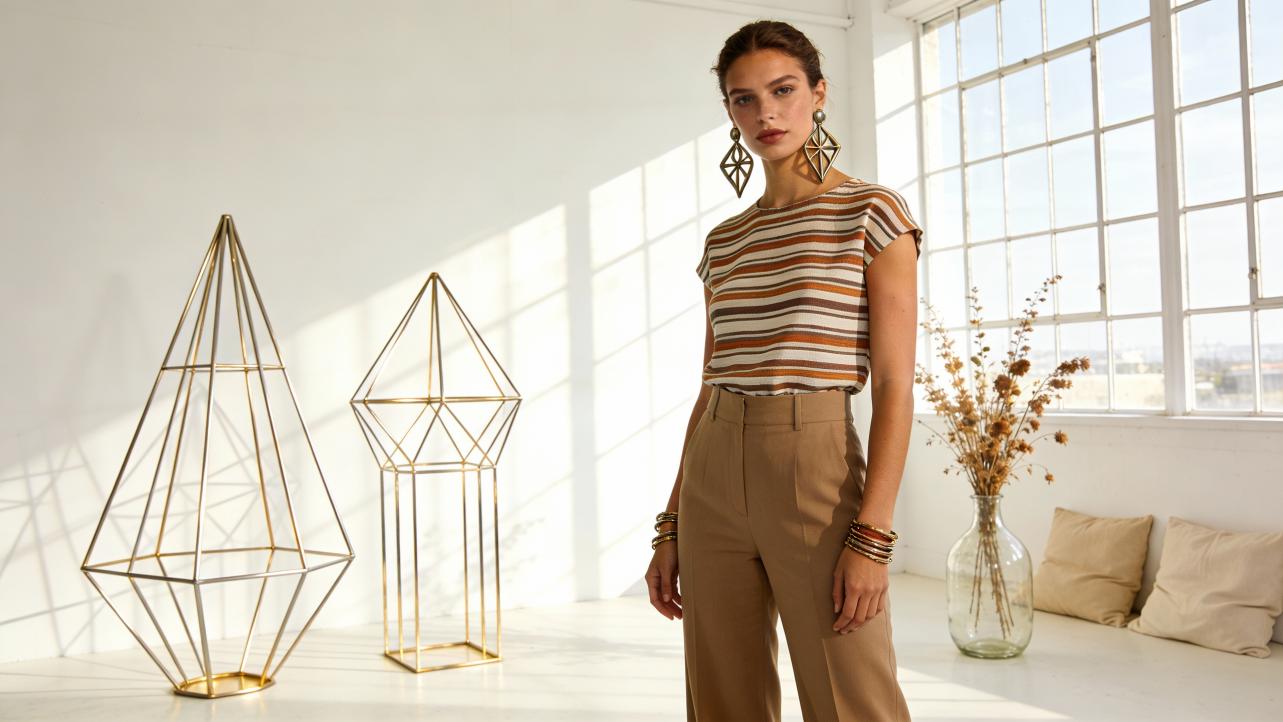
There is a special kind of magic that happens when a simple striped top meets bold geometric jewelry. Lines that run across soft cotton suddenly converse with triangles of gold or circles of polished stone. The effect, when done well, is not loudness but harmony: an elegant equilibrium between pattern and metal, between everyday ease and considered artistry.
In my styling work, I return to this pairing again and again because it turns the most familiar wardrobe staple—a striped tee or sweater—into a refined, modern statement with very little effort. The key is understanding why stripes and geometry belong together, and how to choreograph their shapes, colors, and scale so they never look chaotic.
Why Stripes and Geometry Belong Together
Stripes are, at heart, one of the most accessible geometric patterns. Style guides from brands like Velvet Heart and Family Britches describe them as timeless, seasonless, and remarkably adaptable, able to move from nautical weekends to polished workwear without ever feeling dated. They are the simplest form of repeated line, which makes them a natural counterpart to geometric jewelry built from triangles, circles, squares, and sharp angles, as described in geometric jewelry guides on Smart.DHgate.
Geometric jewelry itself is essentially wearable architecture. Expert buying guides characterize these pieces as modern and artful, defined by clean shapes and crisp lines, and they recommend treating your outfit as the “quiet sidekick” so the geometry can shine. When you place that structural clarity against a striped knit, the patterns start echoing each other: line speaking to line, shape to shape.
Pattern-mixing resources from Ashley Brooke, Grace Per Wear, and Lookastic all agree on three principles that are crucial here. First, color cohesion. If the colors talk to each other, the patterns usually do as well. Second, scale balance. Mixing a bolder pattern with a smaller, more refined one reads as intentional. Third, a sense of play. Pattern mixing is less about rules and more about orchestrating elements so they appear deliberate, not accidental.
Striped tops and geometric jewelry sit exactly at this intersection. The stripe becomes your reliable, repeatable rhythm. The jewelry supplies the melody.

Reading the Stripe: Choosing the Right Canvas
Before you even open your jewelry box, the stripe itself deserves a close look. Direction, width, contrast, and fit will all influence which geometric pieces feel harmonious.
Direction and Illusion
Several stripe guides highlight the visual illusions stripes create. Velvet Heart and Family Britches note that vertical stripes tend to draw the eye up and down, often reading as lengthening and slimming, while horizontal stripes can add width or emphasize curves. Mystylebox complicates the picture by pointing out that certain horizontal placements can, in practice, feel slimming when used strategically. The truth is that context—stripe width, background color, and how the stripe sits on your particular frame—matters more than a single “rule.”
For our purposes, think of direction as the first decision about mood and balance with your jewelry. A vertical striped shirt paired with a long linear pendant or a stack of slim geometric bar necklaces creates a strong sense of length and refinement. The lines are all moving in the same direction, so the result is clean and serene.
Horizontal stripes, especially classic Bretons, bring more visual energy. Une Femme’s guidance for curvier figures recommends narrower stripes with generous “negative space” and lower contrast, particularly in fabrics that drape rather than cling. These softer stripes pair beautifully with smaller geometric shapes near the face: slim triangular studs, delicate hexagon hoops, or a graceful circle pendant that sits just above the bust. The jewelry becomes a punctuation mark that keeps the stripes from feeling like a solid block.
Diagonal or mixed-direction stripes, highlighted by Velvet Heart as a way to create movement and shape, naturally echo angular jewelry. A chevron sweater, for example, finds its perfect partner in a V-shaped pendant or sharp cuff. Here, the geometry of the knit and the geometry of the metal amplify one another in a very intentional way.
Width, Contrast, and Color
Stripe width is another quiet but powerful tool. Mystylebox and Velvet Heart both stress that thinner stripes feel subtler and more refined, while thicker bands make a bolder statement. On a fitted top or dress, narrow stripes keep the silhouette fluid; on relaxed pieces, wide stripes can edge into graphic territory.
With geometric jewelry, this leads to a simple relationship. The bolder the stripe, the more you want to refine your metal shapes. A wide-striped, high-contrast top wants jewelry that is clean, modern, and not overly chunky. Think simple gold or silver triangles or a single rigid collar. On the other hand, a fine pinstripe shirt is an ideal stage for a slightly more assertive geometric necklace or cuff, because the fabric pattern reads almost like a solid from a distance.
Color and contrast belong to the same conversation. Lookastic and Grace Per Wear both emphasize the importance of treating color as your first filter when mixing patterns. If your striped top is black and white—a combination many guides call practically “neutral”—you have enormous freedom with your jewelry stones and metals, provided you keep one unifying color story. Mvraki’s color coordination guide suggests echoing a single dominant hue: perhaps rose-gold geometric hoops if you are carrying a blush tote, or deep green stones if your bag or shoes live in the emerald family.
If your stripes are multicolored, Mystylebox recommends choosing one shade from the stripe and repeating it in another piece of the outfit. Aureus Boutique’s jewelry-with-print guide extends this logic to accessories: when dealing with multicolored prints, either highlight one color in your jewelry or let neutral metals anchor the look. A striped tee in shades of navy, raspberry, and ivory, for instance, might find its calm in a slim geometric navy enamel cuff and small gold squares at the ear.
Necklines and Layers as Frames for Jewelry
Even the best stripe-and-jewelry pairing can be undermined by the wrong neckline. Une Femme advises curvier wearers to avoid very high necklines in traditional Breton cuts, and instead favor open necklines that break up the expanse of stripes over the chest. This is invaluable when introducing geometric pendants and collars. V-necks, split necks, and more open boatnecks naturally accommodate a pendant or choker that echoes their shape.
Mvraki’s styling guide suggests coordinating necklace shape with neckline: pendants and lariats with V-necks, collars and shorter chains with crewnecks or high necks, chokers with strapless or open silhouettes. Applied to stripes, this means a V-striped blouse and a V-shaped geometric pendant reinforce one another, while a high-neck striped tee may be better served by sculptural earrings and bracelets so the neckline remains clean.
Layering also plays a role. Une Femme points out that wearing a striped top under an open jacket or cardi creates vertical “ladder” lines that counterbalance horizontal stripes. Add geometric jewelry and the composition becomes even more deliberate. Perhaps a Breton tee under a navy blazer, finished with a single angular cuff and small hexagon studs. The jacket’s vertical lines, the shirt’s horizontal stripes, and the jewelry’s crisp edges form a trio that feels resolved rather than busy.

Geometry at the Neckline: How Shapes Echo Stripes
Once the canvas is chosen, the question becomes one of shape and structure. How should geometric jewelry interact with the stripes on your clothing?
Geometric jewelry styling guides from Smart.DHgate define these pieces as built around clear shapes—triangles, squares, circles, sharp lines—and advocate one bold geometric element per outfit. Aureus Boutique’s print-and-jewelry guide adds that geometric prints pair well with angular, modern metal pieces, while stripes themselves often sing alongside rounded, curved jewelry such as hoops and bangles. That gives us two pathways: echo the stripe’s linearity or gently oppose it.
To echo the stripe, choose jewelry that repeats or reframes the line. Long bar pendants, rectangular links, or stepped geometric collars feel particularly at home with vertical or narrow horizontal stripes. The repeated linear motif reads as extremely intentional, almost architectural.
To soften the stripe, follow Aureus Boutique’s recommendation and introduce curved geometry. Circular pendants, hoops, rounded bangles, and orb-like rings bring a sense of ease to very sharp, graphic stripes. This is especially effective with high-contrast black-and-white tops or strong chevrons, where a rigid triangle might push the look into severity.
Color cohesion remains non-negotiable. Smart.DHgate and Mvraki both advise staying within a consistent metal tone and a tightly edited color palette. Gold geometric shapes against warm stripes in burgundy or mustard, silver or white-gold pieces against cool navy or forest, and rose-gold against blush or pastel stripes all feel naturally harmonious.
There is an additional, often overlooked consideration: proportion. The geometric jewelry guide emphasizes tailoring jewelry size to the wearer’s frame and the garment’s pattern. Petite frames and fine stripes can be overpowered by oversized angular chokers, where a medium-scale pendant or a slim geometric cuff has far more impact. Larger frames or very simple, spacious stripes can carry more dramatic pieces—a sculptural, triangular statement necklace or an asymmetrical ear cuff without looking overwhelmed.

Balancing Scale, Pattern, and Sparkle
Visual harmony between stripes and geometric jewelry is largely a dance of scale. Pattern-mixing articles from Ashley Brooke, Grace Per Wear, Lookastic, and Velvet Heart all point to the same idea: contrast the scale of your elements and limit how many compete for attention.
When stripes are bold—thick bands, high contrast, or complex layouts—jewelry should be simpler and slightly smaller. The Aureus Boutique guide recommends that the busier or louder the pattern, the more minimalist the jewelry should be. Mvraki echoes this by advising that busy prints pair best with clean metal pieces and smaller-scale designs, especially near the face. In practice, that means a wide navy-and-ivory striped sweater wants perhaps one geometric focal point, such as smooth gold hexagon hoops or a single openwork cuff, rather than a layered choker, earrings, and rings all vying for attention.
When stripes are subtle—pinstripes, very low-contrast bands, or stripes partially hidden under layers—you can let your jewelry take the lead. Smart.DHgate’s geometric jewelry guide suggests choosing a single bold element to energize a plain outfit; a finely striped ivory shirt, for example, becomes the perfect neutral backdrop for a striking angular choker or a stack of geometric rings. The key is not piling on too many strong shapes at once. Both Smart.DHgate and The Stripe’s bold-accessory strategy make the same point: choose one statement and let everything else be supporting cast.
This balance has a practical payoff as well. Grace Per Wear notes that pattern mixing dramatically increases wardrobe versatility and lowers cost per wear. The same principle applies when you introduce geometric jewelry to your stripes. Imagine a well-cut Breton top and a versatile geometric necklace set that together cost $100. If you use that pairing in ten distinct outfits—swapping jeans for linen pants, loafers for espadrilles, blazers for leather jackets—your cost per styled look drops to $10, and falls even further as you wear each piece separately with other garments. In other words, mastering harmony between stripes and geometry is not only aesthetically satisfying; it is financially intelligent.
There is one caveat worth calling out, especially in an era of constant video calls and recorded content. Production guidelines from institutions such as Wharton, NYU, and Ohio University consistently warn against fine stripes and bold geometric patterns on camera because they can create moiré effects—distracting, shimmering distortions—and draw attention away from the face. They also advise avoiding noisy or overly reflective jewelry. For on-camera situations, reserve micro-stripes and highly intricate geometric pieces for off-duty moments. Choose broader, softer stripes, matte or brushed metals, and one clear focal point, like a sleek pendant or pair of earrings, so the viewer’s eye stays where it belongs: on you.

Stripe-and-Geometry Pairings in Practice
The theory becomes clearer when you see how these principles play out in real outfits. Style guides and lookbooks from brands like Just Style LA, Velvet Heart, and Nat McLaughlin’s striped-top features offer a wealth of inspiration, while jewelry-focused resources from Mvraki, Aureus Boutique, and Smart.DHgate provide the accessory logic.
Consider three archetypal scenarios.
For a casual day built around a Breton tee, Nat McLaughlin favors dainty jewelry. A navy-and-ivory striped long-sleeve top with white jeans and woven flats already reads effortlessly polished. Add a pair of small geometric studs—hexagons or triangles in gold—and a fine bar necklace, and you have honored both the stripe’s structure and the jewelry’s clean shapes without crowding the look. The stripes do most of the talking; the geometry adds crisp articulation.
For the office, imagine Velvet Heart’s vision of stripes across seasons: a refined striped blouse tucked into tailored trousers. In a professional setting, interview attire guides from universities like Marymount Manhattan and UW Oshkosh remind us that jewelry should remain simple and understated. Here, that means choosing one architectural but discreet element—perhaps a slim square-link bracelet in gold or a pair of medium hoop earrings with a subtle angular profile. The look remains boardroom-appropriate, but the geometric note signals a discerning eye.
For evening, draw on Smart.DHgate’s recommendation of dark bases with metallic geometric accents. A black-and-ivory striped knit dress in a heavier fabric offers both drama and structure. Pair it with a sharply cut geometric cuff in polished metal and slim, elongated earrings that echo the dress’s vertical lines, and you create an ensemble that feels modern and intentional without relying on sequins or loud color. According to Mvraki’s color guidance, matching the metal tone to your undertone—warm golds for warm skin, silvers and white golds for cooler tones—quietly optimizes how the whole composition flatters your complexion.
To distill some of these relationships, it is useful to see them side by side.
Stripe Mood |
Geometric Jewelry Choice |
Visual Effect |
Ideal Context |
Bold, high-contrast horizontal stripes |
Small, simple shapes (studs, slim cuff) |
Controlled energy, not overwhelming |
Casual days, smart-casual brunch |
Fine vertical or pinstripes |
Larger angular pendant or structured collar |
Lengthened line, modern sharpness |
Office, presentations, dinners |
Soft, low-contrast Breton stripes |
Rounded geometry (hoops, circle pendant, bangles) |
Gentle, approachable sophistication |
Everyday wear, travel, weekends |
Multicolored stripes |
Jewelry echoing one stripe color, simple geometry |
Cohesive, intentional color story |
Day-to-night, social gatherings |
Striped top under strong blazer/coat |
Single structural piece (cuff or earrings) |
Layered yet polished focus |
Work, conferences, city evenings |
This table is not a set of rules but a starting map. The delight lies in adjusting the variables—altering stripe width, switching metals, or shifting where the statement sits—until the harmony feels unmistakably your own.

Pros and Cons of Pairing Striped Tops with Geometric Jewelry
Every styling strategy has its strengths and its traps. Recognizing both allows you to work with confidence rather than caution.
On the positive side, this pairing is extraordinarily efficient. Stripes are, as multiple fashion editors and brands emphasize, perennial staples that rarely leave designer collections. Geometric jewelry, meanwhile, offers a modern, minimalist expression that does not rely on fleeting motifs. Together, they create looks that feel current without being trend-dependent. From a sustainability perspective, guides from Woll Jewelry and Mvraki encourage building capsule wardrobes and curated jewelry collections; stripes plus geometry align beautifully with that philosophy, offering many outfits from relatively few pieces.
This combination also invites creative self-expression in a low-risk way. Pattern-mixing can intimidate, but Lookastic and Grace Per Wear both stress that stripes behave almost like a neutral in the world of prints, especially in black-and-white. Geometric jewelry, when limited to one or two shapes and a cohesive metal tone, becomes an easy way to step into bolder styling without venturing into very loud clothing.
There are, however, real pitfalls. If pattern and metal both become too insistent—thick, high-contrast stripes with multiple large geometric pieces—the effect can tip from intentional to chaotic. Smart.DHgate’s list of common mistakes includes piling on too many bold shapes and ignoring scale; Aureus Boutique warns against letting jewelry compete with strong prints rather than complementing them. Overly reflective or noisy pieces can also become distracting in professional or on-camera contexts, as university production guidelines repeatedly note.
Fit and comfort matter as well. Une Femme and Mystylebox both highlight how certain stripe placements and fabrics can emphasize areas more than you might expect, while Smart.DHgate cautions against geometric pieces that are too heavy or sharp-edged for all-day wear. Jewelry that digs into the collarbone or catches on knit stripes is not only uncomfortable but undermines the elegance of the look.
These cons are not arguments against the pairing, but reminders that visual harmony is as much about editing as it is about adding.
Subtle Strategies for Color, Skin, and Mood
Color is where striped tops and geometric jewelry truly become personal. Mvraki’s work on jewelry color coordination emphasizes skin undertones—cool, warm, or neutral—as well as the emotional tone of color families. Jewel tones communicate opulence; pastels feel romantic; earthy hues read grounded and warm.
With striped tops, this translates into a series of gentle refinements. If your top lives in cool blues and ivories, lean toward geometric jewelry in silver, white gold, or cool-toned stones: sapphires, amethysts, or clear crystals. If your stripes skew warm—mustard, rust, olive—yellow or rose gold and warm stones like amber or citrine will resonate. Neutral undertones have the advantage of moving comfortably between both, but even then, echoing the general temperature of the stripe deepens the sense of harmony.
Aureus Boutique suggests aligning jewelry mood with outfit mood. Soft, bohemian florals call for organic materials; sharp geometric clothing invites sleek, modern metals. Stripes live somewhere between these worlds, especially when cut in relaxed fabrics like linen or cotton jersey. A classic navy horizontal stripe can lean nautical and easy with rounded hoops and a simple bracelet, or feel precise and urban with slim triangular studs and a bar pendant. The choice becomes less about correctness and more about what story you want to tell.
Mvraki also points out that jewelry can correct small color missteps. If a striped top’s palette slightly washes you out, a strategically placed stone in a flattering temperature near the face—a garnet on a warm-toned wearer, turquoise on a cool-toned one—can restore balance without needing to change clothes. In practice, that might mean pairing a pale pastel stripe that feels a bit flat with a geometric necklace containing a warm, saturated stone near your collarbone to bring life back to your complexion.
FAQ
Can curvy or busty figures wear horizontal stripes with geometric jewelry?
They can, and beautifully so, with a bit of refinement. Une Femme recommends narrower stripes with more space between them, lower contrast, and fabrics that skim rather than cling. These choices prevent the stripes from acting like rigid bands across the torso. Pair those softer stripes with medium-scale geometric earrings or a short pendant that sits above the fullest part of the bust, rather than a long heavy necklace that slices through the chest area. Vertical elements introduced through an open jacket or scarf further balance the horizontals, creating a frame that works in your favor.
Is black-and-white always the safest option for stripes and geometric jewelry?
Many pattern-mixing guides, including Lookastic, Mystylebox, and Just Style LA, treat black-and-white stripes as a near-universal base, particularly when mixing prints. They are easy to coordinate and read as chic with very little effort. However, the stark contrast can become intense, especially in broad stripes or under harsh lighting. If you choose black-and-white stripes, lean into clean, simple geometric jewelry in a single metal tone and avoid over-layering. Softer combinations, such as navy and ivory or charcoal and cream, are often more forgiving while offering similar versatility.
What should I change if I am going to be on camera?
Video-production resources from Wharton, NYU, and Ohio University consistently recommend avoiding fine stripes and bold geometric patterns on camera, as well as flashy or noisy jewelry, because they can create distracting visual and audio artifacts. If you know you will be filmed, choose stripes that are wider and lower contrast, or limit stripes to a smaller area of the outfit. Keep geometric jewelry sleek, matte or lightly brushed rather than mirrored, and focus on one piece near the face, such as a pair of earrings or a simple pendant. The goal is to preserve the elegance and structure of your look without anything shimmering, buzzing, or moiré-ing on screen.
When you learn to let stripes and geometric jewelry speak to each other instead of over one another, a simple tee and a single piece of metal can feel like a composed, intelligent outfit. The stripes give rhythm; the geometry supplies architecture. Between them sits your taste—quietly decisive, endlessly expressive, and unmistakably your own.
References
- https://fashionhistory.fitnyc.edu/1510-1519/
- https://support.wharton.upenn.edu/help/preparing-for-your-production-project
- https://www.mmm.edu/offices/career-and-professional-development/dress-for-success/
- https://www.uwosh.edu/career/student-resources/career-closet/
- https://www.nyu.edu/life/arts-culture-and-entertainment/nyu-tv/video-production-services/events/tips-and-resources.html
- https://www.ohio.edu/medicine/about/offices/information-learning-tech/what-wear-camera
- https://utia.tennessee.edu/publications/wp-content/uploads/sites/269/2023/10/W1061E.pdf
- https://unefemme.net/making-it-work-the-striped-top.html
- https://www.joebrowns.co.uk/how-to-style-geometric-prints
- https://jolynneshane.com/pattern-mixing-how-to-mix-stripes-and-leopard.html