What Gemstones Pair Best With a Red Dress Without Clashing?
A red dress does not whisper. It arrives. It fills the room before you say a word. That is precisely why the wrong gemstone can turn drama into discord, while the right one makes the entire look feel inevitable, as if it could never have been styled any other way.
As a jewelry-obsessed stylist, I have watched emerald earrings rescue a difficult burgundy gown and seen a beautiful ruby necklace fight so loudly with a cherry-red dress that we pulled it off seconds before the client stepped into the spotlight. The difference is rarely the dress alone. It is the conversation between fabric, gemstone, metal, skin, and light.
In this guide, I will walk you through how to choose gemstones that make your red dress look intentional and luxurious rather than loud or cluttered, drawing on color theory and practical guidance from jewelry experts at Modern Gents, Grandiani, Aureus Boutique, Grahams, Dean’s Jewelry, Mvraki, and others.
First Question: What Kind of Red Are You Wearing?
Before you even open your jewelry box, answer one deceptively simple question: what kind of red is your dress?
A bright, primary red cocktail dress behaves very differently from a deep wine-red velvet gown. Grandiani describes wine-red tones as mature, elegant, and visually heavy, often with burgundy, plum, or merlot undertones, while Aureus Boutique highlights brighter scarlet and cherry reds as more high-impact and vibrant. That matters, because gemstone color and intensity have to meet that weight.
If your dress is a bright true red, you can safely play with both warm and cool pairings. Gold jewelry will emphasize warmth and old-Hollywood glamour, while silver or white gold will cool the red slightly and feel sleek and modern, as Aureus Boutique and Modern Gents both note. Gemstones such as emerald, sapphire, amethyst, and diamonds all have room to shine here, as long as you keep the overall palette controlled.
If your dress is a deep wine, burgundy, or garnet red, Grandiani advises more discipline. Wine red is already dramatic and heavy; the jewelry’s job is to shape the mood, not compete. Here, gold, antique gold, and pearls soften the intensity. Emerald and amethyst are highlighted as luxurious contrasts, while neon brights and strong blue sapphires are discouraged because they tend to “fight” with wine-red fabric rather than harmonize.
If your dress leans coral or tomato, there is usually a warm, almost sun-kissed undertone. Grandiani and Aureus Boutique both place these in the rose-gold and warm-gemstone territory. Morganite, warm-toned pearls, citrine, and even certain turquoise pieces can look wonderfully fresh against these shades when the metals stay warm.
Think of it as a simple equation you can actually use when you stand in front of the mirror: red dress plus one metal tone plus one gemstone color. If you keep the total visible hues to those three elements, the look almost always feels cohesive from six feet away.
Reading Your Red’s Undertone
To refine that first decision, pay attention to undertone. Jewelry color analysts at Mvraki, Dean’s Jewelry, and James & Sons all emphasize that undertone is the anchor for both gems and metals.
If your red looks slightly blue based, almost crimson or ruby, it is a cool red. That kind of red loves silver, white gold, platinum, diamonds, sapphires, and cool emeralds. Aureus Boutique specifically recommends silver with cool, glossy reds.
If your red leans toward orange, brick, or rust, it is a warm red. Warm reds are beautiful with yellow or rose gold, citrine, garnet, and champagne-colored crystals, as noted by both Aureus Boutique and Dean’s Jewelry in their seasonal palette guidance.
If you cannot decide whether your red is cool or warm, it may be neutral. The good news, reinforced by several color-analysis sources, is that neutral tones are flexible. You can choose your gemstone first based on the mood, then let metals and makeup bridge the gap.

Safest Gemstones That Rarely Clash With Red
Some gemstones behave like excellent guests at a very passionate party: they support, they flatter, and they never steal the show unless you ask them to.
Diamonds and Clear Stones
Diamonds are the most universally safe pairing with a red dress. Modern Gents, Atolea, Grandiani, Grahams, and Aureus all agree that clear stones, whether true diamonds, moissanite, or high-quality crystal, simply do not clash with red.
Clear stones act like tiny mirrors for your environment. They pick up candlelight at a dinner, stage lighting at a gala, and the sheen of the fabric itself. Because they are colorless, they let the red remain the protagonist.
The advantages are obvious. Diamonds and clear stones are undertone neutral. They work with bright scarlet, deep burgundy, coral red, and everything in between. They also adapt to any metal; white gold feels modern, yellow gold feels opulent, and rose gold feels romantic.
The main disadvantage is that they can feel predictable if you love strong color, and heavy crystal bibs can overwhelm certain necklines. As formal styling guides from Grahams suggest, let one diamond element lead, such as a tennis bracelet with stud earrings, rather than covering every visible surface with sparkle.
Imagine a floor-length ruby-red satin dress for a charity gala. Instead of adding yet another strong color, you choose a slender white-gold tennis necklace and simple studs. From across the ballroom, your look reads as luminous and composed, not busy.
Pearls
Pearls are the soft-focus lens for a red dress. Atolea, Grandiani, Tyaani, Grahams, MissJ, and Soulmatcher all emphasize how pearls temper red’s boldness and add refinement.
On bright reds, white or cream pearls create a chic, almost cinematic contrast. On deeper burgundy or wine-red dresses, gold-accented pearls or even black pearls deepen the mood without making the outfit feel heavy. Tyaani explicitly notes that pearls combined with gold-polki details produce a romantic, bridal effect with red.
Pearls shine in situations where you want strength, but not sharpness. A strand of cream pearls with a classic red sheath reads boardroom powerful. Delicate pearl drops with a red wrap dress can feel appropriate for both brunch and evening cocktails.
Their limitation is that very traditional strands can skew conservative. If you prefer a more modern aesthetic, look for baroque pearls, lariat styles, or asymmetrical designs, which Atolea suggests as ways to modernize pearls with a red dress.
Soft Neutrals: Moonstone, Opal, Smoky Quartz
Grandiani highlights moonstone and smoky quartz as subtle options with wine red, while ModGents and Soulmatcher mention opal and moonstone as neutral, ethereal choices that do not compete with bold colors.
Moonstone and opal introduce a soft glow that reads almost like moonlight on fabric. They are especially effective when your red dress has lace, ruffles, or complex textures, and you do not want another strong color to complicate things. Smoky quartz adds understated richness that echoes burgundy and garnet tones without screaming for attention.
Picture a merlot velvet gown for a winter wedding. A smoky quartz pendant in warm gold and a slim matching bracelet quietly echo the depth of the fabric instead of shouting over it. From a distance the effect is tone on tone, not clash versus clash.
Quick Reference: Reliable “No-Clash” Gemstones
Gemstone |
Effect with red dress |
Works best with red shades |
Watch out for |
Diamonds/clear |
Neutral sparkle, adds light and formality |
All reds, all undertones |
Heavy, wide-set pieces can overpower delicate cuts |
Pearls |
Soft, romantic, slightly vintage elegance |
Bright reds, bridal reds, wine reds |
Classic strands can feel too traditional for edgy looks |
Moonstone/opal |
Ethereal, soft glow, very gentle contrast |
Mid to deep reds, lace or textured dresses |
Pastel opals can disappear on very pale skin in strong light |
Smoky quartz |
Subtle depth, refined richness |
Wine, burgundy, garnet reds |
Too much smoky quartz plus dark fabric can feel heavy |
Bold Color Gemstones That Flatter Red Dresses
Now we move to the more exciting question: how do you introduce color without creating a fight between dress and jewelry? Here, color theory becomes your best ally.
Green Gemstones: Emerald and Peridot
On the color wheel, green sits opposite red, making emeralds the classic complementary pairing. Modern Gents, Grandiani, Soulmatcher, MissJ, Mvraki, and Aureus all highlight emeralds as a stunning, luxurious contrast to red.
Emeralds deliver a regal effect, especially with deeper reds. Grandiani recommends emeralds for wine-red gowns to create luxurious contrast, while another Grandiani guide suggests emeralds for deep burgundy and cherry reds. Soulmatcher points out that larger emerald drops against a simple red gown demand minimal additional accessories; the contrast is strong enough to carry the look alone.
Peridot introduces a fresher, yellow-green counterpoint and is recommended by Modern Gents as a refreshing complementary color. It shines against true or bright reds and feels more playful than emerald.
The only real risk with green stones is visual overload if you add still more colors. Grandiani explicitly cautions against mixing too many gemstone hues around a wine-red dress. If you choose emerald earrings with a red gown, treat green as your single accent color and keep everything else in diamonds, pearls, or metal.
A practical way to keep it balanced is to think of the outfit as a small color budget. You already have red and your metal tone. Add emerald as the one accent color, and repeat that green just once more, perhaps on a ring or a clutch detail, rather than scattering tiny hints of other bright stones.
Blue Gemstones: Sapphire and Aquamarine
Blue is not directly opposite red on the wheel, but Modern Gents and Soulmatcher both highlight sapphire and aquamarine as powerful partners for red.
Deep blue sapphires lend cool sophistication, especially to warm reds. Soulmatcher describes sapphires with cherry or crimson dresses as ideal for corporate events or formal evenings, particularly when set in white gold or platinum. The cool blue reins in the heat of the red.
Aquamarine offers a lighter, daytime-friendly version of that effect. MissJ and other guides mention soft blue stones as elegant options for daytime red looks, especially when you want to look polished but not severe. A tiny aquamarine pendant with a red wrap dress can feel fresh and approachable.
However, Grandiani specifically warns that strong blue sapphires can clash with deep wine-red gowns. The coolness of an electric sapphire against a warm, murky burgundy can create the visual equivalent of two soloists singing in different keys. If your dress is wine red, consider emerald, amethyst, pearls, or smoky quartz instead, or keep blue extremely subtle, perhaps as an accent alongside clear stones.
Purple Gemstones: Amethyst
Purple sits close to red on the color wheel, making amethyst an analogous rather than complementary color. Soulmatcher and Grandiani both frame amethyst as a way to create harmony that still feels lively.
With bright reds, amethyst introduces a playful, artistic note. With deeper reds and burgundies, it becomes a jewel-tone echo that feels sophisticated and rich. Dean’s Jewelry and Your Color Guru describe jewel tones as deeply saturated hues inspired by gemstones themselves, which is exactly where amethyst excels.
Picture a sleek, knee-length scarlet cocktail dress for a creative-industry event. Slim silver hoops set with amethyst and a matching ring lend an imaginative twist that says you understand color, not just trends. The key is to keep the purple in one concentrated area, like the ears and a single ring, rather than scattering it everywhere.
Monochrome Reds: Ruby and Garnet
Red on red is the sartorial equivalent of double espresso. Soulmatcher, Grandiani, MissJ, and Tyaani all endorse ruby and garnet with red dresses, but the styling needs to be precise.
Rubies are potent, especially those vivid pigeon-blood shades Soulmatcher describes. On a bright red dress, ruby jewelry can either deepen the look into modern glamour or push it into almost costume territory. To avoid clashing, keep ruby pieces either small and sharp, such as studs with thin halos of diamonds, or make one piece the undeniable focal point, like a single statement ring, and let everything else fade back.
Garnets, with their darker, wine-like tones, tend to be more forgiving with deep reds and burgundy. Soulmatcher notes that garnets create a mysterious monochrome effect that pairs beautifully with rich fabrics, especially in vintage or cluster settings. Grandiani suggests garnet earrings and bracelets for velvet wine-red dresses.
When you choose red gemstones with a red dress, manage contrast by value rather than hue. A garnet that is noticeably darker than your dress reads as depth, not clash. A ruby that is slightly lighter and lit by diamonds can feel like reflected light, not a competing red.
Black Gemstones: Onyx
Black onyx is the high-contrast, fashion-forward choice. ModGents, Grandiani, Soulmatcher, Aureus Boutique, Grahams, and MissJ all mention black or blackened metals as tools for creating a graphic, modern look with red.
Black jewelry against red fabric signals intention. Chunky onyx collars, geometric earrings, or bold rings are especially effective with sleek, structured dresses and minimalist silhouettes. Soulmatcher notes that onyx is well suited to nightlife and edgier, fashion-forward events.
The downside is that too much black with a red dress can feel heavy, especially in daytime or softer social settings. Think of onyx as high-contrast punctuation: one strong piece at the neck or in the ears, while the rest of your jewelry remains restrained.

Matching Gemstones to Your Skin Undertone and Season
The same ruby necklace will not read identically on everyone. That is where undertone and seasonal color analysis enter the conversation.
How to Read Your Undertone
Jewelry color specialists at Mvraki, Dean’s Jewelry, and James & Sons all describe undertone as the subtle color beneath your skin, distinct from how light or dark your complexion is.
If you tan easily and your wrist veins look greenish, you are likely warm toned. If you burn, struggle to tan, and your veins look blue or purple, you are probably cool toned. If you sit somewhere in the middle, with some features of both, you may be neutral.
Dean’s Jewelry adds that the words often used to describe your complexion can be clues. Golden, peach, or olive usually point to warm undertones, while rosy or pink often point to cool. Hair and eyes help too. Copper, auburn, warm blondes, and golden browns lean warm. Ashy blondes, cool browns, and true black tend to read cool.
Undertone does not dictate your entire palette, but it strongly influences which metals and gemstones will look most natural against your skin.
Warm, Cool, and Neutral: Gemstones That Love Your Skin
Warm undertones usually glow in yellow and rose gold. James & Sons and Dean’s Jewelry both associate warm skin with metals like gold, copper, and bronze, plus gemstones such as citrine, amber, garnet, and turquoise. When you place these warm stones near a red dress, ruby, garnet, warm emeralds, smoky quartz, champagne crystals, and warm pearls tend to sit comfortably on warm-toned skin.
Cool undertones generally respond best to silver, white gold, and platinum. James & Sons, Dean’s Jewelry, and Mvraki all suggest pairing cool skin with stones like sapphire, amethyst, turquoise, aquamarine, and true diamonds. With a red dress, this translates to diamonds, cool-toned emeralds, sapphires, aquamarine, amethyst, and even cool white pearls in silver settings.
Neutral undertones, as James & Sons notes, can usually move between both families. Neutral skin can often handle a red dress with gold and emerald one day and silver with diamonds the next, as long as the overall color story remains focused.
Seasonal color analysis, as explained by Dean’s Jewelry and Jade Thomas, refines this further into Spring, Summer, Autumn, and Winter palettes. Springs and Autumns, with their warmer coloring, often wear yellow and rose gold plus warm stones particularly well. Summers and Winters, with cooler coloring and sometimes higher contrast, usually shine in silver, platinum, and cool jewel tones.
A simple, real-world example. Two friends wear the same cherry-red dress. One has golden-olive skin and warm brown hair; the other has porcelain skin with dark hair and cool, blue veins at her wrist. The warm-toned friend looks extraordinary in gold hoops with tiny garnet drops and a delicate gold bracelet. The cool-toned friend glows in slender diamond studs and a white-gold tennis bracelet. The dress is identical, but the gemstones have been cast differently to flatter each wearer’s coloring.

Avoiding Clashes: Common Pitfalls With Red and Gemstones
Knowing what works is only half the story. The other half is recognizing when an otherwise beautiful gemstone is about to sabotage your look.
Too Many Colors at Once
Multiple sources, including Grandiani, Aureus Boutique, MissJ, and Mvraki, caution against mixing numerous gemstone colors around a red dress. Red is already a saturated statement color. Add emerald earrings, a sapphire pendant, and an amethyst ring, and the effect becomes chaotic.
A practical rule is to decide on one accent stone color and repeat it with intention. If you have emerald earrings, perhaps echo them once in a ring or bracelet and let everything else be metal, diamonds, or pearls. From the distance of a photograph or across a room, your outfit will then read as red plus one accent color, not a kaleidoscope.
Fighting Undertones
Grandiani explicitly notes that strong blue sapphires can clash with certain wine-red dresses. This is a classic undertone battle: cool, intense blue against a warm, deep red with brown or plum undertones.
Similarly, Tyaani strongly prefers gold-polki jewelry with red and suggests that silver can sometimes fight with the richness of red in more traditional outfits, while Una Storia proposes rhodium-plated silver as an elegant choice with a red dress. The apparent contradiction in expert advice is actually useful. It reminds you that context matters.
If your red is cool, silver and certain blues will likely behave. If your red is warm, gold and warmer stones usually feel more natural. When you are unsure, lean back on the non-clashing families: diamonds, pearls, moonstone, or smoky quartz.
Overpowering the Dress: Scale, Neckline, and Event
ModGents, Grandiani, Grahams, and Soulmatcher all emphasize that the style and neckline of your red dress should dictate where your gemstones appear.
Strapless, sweetheart, and wide scoop necklines invite necklaces, whether that is a diamond choker, a pearl strand, or a statement emerald piece. When the necklace is bold, keep the earrings discreet; when the necklace is a fine chain with a small stone, you can afford more dramatic earrings.
High-neck and halter dresses generally look cleaner without necklaces. Instead, drop the focus to the ears with chandelier diamonds, slim emerald drops, or sculptural onyx shapes, as suggested in both Modern Gents and Grahams’ guidance.
Think about visual balance as a simple distribution of emphasis. You have three main jewelry zones around a dress: ears, neck, and wrists or hands. Let one of those zones carry perhaps seventy percent of the visual weight and allow the other two to share the remaining thirty percent in smaller, supporting pieces.
For instance, a minimal red column gown for a formal dinner could feature large emerald drops at the ears, a bare neckline, and only a thin gold bracelet. The gemstones are present but controlled. The dress, as it should, remains the lead.
Putting It Together: Real-World Pairings That Work
Theory is helpful, but real outfits are built in front of mirrors. Here are a few scenarios that bring these principles to life.
Imagine a bright cherry-red sheath dress for a cocktail party, worn by someone with cool undertones. Aureus Boutique and Modern Gents both recommend silver or white gold for cool reds. Pairing slim white-gold sapphire drops with a matching sapphire and diamond ring gives a cool, refined contrast. Because cherry red is strong, you skip a necklace and let the clean neckline and earrings do most of the talking.
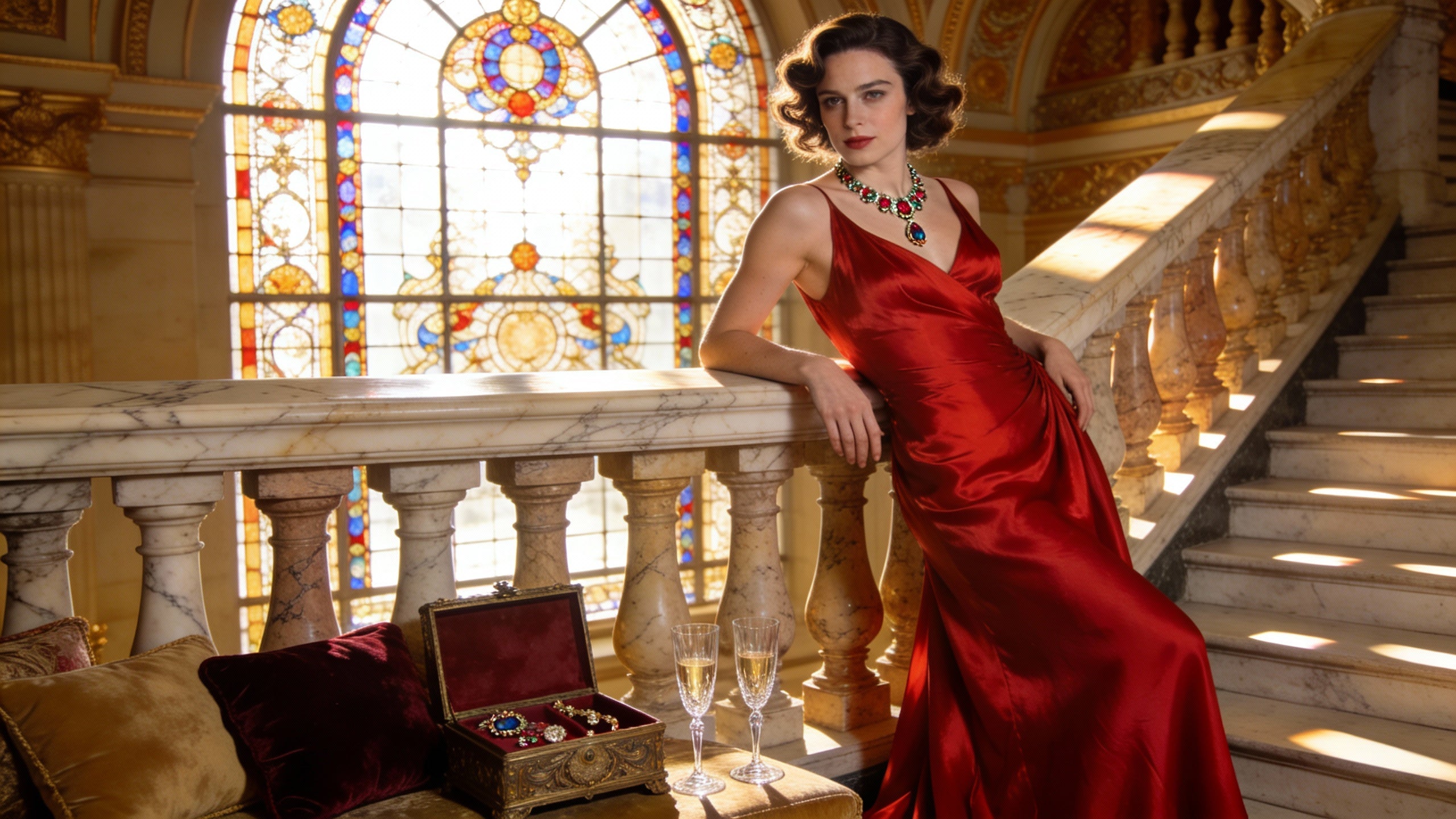
For a winter gala, picture a floor-length wine-red velvet gown on someone with warm undertones. Grandiani and Tyaani both advocate gold and gem-rich combinations here. A pair of emerald and gold drop earrings, perhaps accented with tiny diamonds, plus a gold cuff with smoky quartz stones, adds regal contrast without clashing. You intentionally avoid bright blue stones and neon colors, following Grandiani’s caution, and keep the metal exclusively gold so the look feels coherent.
Consider a tomato-red sundress for a daytime garden party on neutral-toned skin. Rose gold, as described by Aureus Boutique and Modern Gents, is perfect for mid-toned, slightly warm reds. Small rose-gold hoops with tiny aquamarines, a simple rose-gold chain, and perhaps a delicate bracelet with one amethyst charm keep the look breezy and modern. The gemstones add personality without demanding evening-level drama.
Finally, think of a red-and-black color-blocked dress for a fashion-forward evening out. Soulmatcher and MissJ both support black onyx for high-impact, modern style, and Tyaani recommends emerald and pearl accents with red-and-black outfits. You might choose bold onyx and gold geometric earrings, a single onyx cocktail ring, and leave the neckline clean. The gemstones and metals mirror the graphic contrast of the dress itself, giving you a deliberate, editorial finish.
Brief FAQ
Is there one gemstone that always works with a red dress?
Clear stones such as diamonds, moissanite, or high-quality crystal are as close to universal as it gets. Modern Gents, Atolea, Grandiani, Grahams, and Aureus Boutique all present clear sparkle as a fail-safe option with red because it adds light without adding another competing color. Pearls are a close second if you want a softer, more romantic effect.
Can I wear emerald earrings and a ruby ring with a red dress, or is that too much color?
It can work, but it requires discipline. Grandiani and Aureus Boutique both advise choosing one dominant accent color. If you truly love both, let one stone be the star and keep the other quite small and near the hand, where it will not fight as much with what is happening near your face. For example, emerald drops at the ears and a slim ruby band can coexist if the rest of the jewelry stays in diamonds and metal.
What gemstone earrings are best if I am a wedding guest in a red dress?
Soulmatcher recommends diamonds for formal events and weddings because they are neutral and timeless. Pearls are also excellent if you want a softer, more romantic mood, a view echoed by Grahams and Tyaani. If you want color without upstaging anyone, small emerald or amethyst studs are a refined compromise. They give subtle contrast without the drama of large drops or chandeliers.

Closing Thoughts
A red dress already tells a powerful story. The gemstones you choose are not there to compete with that story; they are there to write the punctuation and the subtext. When you understand your dress’s shade, your own undertone, and the character of each stone, you can move from avoiding clashes to creating unforgettable compositions. The next time you step into a red dress, let your jewelry feel less like decoration and more like the final, confident signature on a look that is entirely your own.
References
- https://www.jamesandsons.com/blog/the-art-of-jewelry-color-analysis?srsltid=AfmBOort5UljfgReuL8jeNLkP5LqFlKHl2mkmgLQFqn1fFwU19m3-un8
- https://www.angara.com/blog/red-dress-jewelry/?srsltid=AfmBOoo8AhSDbKzWClSguX8ln7SLeNJcOFsuArKCKqyIVFr3WR5wpvKf
- https://applesofgold.com/jewelry/color-coordinate-your-gemstone-jewelry-with-your-dress/?srsltid=AfmBOoqW0SHiCZuOB21dzOz24yxmtpx6CyMIWTbBqbsapb9Pu9h89cyK
- https://atoleajewelry.com/blogs/waterproof-jewelry-blog/what-color-jewelry-goes-with-red-dress?srsltid=AfmBOoqnWRaBwOGSZBk4Z_ngvq1yzO9w4e1pgC-5c-BNxXMOx9io3cB2
- https://www.aureusboutique.com/blogs/articles/what-color-jewelry-should-you-wear-with-a-red-dress?srsltid=AfmBOooovA8_XXc17BKypLppefkClXf5SyM7Z0evw4xvPc_uyxBnzZls
- https://www.grahams.com.au/a/blog/how-to-accessorise-a-red-dress?srsltid=AfmBOop3DsoJYs0U2Gdo4OFZg6PF1CBcs7N6BfPnG8SsMkFzSZ3RYiAF
- https://connectedapparel.com/blogs/news/style-guide-how-to-wear-jewel-tones?srsltid=AfmBOor2S7EynhOJUyNDZVzKrGsh5bKVIA6YTmiH1fBKIwy9OwFzO42n
- https://grandiani.com/blogs/posts/best-wine-red-dress-matching-jewelry?srsltid=AfmBOorZMsKXcrdhpmpLtCfTzJe0sA0ujnJwbinF-oVDdeAiuQ-fp1F_
- https://merlettenyc.com/blogs/news/jewel-tone-outfit-ideas?srsltid=AfmBOorbTEuE4lEAmfbjRSHhFsJXQwxOmMOVvwPPoxld0rKeByeq2n27
- https://www.missj.eu/styling/what-colour-jewellery-with-a-red-dress-perfect-styling-guide/